4 hours ago
6
4 hours ago
6
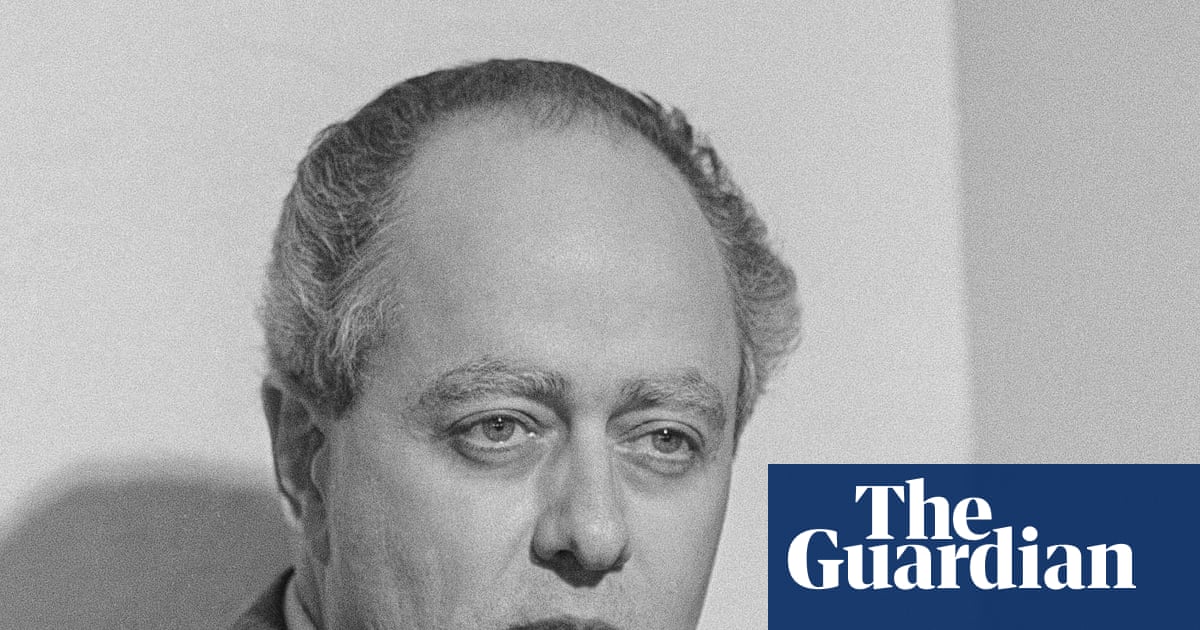
In 1960, on a travelling scholarship from the Slade School of Fine Art, Tess Jaray, who has died aged 88, made her first trip to Italy. At the Slade she had been taught by Ernst Gombrich, then Britain’s foremost historian of early Renaissance art. She arrived in Florence with her head full of painting, of Giotto and Duccio and Cimabue.
It was not these, though, who were to move the 22-year-old student most. “Nobody who heard Gombrich speak has ever forgotten it,” Jaray recalled 60 years later, “but he never talked about architecture. Going to Italy was like opening a door into paradise. It was truly shocking, in a wonderful way. Suddenly seeing, and moving in and around, buildings by Brunelleschi, Bramante and Alberti – I didn’t understand why one should be so affected by these extraordinary spaces. It took many years before I grasped that creating space is how we define ourselves, how we protect ourselves.”
This revelation would shape Jaray’s art. If space was inexplicable, it was also abstract. In the late 1950s, a series of exhibitions introduced non-figurative American painting to an awe-struck London. Shows such as Modern Art in the United States (1956) and The New American Painting (1959), both at the Tate, changed British art overnight. “It was slightly annoying that the Americans should have done it first, but there you are,” Jaray told the Art Newspaper in 2023. “They were serious people. We haven’t had anything comparable since. But then in one lifetime – mine – you wouldn’t expect to.”
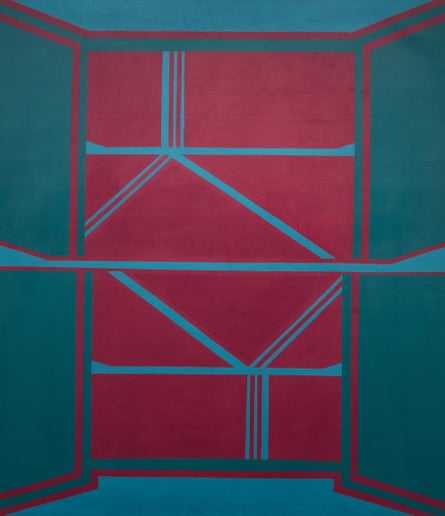
The delineation of space she had seen in Florence and Siena was both centuries old and utterly new. By 1962, Jaray was making abstract paintings with such allusive titles as Cupola Blue that did not replicate architecture so much as evoke it. The work’s geometric lines were both insistently flat and suggestive of movement, a duality that sometimes led to Jaray being mistaken for an Op artist.
In 1967, she was commissioned to make a mural for the British Pavilion at Expo 67 in Montreal, a work that, at 3m high by 12m wide, was architectural in both size and feel. Jaray’s typical scale, though, would be more intimate. From Rialto and Haven in 1966 to Victory II in 2019, her canvases would seldom exceed 2m in any dimension. A one-woman show at the Serpentine Gallery in London in 1988 brought her work to a wider audience even as her precise, geometric abstraction was beginning to go out of style.
Born in Vienna to Franz Ferdinand, an engineer and inventor, and Pauline (nee Arndt), who had studied painting, Jaray had artistic roots. Her father’s aunt was Lea Bondi Jaray, a noted collector and gallerist in Vienna and, later, in London. His godfather was Gombrich.
The family were also Jewish. After the annexation of Austria by Nazi Germany in March 1938, those members who could fled to Britain, Jaray’s parents to the cottage in rural Worcestershire where, from the age of eight months, she was raised, later attending the Alice Ottley school in Worcester; she then studied at St Martin’s School of Art in London (1954-57), before her three years at the Slade.
“When people ask where I grew up, I say in Vienna in the English countryside,” Jaray said. “My parents brought Viennese culture with them, and their values didn’t change.” Her father’s brother Richard Jaray – “Uncle Dicky” – a furniture designer and architect, did not make it out. He was deported to the Łódź ghetto and murdered there, as were other relations.
If Worcestershire was not Vienna, its landscape was, as Jaray recalled, “spectacular. You’d had to have been a real dummy not to have been moved by it.” In particular, it was red, “the earth all red-based”. From this sprang a fascination with colour, and particularly with red, that would last for the rest of her life. “Red jumps forward in a painting,” she would say. “It’s the colour you see first. It’s almost impossible to be logical about colour, even if you’re working from a landscape.”
Her own work, she insisted, was “entirely intuitive”. “I’m always accused of being intellectual,” Jaray said, “and I’m not.” It was easy to see how the mistake might have arisen. Her paintings were so formally elegant as to look engineered, which they were. Each was prefigured by what its maker called “a big pile of drawings”, latterly done on a computer. Jaray had been an early adopter of technology in her art, starting in 1960 with her discovery of masking tape (“very hi-tech that year”).
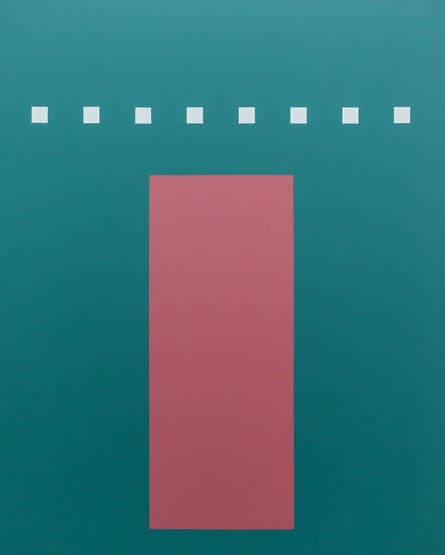
By 2014, she was making pictures such as the Thorn series, in which patterns were cut by laser into acrylic laid on metal. Her painted surfaces were flat, leaving the drama to shape, colour and repetition. A work such as Thorns 22, with its interplay of light teal and cinnabar, seemed driven by logic, although its emotional punch and shimmering ghost-images were anything but logical.
This willingness to embrace the new also marked her career as a teacher. For four years from 1964 she taught at Hornsey College of Art. Returning to the Slade in 1968, she ran the postgraduate course there for more than 30 years. These saw conceptualism supplanting painting at the school. “It seems to me that younger artists are more interested in making things, in making references,” Jaray mused in 2023. “Maybe non-figurative art had just come to an end, and we’ll have to wait 50 years to see it again,” she said, adding with a laugh, “I certainly won’t be around.”
None of this seemed to bother her. In 2013, she curated a show in London called The Edge of Painting, notable for the fact that, a canvas of her own apart, none of the work in it used paint. “My favourite art is young art, before cynicism and cool has set in,” Jaray said. “I love watching young artists searching for what they want to say.”
These included the Turner prize-winning conceptualist Martin Creed, who had been a protege of Jaray’s at the Slade and whose contribution to the show was made of cropped masking tape. (Another ex-student’s was of rattlesnake venom.) If none of the works was painted, all were painterly, and thus held promise for the future. “Painting has died a thousand deaths in the last century,” Jaray reasoned. “But it rises from the grave as many times.”
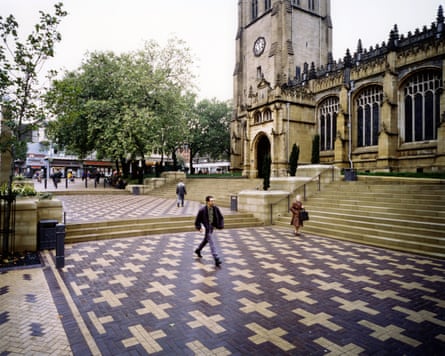
In the 1980s, she began to take on public art commissions, the first being for a floor at Victoria Station in London (1985). This was followed by a patterned brick precinct for Wakefield Cathedral (1989-92) and a complete decorative programme including paving, railings and lamps for Birmingham’s Centenary Square (1988-92; all removed in 2017). As a result, in 1995, Jaray was made an honorary fellow of the Royal Institute of British Architects, 15 years before becoming a Royal Academician.
In 2001, she produced a series of screenprints responding to “the distortion of and evocation of space” in WG Sebald’s books The Rings of Saturn and Vertigo, followed by a poetic collaboration with the author called For Years Now, shortly before Sebald’s death later the same year.
In her 80s, Jaray was also reconciled, as an artist, to the city of her birth. Brexit and the rise of nationalism had appalled her. In 2021, she returned to Vienna, to a show at the Secession gallery followed by others at the aptly named Exile gallery. She also donated a portfolio of her Uncle Dicky’s designs, brought to England by her parents in 1938, to the MAK – Museum of Applied Arts, in Vienna.
In the summer of 2024, she was given a retrospective at the Millennium Gallery in Sheffield, and a show of paintings and drawings at Frieze Masters later that year.
In 1960 she married the painter Marc Vaux; they divorced in 1982.
She is survived by their daughters, Anna and Georgia, and by four grandchildren.