3 months ago
142
3 months ago
142
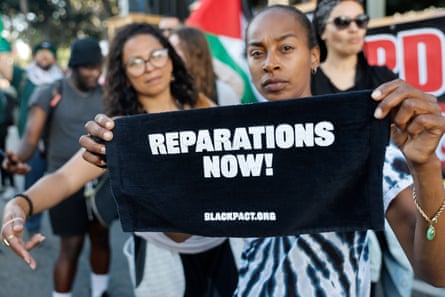
Last month, at commemorations marking the 25th anniversary of France’s Taubira law recognising the trafficking of enslaved Africans as a crime against humanity, Emmanuel Macron did the unthinkable: he became the first French president to publicly utter the word “reparations”.
Since 1825, when France punished Haiti for daring to declare itself the western world’s first Black sovereign republic by extorting 150m francs in compensation for the loss of what it regarded as enslaved “property”, reparations to Black peoples and nations have been politically “unthinkable”.
The Haitian historian Michel-Rolph Trouillot famously argued that the 1804 Haitian revolution was the ultimate “unthinkable” event – a claim to Black sovereignty that the west could neither comprehend nor countenance. And so it sought to crush it.
Compelled by shifting geopolitical realities and Africa’s growing demands for economic sovereignty, Macron invoked “reparations” 10 times as part of a pre-emptive attempt to shape the terms of engagement before the African Union (AU) adopts its common position on reparations and Ghana hosts a global reparations conference this month.
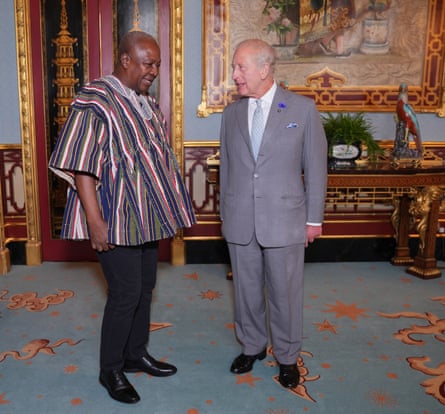
He made those remarks a week after the Africa-France summit in Nairobi – France’s scramble to recapture influence as its economy reels from a series of expulsions across the Sahel. Speaking alongside Ghana’s president, John Dramani Mahama – the AU’s leading advocate for reparations – Macron’s intervention came just two months after France abstained from Ghana’s UN resolution declaring the trafficking of enslaved Africans the gravest crime against humanity.
What Macron did not address was what reparations would actually entail: what France would pay, to whom and by when. Above all, he avoided the question of whether France would return the indemnity imposed on Haiti in 1825. Instead, the proposals centred on a commission, a memorial and the formal repeal of the 1685 Code Noir (Black Code), which classified African people as “meuble” (movable furniture). Symbolic gestures, certainly. But not restitution.
This goes to the heart of what I call the Africa exception in global reparations. The west has repeatedly demonstrated its willingness to pay reparations for the loss of what it once considered its African property – but never for the loss of the African person.
In 1833, the British empire paid £20m reparations to enslavers for their “lost assets”. In 2013, Britain paid Mau Mau torture and abuse survivors £19.9m while continuing to deny liability. In 2021, Germany described its settlement over the 1904-08 Nama and Herero genocide as “development aid”. Yet western countries have paid reparations to non-Black people and countries it recognises as sovereign – including the 1952 Luxembourg agreement with Israel, and Japanese Americans under the 1988 Civil Liberties Act.
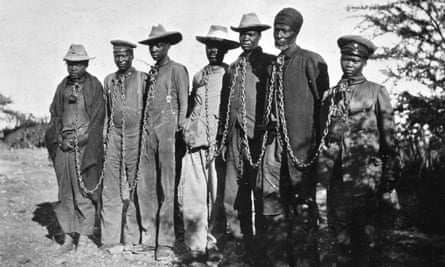
The Africa exception is not simply a moral failure. It is a structural feature of an international legal order that, since the 1928 Chorzów factory case – a dispute between Germany and Poland that established reparations as the mandatory consequence of wrongdoing between sovereign states – has provided reparations to those it recognises as sovereign, but never to Black people and countries. This is because it refuses to go beyond flag independence and recognise its former “property” as sovereign.
Haiti and France are the Africa exception’s exemplar. In 2003, when the Haitian president, Jean-Bertrand Aristide, demanded $21bn restitution for the 1825 indemnity, he posed a fundamental question: how can “property” demand its value back? The answer – a US and France-backed coup – was the ultimate denial of Black sovereignty.
Reparations remained “unthinkable” when Ghana tabled its UN resolution. Drawing on the AU Framework for Reparations, A Crime Does Not Rot, 1441-present – which I conceptualised and drafted as rapporteur of the AU committee of experts on reparations – the resolution invoked the pan-African legal principle of continuing obligation embodied in the dictum, “a crime does not rot”. One hundred and twenty-three states voted in favour; three voted against, while 52 abstained.
The EU dismissed the principle that “a crime does not rot” as “regional jurisprudence” beyond the universal reach of international law. The irony is striking: international law does not descend from God but from history. The 1648 treaty of Westphalia – mythologised as the birth of modern sovereignty – was itself a regional European settlement later universalised through slavery, colonialism and apartheid.
Drawing on the AU Framework, Ghana’s resolution sets the record straight: the birthdate of modern sovereignty, and the modern racial capitalist system, is not 1648. It is on the coast of present-day Mauritania in 1441, when the Portuguese sailor Antão Gonçalves captured 12 Africans as the first cargo of the trafficking era.
It is in the Vatican’s papal bulls – Dum Diversas (1452), Romanus Pontifex (1455), Inter Caetera (1493) – which reduced Africans to “perpetual slavery” and codified the Doctrine of Discovery that licensed European conquest. It is, as Sylvia Wynter and Mahmood Mamdani remind us, in 1492, when Columbus “discovered” the “New World” and Spain expelled Jews and Muslims from Iberia. It is in the international law that codified African people as property through the Portuguese Peça de Índias (1513), the Spanish Asiento de Negros (1518), the Dutch West India Company charter (1621), the English Barbados Slave Code (1661), and the French Code Noir (1685).
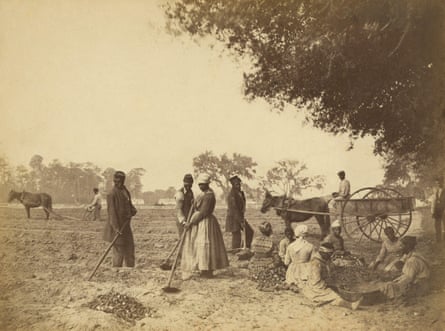
Slavery is ancient. As black feminist scholars such as Jennifer L Morgan and Bibi Bakare-Yusuf have shown, what was unprecedented was the racialised system of chattel enslavement that reduced African people to property in perpetuity through partus sequitur ventrem – the principle that status follows the womb. Codified in Virginia in 1662, it made enslavement hereditary through Black women’s wombs, regardless of paternity.
As the US president Thomas Jefferson, father of six enslaved children, wrote in 1819: “I consider a woman who brings a child every two years as more profitable than the best man of the farm. What she produces is an addition to the capital.” Just as Africa became the world’s site of capital accumulation, Black women’s wombs became the site of capital reproduction. Without sovereignty over our wombs, what meaningful sovereignty can we claim?
By reducing Black people to property in perpetuity, racialised chattel enslavement positioned Black people as the world’s ultimate non-sovereigns. Race is sovereignty. This is the global reparations trap: the post-1928 international legal order requires a victim to be sovereign in order to receive reparations, yet the crimes of chattel slavery, colonialism and apartheid depended on the systematic destruction of Black sovereignty.
Ultimately, the Africa exception demonstrates that reparations are not simply a moral imperative but a geopolitical question of sovereignty. It is no coincidence that France announces reparations without payment – invoking the language of justice while avoiding its cost – just as growing African demands for sovereignty threaten its economic interests. We cannot wait for the west to deem us sovereign.
The central challenge for the 21st-century global Black reparations movement is to build geopolitical leverage across the African continent, the African diaspora and the global south majority that backed the resolution. One substantial source of leverage is that Africa holds 30% of the world’s known critical minerals – including cobalt, lithium manganese and rare earths – on which the west’s green transition and AI infrastructure depend. Without reparations, there should be no access to Africa’s critical mineral supply chains.
Another source of leverage lies in institutions such as the AU, the Caribbean Community (Caricom), and the Community of Latin American and Caribbean States (Celac), which are building south-south trade and financial coordination beyond the reach of former slaveholding empires. Without reparations, there should be no participation in global south trade and economic integration.
Just as Haiti emancipated itself by making the cost of enslavement intolerably high, the 21st-century reparations movement must shift from moral persuasion to geopolitical cost imposition. What has been “unthinkable” for two centuries will become “thinkable” only when the cost of refusal is higher than the cost of reparation.
Panashe Chigumadzi is rapporteur for the African Union committee of experts on reparations for racialised chattel enslavement, colonialism and apartheid
************************
The Guardian’s connections to enslavement: can an institution atone for its history?
On Thursday 2 July, join Maya Wolfe-Robinson, Ebony Riddell Bamber, Prof Verene A Shepherd and Ahmad Ward in this free event for a wide-ranging discussion on the Guardian’s Legacies of Enslavement programme. Book tickets here or at guardian.live