3 months ago
210
3 months ago
210
Hands up if your favourite way to spend a Sunday afternoon is tackling a mountain of ironing? No takers? Shocking. Faced with crumpled cottons and crinkled collars, there won’t be many who approach the ironing board with anything resembling excitement – and if you do, honestly, what’s wrong with you?
I am certainly no fan of ironing. In fact, I’d be happy with a wardrobe full of everything “stretch”. But when my children were in school uniforms, I faced a daunting pile of creased clothing every week – and found the only way through it was to arm myself with the right tools.
You want an iron that glides smoothly across garments, without the risk of scorching or leaving any limescale marks. I also swear by a decent ironing board – one that’s sturdy, height-adjustable and comes with a quality cover and padding is, frankly, essential (look out for my upcoming test of the best).
Stick with me as I reveal the best irons from my testing – models that will see you speed through those sheets and shirts in no time at all.
At a glance
-
Best iron overall:
Breville DiamondXpress VIN401
-
Best cordless iron:
Tefal Freemove Power
-
Best iron for storage:
Russell Hobbs Easy Store Pro Plug & Wind
-
Best workhorse iron:
Tefal Ultimate Pure
Why you should trust me
You might have gathered by now that ironing isn’t my favourite sport – but it’s definitely one where I’ve put in a lot of hours. Ironing two uniforms, five days a week, for 12 years means I have ironed literally thousands of shirts.
These days, the pile is smaller, but the stakes are higher: when you’re ironing your nicest threads (or the young people’s best drip), the last thing you want is one scorch mark or a rogue water droplet to ruin your finery. I also use my iron to flatten fabrics for dressmaking.
How I tested
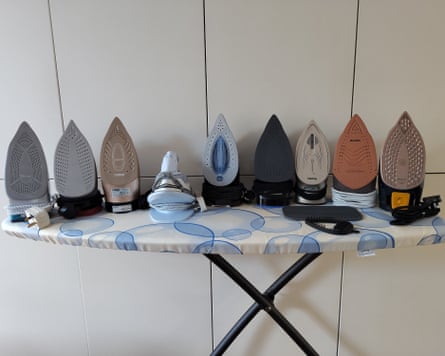
I selected nine irons from leading brands to test, and started by considering their size, weight and ergonomics in my hand while I used them, noting comfort and efficiency.
Each iron was used to cut through the crinkles on items including bedsheets, tea towels and cotton shirts, the latter to see how it handled collars and manoeuvred around buttons. I also ironed a silk sari, to see how each model fared on delicate fabrics – and, while I would never normally iron jeans, I did for this test to see how the irons coped with heavier fabrics.
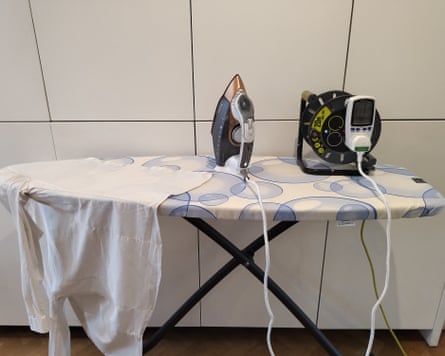
As well as evaluating performance and features, I used a power meter to measure the maximum wattage as each iron was heating up to gauge how much electricity it was using. I also timed how long the irons took to reach their top temperature, looking out for any that were especially fast or slow.
I tested all of the models on a height-adjustable Brabantia ironing board D with a PerfectFlow cover, which I recommend because it doesn’t become soggy from steam, thanks to three layers of padding, including Fairtrade, unbleached cotton.
After testing, all the irons that weren’t collected by manufacturers were donated to Furnishing Futures, a charity that creates fully furnished homes for women and children who have survived domestic abuse.
The best irons in 2026
Best iron overall:
Breville DiamondXpress VIN401
Breville
DiamondXpress VIN401
from £39.99
What we love
Great ironing performance; bargain if you shop around
What we don’t love
The blingy diamond theme and rose gold finish
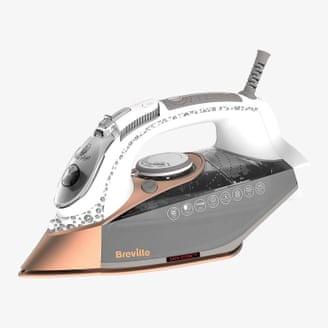
You’ll either love or loathe the rose gold finish of Breville’s iron – personally, I’m not a fan – but what you won’t be able to dispute is its performance, especially if you find it for less than the RRP. I picked it up online for less than £40.
Fans of a bit of bling will love that the ceramic soleplate of this model features actual crushed diamonds for improved durability and glide.
Why we love it
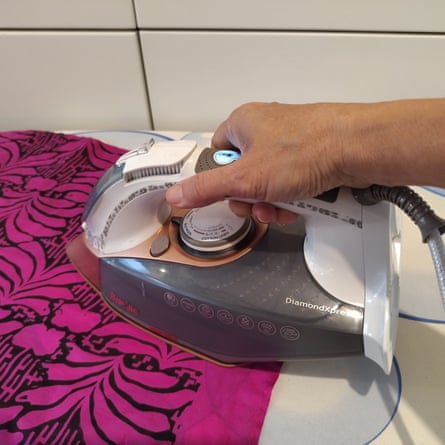
This iron impressed with its excellent performance, and strong and constant flow of steam. A wide soleplate makes quick work of large, flat areas of clothing, while the narrow nose lets you easily reach into folds and around buttons.
The iron heated up in just 40 seconds, and did a great job of ironing even the silk sari, to which it didn’t stick, nor did it cause the fabric to wrinkle.
I also liked the “safe store” strip on the side, near the soleplate, which indicates when the iron is cool enough to put away.
It’s a shame that … the crystals on the temperature dial are OK, but in my opinion, the pictures of diamonds on the side of the iron (that’s the grey and white pattern) look naff. Also, while you can loop the cord around the heel for storage, there’s no clip to hold it in place.
Cordless or corded? Corded
Tank capacity: 400ml
Weight in the hand: 1.29kg
Steam output: 70g/min
Steam shot: 200g/min
Peak power use on test: 2.9kW
Breville
DiamondXpress VIN401
from £39.99
What we love
Great ironing performance; bargain if you shop around
What we don’t love
The blingy diamond theme and rose gold finish
Best cordless iron:
Tefal Freemove Power
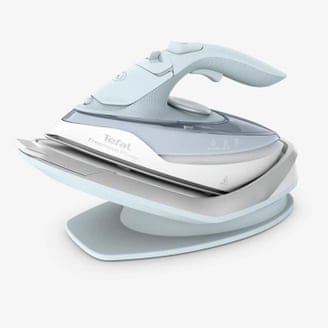
Tefal
Freemove power
from £79.99
What we love
Great cordless performance; ergonomic charging base
What we don’t love
It can’t sit back on its heel like most irons
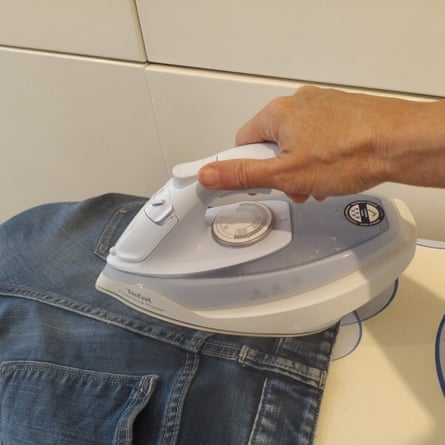
Tefal’s Freemove Power is a cordless model that works brilliantly: it recharges each time you place it down on the dock to adjust a garment on your board.
A clip over the nose holds the iron on to the base for carrying and storage, much like a steam generator iron.
Why we love it
The iron is light in the hand and, from an ergonomic standpoint, works flawlessly; placing the iron back down on to its base in between bouts of ironing felt effortless. The other cordless iron I tested, the Tower Ceraglide 360, didn’t feel so natural in use.
It’s quick to iron and to recharge. The iron heated up in just 20 seconds, and when it’s on the dock, it has a light to clearly indicate when it’s up to temperature.
I liked the traditional controls with a temperature dial. The Freemove Power ironed all my test clothing really well, even the silk sari.
On top of a two-year guarantee, Tefal irons also come with a promise of 15-year repairability with low-cost parts.
It’s a shame that … it can’t sit back on its heel like most irons, although this is only an issue if you like to fill your iron using a jug. The base also gets a little wet with condensed steam.
Cordless or corded? Cordless
Tank capacity: 250ml
Weight in the hand: 0.95kg
Steam output: 35g/min
Steam shot: 200g/min
Peak power use on test: 2.7kW
Tefal
Freemove power
from £79.99
What we love
Great cordless performance; ergonomic charging base
What we don’t love
It can’t sit back on its heel like most irons
Best iron for storage:
Russell Hobbs Easy Store Pro Plug & Wind
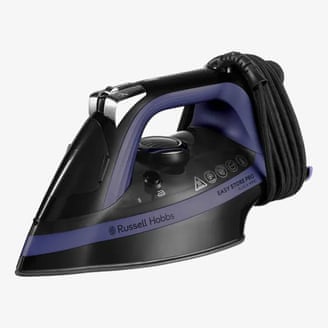
Russell Hobbs
Easy Store Pro Plug & Wind
from £37
Why we love it
Good value and good cable storage
Why we don’t love it
The steam shot button needs a really strong push
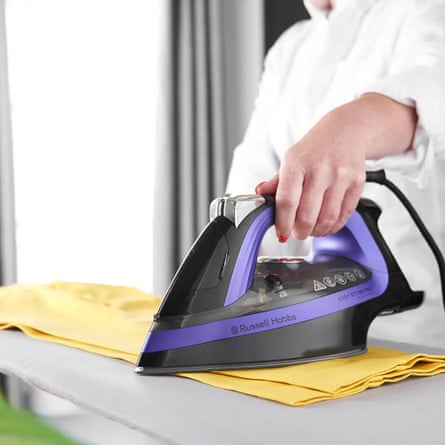
The Russell Hobbs has a single smart setting, rather than a dial or temperature control indicated by one, two or three dots. The advantage of this is that you can make your way through your ironing pile in any order, rather than tackling clothes in order of heat setting required.
Why we love it
The temperature dial is replaced with a large, circular light that’s illuminated red. It would have been helpful to see this turn green once the iron was ready to use, but I saw great results with my clothes, and it’s great value, too. Register your purchase for a three-year guarantee.
Most irons feature an indent at the base, around which you wrap the power cable for storage. The Russell Hobbs goes one further by providing a space to stow the plug, so you can store your iron tidily. This is despite being no bigger than rivals.
It’s a shame that … you have to push the steam button very hard to get a steam shot.
Cordless or corded? Corded
Tank capacity: 320ml
Weight in the hand: 1.14kg
Steam output: 50g/min
Steam shot: 200g/min
Peak power use on test: 2.3kW
Russell Hobbs
Easy Store Pro Plug & Wind
from £37
Why we love it
Good value and good cable storage
Why we don’t love it
The steam shot button needs a really strong push
Best workhorse iron:
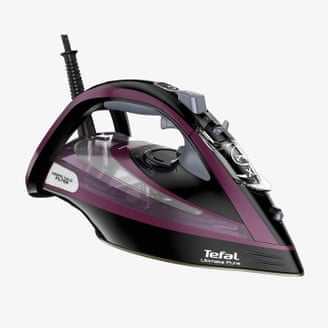
Tefal Ultimate Pure
Tefal
Ultimate Pure
from £84.99
What we love
Incredibly powerful steam; great performance
What we don’t love
It’s expensive, and it’s the heaviest iron here
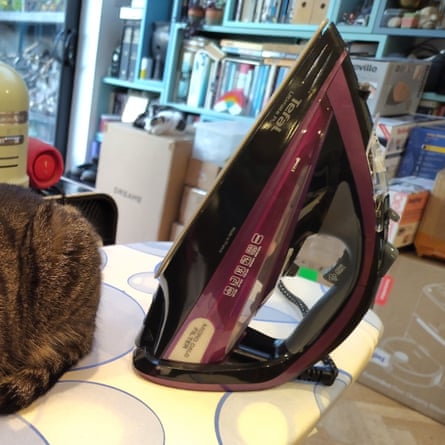
Tefal’s Ultimate Pure iron is pricey but powerful. If your weekly basket of washed clothing is more mountain than pile, the Tefal’s strong, constant flow of steam and steam shot will make light work of it.
It performed well on all fabrics, and it was the very best on test when it came to the silk sari: the fabric could become stuck as a result of moisture on the soleplates of some irons, causing wrinkles, but the Tefal Ultimate Pure pressed the long length of cloth beautifully.
Why we love it
The steam function here is impressively powerful, with even hard creases ironing out easily. The iron also comes with a heavy-duty anti-calc filter that keeps scale out of the steam. Simply remove the filter from the heel and rinse it out before reinserting. It’s more like a steam generator iron than a standard one. In fact, if you’re still deliberating over which of the two to choose, the Tefal Ultimate Pure might be the one for you.
It comes with a two-year guarantee, plus a promise of 15-year repairability with low-cost parts. It seems pricey at RRP, but there are deals to be found online. If you can find it for £100 or below, then it’s well worth the money.
It’s a shame that … it’s heavy in the hand.
Cordless or corded? Corded
Tank capacity: 350ml
Weight in the hand: 1.62kg
Steam output: 60g/min
Steam shot: 260g/min
Peak power use on test: 2.9kW
Tefal
Ultimate Pure
from £84.99
What we love
Incredibly powerful steam; great performance
What we don’t love
It’s expensive, and it’s the heaviest iron here
The best of the rest
Tower Ceraglide 360 Cord Cordless steam iron
Tower
Ceraglide 360 Cord Cordless steam iron
from £27.99
What we love
You can use it corded or cordless
What we don’t love
The round charging base is annoying every time you dock
Best for: convertible ironing
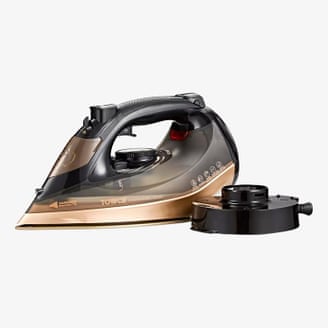
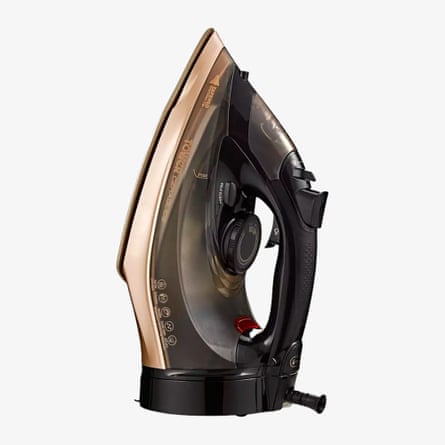
You can use this iron both corded and cordless. In its cordless form, it sits on its heel on a round base to charge, much like a kettle. You simply slide a bar across to lock it to the base for corded use.
The iron heated up fairly quickly, in 1min 40secs, and I was a fan of the traditional controls and its black and gold Duracell-style finish. The steam and spray function worked well, too.
It didn’t make the final cut because … that 360-degree charging base is insanely annoying. You have to tip back the iron to place its heel on the charging base, and putting down the iron on to the base at that angle just doesn’t come naturally. I would buy this iron for its light weight and good value, but use it corded most of the time.
Cordless or corded? Both; tank capacity: 370ml; weight in the hand: 0.93kg cordless, 1.03kg corded; steam output: 35g/min; steam shot: 170g/min; peak power use on test: 2.7kW
Tower
Ceraglide 360 Cord Cordless steam iron
from £27.99
What we love
You can use it corded or cordless
What we don’t love
The round charging base is annoying every time you dock
Philips Azur 8000
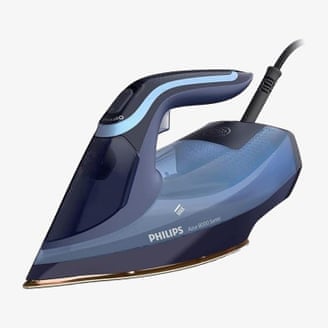
What we love
The single setting means you can iron in any order
What we don’t love
It’s expensive – I didn’t think it was worth the price
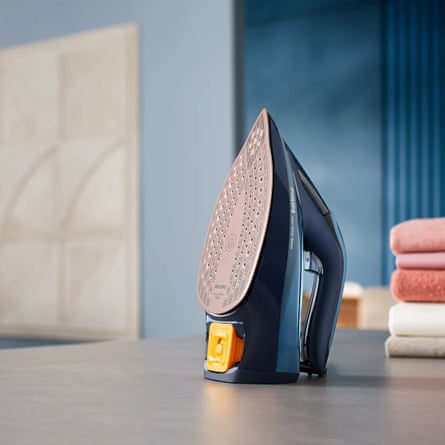
Best for: smart setting steam
The Philips is pricey, but a bit of a workhorse. As with the Russell Hobbs Easy Store Pro above, it arrives with a single smart setting, rather than a temperature dial, so you can tackle your ironing pile in any order.
The steam function is powerful, with the Azur performing well on the silk sari, but the lack of temperature setting meant that I didn’t feel as if I was in control. There’s a good steam shot but no water spray.
It didn’t make the final cut because … the Russell Hobbs Easy Store Pro has a smart setting for a fraction of the price and is only a little less powerful. I didn’t think the Philips was worth the price tag.
Cordless or corded? Corded; tank capacity: 300ml; weight in the hand: 1.35kg; steam output: 55g/min; steam shot: 240g/min; peak power use on test: 2.7kW
Philips
Azur 8000
from £79
What we love
The single setting means you can iron in any order
What we don’t love
It’s expensive – I didn’t think it was worth the price
Polti Vaporella Quick & Slide QS220
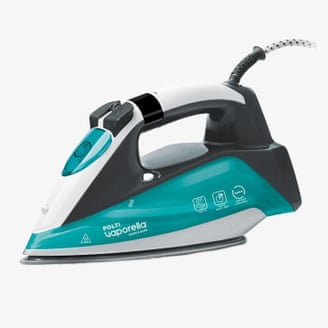
Polti
Vaporella Quick & Slide QS220
from £78.70
What we love
Performance is OK; good steam shot
What we don’t love
The controls are annoying and the cable’s too short
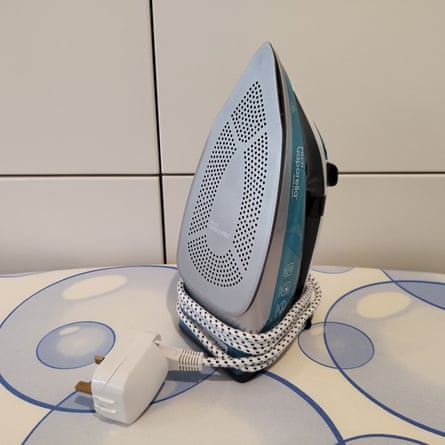
Best for: value steam shot
The Polti performs OK, but I found the controls super annoying. To choose the temperature setting, you turn the black band (below the steam buttons) on the handle left or right to select one, two, three dots or max. The digital display will indicate the one chosen.
But I wanted to be able to simply swipe left or right on that band – or at the very least jog it with my thumb – to change settings. Instead, the only way to move it was a firm grip with thumb and index finger.
It didn’t make the final cut because … the controls proved annoying, the cable was short (1.9 metres, where many irons have 3 metres), and the plug was bulky – it’s a European plug inside an adaptor.
Also, while you can loop the cable around the base to store the Polti, there’s no clip to hold it in place, so it will unravel.
Cordless or corded? Corded; tank capacity: 350ml; weight in the hand: 1.36kg; steam output: 40g/min; steam shot: 250g/min; peak power use on test: 2.3kW
Polti
Vaporella Quick & Slide QS220
from £78.70
What we love
Performance is OK; good steam shot
What we don’t love
The controls are annoying and the cable’s too short
Morphy Richards Power Steam Elite
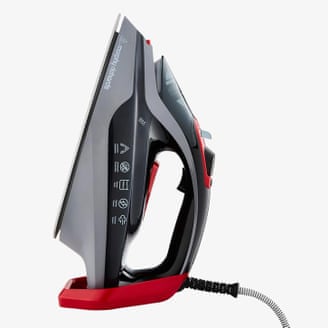
Morphy Richards
from £44.99
What we love
Interesting digital controls: tap to cycle through settings
What we don’t love
The icons for those temperature settings are hard to see
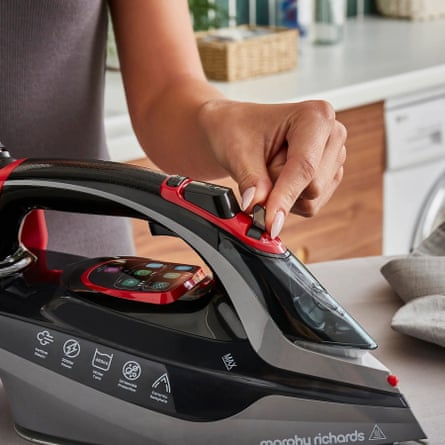
Best for: an attractive display
Ironing performance here was good, but not great. The cord is a decent length at three metres and stores well. I liked the Power Steam Elite’s looks, but found the controls bothersome.
There are six light-up icons on the iron’s body: they’re positioned beneath the handle when you look down on to the iron. These display the power setting, presented as dots, and the type of fabric.
But their position makes them difficult to see. And because they’re lights, not buttons, you have to tap a button on the handle and cycle through the temperature settings. Seasoned ironers will start at the bottom and go up, but if you do need to go down a setting, then you’ll need to press the button five times and shift your head to see the lights to check you’ve got it right.
It didn’t make the final cut because … the controls were too annoying.
Cordless or corded? Corded; tank capacity: 450ml; weight in the hand: 1.09kg; steam output: 35g/min; steam shot: 170g/min; peak power use on test: 2.8kW
Morphy Richards
from £44.99
What we love
Interesting digital controls: tap to cycle through settings
What we don’t love
The icons for those temperature settings are hard to see
What you need to know
Should I register my new iron?
Many of these irons provide an extra year’s guarantee (so one year becomes two, or two becomes three) if you register the product online. So, yes, it’s worth registering.
Corded vs cordless irons
Cordless models are certainly convenient for a host of reasons – freedom of movement, no tangles, easy storage – but not at the expense of performance. I tested one excellent cordless model and one convertible that I frankly preferred when corded.
Does the ironing board matter?
If you iron rarely, a small board, or even a towel on a table, will do. But if you do lots of ironing, get a good ironing board that doesn’t become soggy when you use the steam shot. Mine is height-adjustable, too: being able to sit down while ironing is a gamechanger.
Are steam generator irons worth it?
Steam generators (an iron on a big base) often produce twice as much steam, making quick work of ironing. One of the main reasons for their appeal is the large water reservoir – holding litres, not millilitres – which means you won’t need to refill them often. Great if you have a mountain to get through. Look out for tests of steam generators and ironing boards in the coming months.
How much does it cost to do the ironing?
The maximum power use of the irons in this test ranged from 2.3 to 3.9kW. Electricity costs are in kilowatt hours (kWh), so if you’re using a 2.8kW iron for half an hour, it will use 1.4kWh. The energy price cap introduced on 1 January 2026 is 27.69p a kWh. Multiply this by the last figure, and you’ll discover it costs 39p to use a typical iron for half an hour.
This is, of course, the maximum it costs, based on an iron’s peak power rating. In practice, it may cost less, as the iron uses less energy when it’s up to temperature. So half an hour of non-stop steam ironing costs 39p; half an hour where it’s sitting on its heel half the time and you don’t use much steam will cost less.
Do I need to use water?
No. While steam and water sprays can help with stubborn creases, all of the irons here can be used dry. Without water, they’ll weigh less in the hand, too.
Do I need to use distilled water?
No – all these irons are designed to work with tap water. If you’re in a hard-water area, then the iron’s anti-calc filter will collect any limescale in the water you add. Remove it periodically by using the self-clean function so the iron doesn’t deposit white powder on your clothes.
Beyond that, read the instructions that come with your model of choice. Some suggest distilled, deionised or demineralised water as a good alternative to hard water. For example, the water from a dehumidifier is distilled and limescale-free. But other iron manufacturers caution against it.
For more:
The best heated clothes airers
Home organisation hacks for shared households
Caramel Quin is a journalist specialising in consumer technology. She prides herself on real-world testing and plain language. Her pet hates are jargon, pointless products and overcomplicated instruction manuals. Caramel is an engineering graduate who has won awards for communicating hi-tech subjects to normal people. When she’s not testing gadgets, she’s feeding pets (16 beasts at the time of writing) or pottering at the allotment