3 months ago
184
3 months ago
184
Georges Seurat died young. His two most famous paintings, both extremely large and innovative in their composition and technique, were completed while he was still in his mid-20s. As it was, Seurat painted approximately 45 paintings before his death, probably from diphtheria, in March 1891 when he was 31. More than half these works depict the Channel coast and sea and were completed on his summer trips between 1885 and 1890. Seurat and the Sea at the Courtauld is the first exhibition to be devoted entirely to these images. Twenty-three paintings and smaller oil studies, and three drawings hang in two rooms. It is a quietly tremendous exhibition.
Even if one takes on board the artist’s claims to science, objectivity and his adherence to theories about colour and perception which distance him from impressionism, Seurat’s paintings are peculiar and strange. Sometimes his line is very odd and stiff, yet his drawings themselves – tonal studies worked in conté crayon on textured, laid paper, are among the most marvellous I can think of. It is clear Seurat knew what he was doing; who knows what he might have gone on to achieve?
For all his adherence to the juxtaposition of discrete dots and strokes of pure colour rather than mixed pigments, in order that the human eye would register transitional colours and that the surfaces of his paintings would retain a naturalistic luminosity, Seurat sometimes went overboard with his borders of dots that he added to paintings often years after the original compositions were completed (and which to my eye add little). These strongly and often darkly coloured painted frames, devised and painted by the artist, have now mostly been discarded and lost.
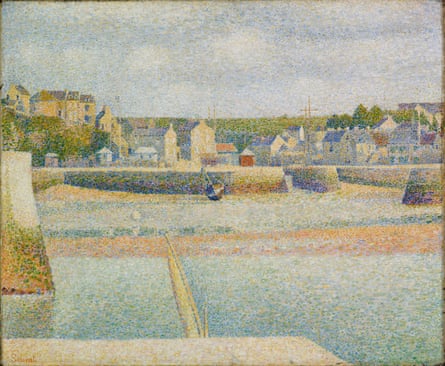
As for what came to be called Seurat’s pointillism, his cumulative little strokes and pustules of pigment, which make one aware of the effort and the artifice of his technique, sometimes you sense a kind of veil of interference between yourself and the image. In his small studies, usually painted on little wooden panels, the scale of his marks makes each individual touch count – both in terms of tonality and in its colour value – in the construction of an image. In Seurat’s larger paintings, when the artist is working his way across the undifferentiated expanse of a sandy beach, grass on a clifftop or slack water in a harbour, all that painstaking effort can feel plodding.
But when it all comes together, as it often does, that labour turns into something else, and Seurat’s largely emptied-out and unpeopled everyday scenes take on a quivering psychological sense of import. Real or not, you feel his fixation and his stare. There’s something going on beyond the sunny day, the light striking the harbour wall and glinting on the unruffled water, the boat out in the offing, the water stretching away to meet the sky, the bollard by the wall, the stanchions and other bits of metalwork beside a working harbour: everything is happening everywhere all at once, but it all takes time to register.
There is also a great deal of pleasure to be found in the anomalies and sometimes puzzling decisions Seurat made. He could be as capricious as he was analytical. The blue sky on one side of The Lighthouse at Honfleur is less saturated than on the other. The view of a regatta at Grandcamp is interrupted by a fabulously unkempt and profuse patch of shrubbery, which creates a terrific foil for the orange jib on the boat just entering the painting to its left. These are the sort of wilful incidents someone might introduce to give pleasure to another painter. Seurat worked with, and played with, the given. But he was careful to paint the brimming brightness of the Channel coast on fine days when the weather had not moved in and the sea and sky became the colour of lead. On those days, I suppose, he stayed in and worked on his drawings and his yet unfinished canvases.
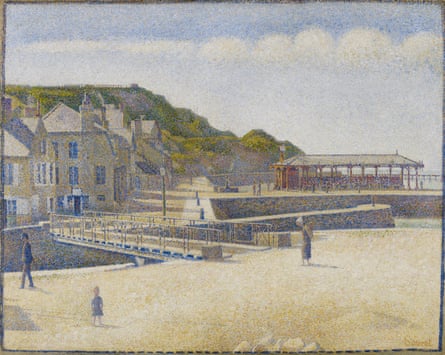
The new semaphore on its clifftop gantry at Port-en-Bessin sits in the top left-hand corner of the canvas, almost out of view, so that the eye almost clambers to find it. The entire series of six paintings Seurat completed in Port-en-Bessin, north of Bayeux, in the summer of 1888 have been bought back together for the first time since an exhibition in Brussels the following year. One gets a sense of the artist wandering the small town alone, noticing things. The pennants and French flags flapping wildly on the masts of boats moored in the inner harbour, while the water itself is perfectly calm. A few stick-like figures crossing a bridge in the distance. Another view, from the other side of the bridge, shows three figures in the foreground, a man walking, head down, a woman carrying a pannier, and a small child, alone and as stilted as a mannequin. Other solitaries loiter about in the distance, as casual as they are posed. There’s an air of the impending, of something about to happen. In another painting we are up on the cliff, observing the same scene from yet another point of view, and in another, we turn to watch sailing boats pass between lovely ovoid pools of shadow cast on the water by small clouds which we can’t see.
All the while I think of Seurat, another solitary, with his portable, handheld paint box and a little panel, on which he lays out the scene, wedged into its lid. You think of him painting the light, but he is just as interested in the topography, the shapes of things, the bollards and lamp-posts, the new bridge and the cast-iron pillared fish market. Two summers later, in 1890, the artist is at Gravelines, a flat coastal area between Calais and Dunkirk. By now, his paintings are prickling and erupting with his little painted dots. The North Sea light is milky, turned down a notch from his summers farther south. A boat moves down the Channel at evening. There’s no one about in this violet hour, the sun gone, only the man on the boat and, I suppose, the painter following its progress.
Seurat’s paintings are full of things – light, colour, objects and atmosphere and a sense of place, but what he has most of all is a wonderful feel for emptiness. It is there in the lassitude of the National Gallery’s Bathers at Asnières (1884), and in the crowded stylisations of A Sunday on La Grande Jatte (1884-6) just as much as it is in the seascapes. Sometimes I think I’m watching Seurat’s paintings as much as I’m looking at them, weaving through them, unseen and unnoticed, between his blizzards of light.