2 months ago
102
2 months ago
102
The small green oilseed rape plants are buffeted by the wind on a blustery spring day. Sown last August, the crop is starting to shoot up and should be ready for harvesting in July, when it can be turned into cooking oil or biofuel.
The peaceful 230-hectare (568-acre) arable farm owned by James Cox on the edge of the Cotswolds in Gloucestershire is a world away from the conflict in the Middle East. However, the consequences of US and Israeli strikes on Iran – and Tehran’s retaliation – are already rippling out to affect Cox and Britain’s other food producers.
The prices of crucial farming inputs such as fuel and fertiliser have skyrocketed, just at a time when their use will increase in the coming weeks as the spring planting season gets under way and farmers use their tractors more.
Cox has already applied one dose of fertiliser to his oilseed rape, with the second to follow in a few weeks’ time, and he will soon be planting his spring barley crop.
He is one of the lucky ones – all the fertiliser he needs for this season has already been delivered and his tanks are full of diesel for his vehicles and the heating oil which he and many other rural residents rely on to warm their homes, cook food and provide hot water. But he has no idea what it will cost the next time he needs to top up his supplies.
“Not everybody will have got all the fertiliser they need, because of their finances and poor prices on the grain market,” says Cox.
It is estimated that about a third of the global seaborne trade in fertilisers passes through the strait of Hormuz, according to the UN Conference on Trade and Development (Unctad), based on 2025 figures from the data agency Kpler. A fifth of seaborne crude oil and gas also passes through the important shipping channel off the southern coast of Iran.
The narrow trade artery has effectively been closed since the start of the war, halting the transport of fossil fuels as well as ammonia, nitrogen and sulphur, vital ingredients in many synthetic fertiliser products.
A prolonged transport shutdown could disrupt production at the world’s largest fertiliser manufacturing sites, many of which are located in the Gulf. About 16m tonnes of fertilisers were transported by sea from the region in 2024, according to Unctad.
The rising cost of the energy needed to produce it is already pushing fertiliser prices higher. Egyptian urea prices, which are a benchmark, have risen by more than 45%, reaching $700 (£525) a tonne, up from about $484 in late February.
Roughly half of global food production depends on synthetic nitrogen and crop yields would fall without fertiliser – it is estimated that Britain’s farmers use about 1m tonnes of synthetic nitrogen each year, to grow crops for human consumption as well as grass for their animals.
Any shortages are expected to push up the price of household staples such as bread, pasta and potatoes and food price inflation is expected to accelerate towards the end of the year, according to analysts at broker Jefferies.
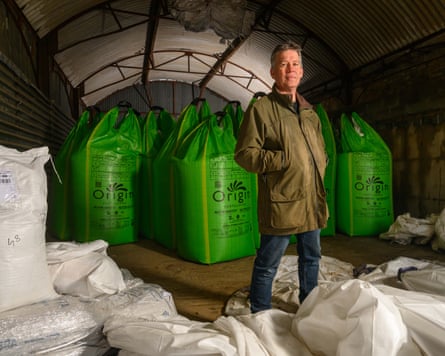
Cox is in the fortunate position of having a couple of dozen 600kg bags of fertiliser sitting in a locked farm building. This isn’t the case for all farmers – Cox knows others who did not have enough money to make an early purchase and have now been caught out by rising prices.
“Historically, farmers received the basic farm payment in December and that helped with buying fertiliser. That’s not the case any more and cashflow is pretty tight on lots of farms,” he says.
The basic payment scheme (BPS) was an EU agricultural subsidy paid to farmers based on the amount of eligible land owned, but has been phased out in England since Brexit, although it currently remains in place in the devolved nations.
The environment secretary, Emma Reynolds, has said in recent weeks the new sustainable farming incentive (SFI) subsidy system – designed to pay farmers to look after the land and nature – will be “fairer” than in the past.
However, the latest rises in the cost of fertiliser and fuel come at a time when British agriculture was already under significant financial pressure and many farmers were worried about whether they will be able to make a profit.
Along with changes to post-Brexit subsidies, food producers have been struggling with unpredictable weather amid the climate crisis, lower prices for their crops on global markets and the impending introduction of inheritance tax on agricultural properties.
This is leading to worry and uncertainty among farmers, particularly when many are unsure what price they have to pay for crucial products.
Fuel suppliers have been unable to keep up with the fluctuations in global oil markets. They have told buyers of red diesel – fuel used for agricultural vehicles and machinery that is taxed at a lower rate to standard diesel – that they will confirm the cost on delivery day, says Alex Harrison, a fuel buyer at Fram Farmers, a not-for-profit, farmer-owned co-operative.
“The biggest challenge for us is that we haven’t received any price lists from suppliers. Given everything that is going on, farmers want a price,” she says.
The current surges in costs have triggered unpleasant memories for farmers of the price increases they suffered in early 2022, after Russia’s full-scale invasion of Ukraine.
However, there is one major difference to the Ukrainian conflict. Kyiv’s status as a leading food producer and exporter meant the price of crops pushed higher on global markets, helping to partly offset the rising costs of raw materials, as farmers expected to receive more for their harvest.
This time, grain prices have not moved much in response to the war in Iran, prompting some farmers to reconsider their planting. Cox is now considering whether it is worth using more fertiliser on his wheat crop to make it suitable for milling into flour.
“The premium for milling wheat at the moment is about £13 to £15 a tonne. That probably wouldn’t even pay for the extra fertiliser you need to put on there,” he says.
“The costs are all front-loaded, but with no guarantee you’ll get the right quality at harvest either, especially if it pours with rain. So there’s a very good chance I won’t do that as the sums don’t add up.”
Other food producers are changing their behaviour in an attempt to insulate themselves from cost pressures, says David Wilson, a crops specialist at Fram Farmers.
“Some farmers this year are growing more peas and beans as you don’t apply any nitrogen to those crops,” he says, while others are working out how to make do with less fertiliser.
“There will be a point where people will consider if it’s worth planting the crop in the first place,” Wilson adds.
The National Farmers’ Union (NFU) is concerned about the impact of the Middle East conflict on the UK’s food resilience and said Reynolds had committed to monitoring food supply chains.
It comes as Rachel Reeves has warned the government would not tolerate companies exploiting the crisis to make “excess profits” and has called on the competition watchdog, the Competition and Markets Authority, to monitor fuel retailers and heating oil suppliers.
“The impact on food production and food price inflation will depend on what happens over the coming weeks,” said the NFU president, Tom Bradshaw.
“We have to build our ability to withstand global shocks so we can continue to produce food for the 70 million consumers of the UK.”