3 months ago
171
3 months ago
171
Any fan of Marian Keyes (and we are legion, as her 23 books, 30-year career and millions of sales attest) can give you a potted but passionate account of why (most often) she loves her. Keyes captures life as it is truly lived. It is lived as part of a family (Keyes is mercilessly attuned to the specific cadences and attitudes of a large, Irish Catholic one, but she is adept at rendering it universally relatable). We live as part of a couple, part of an office, part of a community (wanted or – if you are, for example, an addict, a woman having fertility treatment, or a domestic violence victim – unwanted). Or as a sister, a daughter, a polished professional, or a hot mess (the last two by no means mutually exclusive).
In Keyes’ version, all life’s highs are burnished and its lows made bearable by the human capacity for finding the humour in everything. Her books – once dismissed as “chick lit”, “romcoms” or AN Other of the sniffy labels people have attached to novels written by women, largely for women, about largely female experiences (though I think we are starting to move out of that tiresomely reductive era) – hold all these elements in perfect balance.
They are, unfortunately – not fatally, but unfortunately – out of whack in the first television adaptation of her work, by Stefanie Preissner and Kefi Chadwick. The Walsh Sisters is an amalgamation of the main plotlines of Rachel’s Holiday (published in 1997) and Anybody Out There? (2006), which are part of Keyes’ beloved series about the large, loving, chaotic family of five daughters, their matriarch Mammy Walsh and – somewhere in the background but with a steadying hand on the tiller – their father, Jack.
Rachel (Caroline Menton) is one of the middle sisters and, ostensibly, a party girl. The six-part series opens with her boyfriend Luke (Jay Duffy) calling an ambulance when he can’t wake her the morning after the night before. When she does come to, she and her sister Anna (Louisa Harland, of Derry Girls and Renegade Nell) mock him for his overreaction. But he sees what Anna does not and Rachel will not – that his girlfriend’s appetite for oblivion is dangerously out of control. In a slightly rushed and unconvincing manner, Anna is shown the error of Rachel’s ways and comes to support the idea of rehab.
Anna is recently engaged to her fairly new boyfriend Aidan (“Just another one of your notions,” reckons Rachel; this appears to be a hangover from the books, in which Anna is – for an Irish Catholic, you understand – a relatively free spirit, though there is little sign of it here). The central tragedy of “her” book comes in episode two, in attenuated form, and the ensuing grief and guilt complicates the relationship between the sisters.
Rounding out the set is dutiful Maggie (Preissner), who is trying for a baby without success and without much emotional support from her husband, Garv (Stephen Mullan). Plus, there is oldest sister Claire (Danielle Galligan), who is divorced and technically a single mother, although as volatile youngest sister Helen (Máiréad Tyers) points out: “We’re all raising that child.”
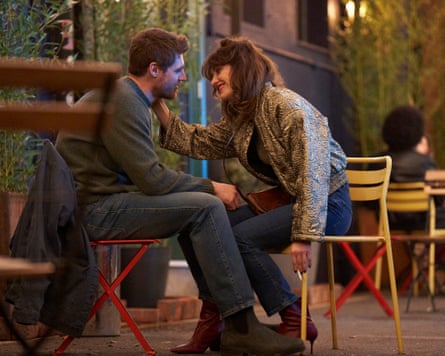
There is – perhaps inevitably, given that the source material comprises a 400-page novel devoted to each sister in turn – a flattening of all the characters. But there is also alteration, which throws off the whole dynamic and presents us with something very different from what any Keyes fan will have been expecting. The most obvious example is Mammy Walsh (Carrie Crowley) who, instead of being the Magnum-disbursing, joyfully self-confident borderline narcissist who loves soaps, magazines and Harrison Ford and “wears the smile of a woman whose husband has done the hoovering for the past 15 years”, has been turned unfathomably into a bitter shrew.
Transforming Helen into a stroppy-teen-a-like and concentrating on the selfishness and bleakness of addiction, with the addition of Anna’s suffering, hardly helps. Nor does reducing Daddy Walsh to a cash dispenser, which is a waste of his tenderly drawn character – and of Aidan Quinn, who plays him. But it is the loss of the “real” Mammy Walsh that strips The Walsh Sisters of the vital love and warmth that defines Keyes’ creations, and gives us something distinctly cheerless instead. The portraits of addiction and grief are very well done, but you find yourself wondering whether Preissner and Chadwick shouldn’t just have gone the whole hog and written something fully dramatic and interrogative of the subjects, and abandoned the comedy that Keyes blends into it with such apparent ease.
On its own terms, and as a drama rather than a comedy-drama, it’s fine. And, of course, the books remain, and are as clever and comforting and funny as you remember.