2 months ago
134
2 months ago
134
Welcome and summary
Hello and welcome to the Guardian’s coverage of the continuing crisis in the Middle East.
Iran was pummelled with a volley of missiles for a second consecutive night, with the US military claiming to have struck 170 Iranian targets in the last 48 hours.
US Central Command (Centcom) said the intense bombing aimed to “further degrade Iran’s ability to attack commercial shipping and innocent civilian mariners in the strait of Hormuz”.
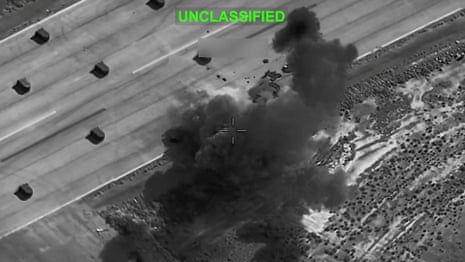
Iranian state media reported explosions in several cities, most of them concentrated in the south of the country, as its army responded with retaliatory strikes on US bases in Bahrain, Kuwait and Qatar.
The regional crossfire sparked by a battle to control movement in the narrow and strategic shipping channel threatens to unravel an interim truce between the US and Iran.
Both sides have vowed to escalate retaliations should provocations continue, with president Donald Trump warning that worse could come, while Iran has threatened to expand its attacks against US bases in the region.
During the Nato summit in Turkey, Trump said he considers the memorandum of understanding with Iran to be “over”, adding: “I don’t want to deal with them.”
Iran’s top negotiator, Mohammad Baqer Qalibaf, vowed that the strait of Hormuz would remain under Iranian management. “The strait of Hormuz will be reopened only under Iranian arrangements, not through US threats,” he wrote on X.
The fresh strikes came as Iranians prepare to bury their late supreme leader Ali Khamenei in his home town of Mashhad in north-east Iran. The burial follows a multi-day funeral ceremony that attracted millions of mourners across various cities in both Iran and Iraq.
Read the full report here:
Key events
Iran’s semi-official Mehr news agency has reported “several explosions” in the southern Bushehr province, home to Iran’s nuclear power plant complex on the Gulf coast.
We will bring you more as we get it.
Also in Mashhad, Iranian state media reported a US strike on two railway bridges on the route to the city from the capital Tehran.
Train services in Mashhad were suspended as technical and operational teams were dispatched to the scene, Iran’s official Irna news agency reported.
The Iranian foreign ministry denounced the attack and said it amounted to a war crime.
Bombing civilian infrastructure could constitute a war crime if they “are not military objectives”, according to international humanitarian law. My colleague Peter Beaumont explains more about the laws of armed conflict here:
In a statement, Iran’s foreign ministry said:
The ministry of foreign affairs condemns in the strongest terms the aggressive attacks of the US terrorist army on several points in the southern coastal provinces and two bridges in the eastern provinces on the railway route to the holy Mashhad on Thursday morning, which undoubtedly constitutes a gross war crime, and emphasises the resolute determination of the brave Iranian nation to defend its territorial integrity, sovereignty and national security.”
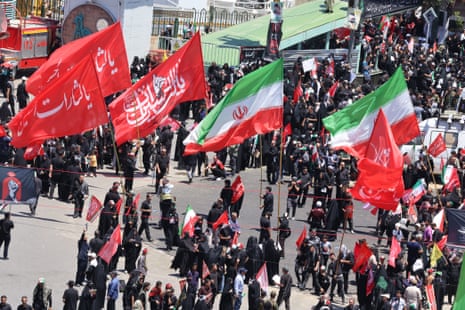
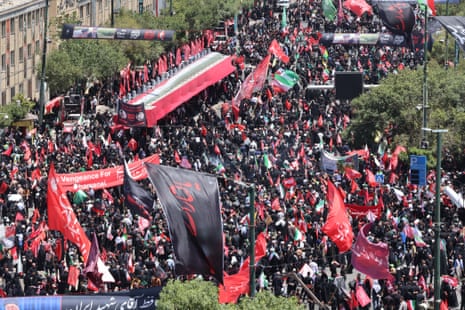
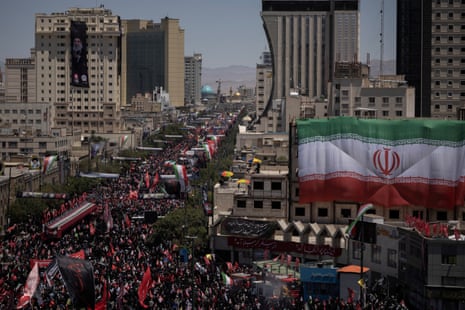
Massive crowds have begun marching through streets of Mashhad in north-east Iran where the slain supreme leader Ali Khamenei will be buried later today.
It follows a week of funeral processions around Iran and Iraq that has coincided with the fresh bout of fighting with the US.
Iran summons British ambassador over 'baseless' security allegations made by UK government, state media reports
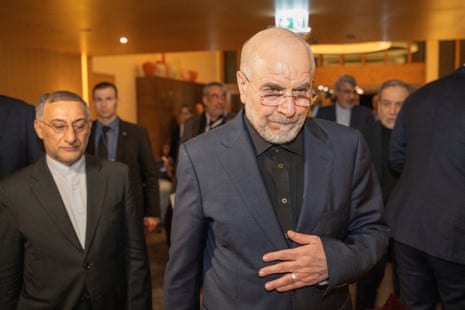
Iran’s foreign ministry has summoned the British ambassador in Tehran, according to state media, two days after the UK called in the Iranian charge d’affaires in London following the conviction of two Romanian men over the stabbing of an Iranian journalist.
The ministry said it’s director general for western Europe, Alireza Yousefi, handed the ambassador a protest note rejecting what he called “baseless and false” allegations made by British officials of security threats posed by Iran.
The UK summoned Ali Nasimfar on Tuesday after George Stana and Nandito Badea were sentenced to 12 years and eight years in prison, respectively, for their role in the 2024 knife attack on Pouria Zeraati, an Iranian-British journalist who worked for Iran International, which is critical of the Tehran regime.

The UK Foreign Office said the judge had concluded that the attack was carried out “in the interests of, and on behalf of, the Iranian state”.
The Iranian foreign ministry rejected the allegation, accusing the UK of “levelling ridiculous and fabricated accusations” against Iran to divert attention from its own conduct.
“It should amend its behaviour towards the Iranian nation and … also desist from its all-out support for the apartheid, genocidal, and terrorist regime of Israel, which is the greatest security threat to global peace and security,” the ministry said.
'If you strike, you'll get hit', warns Iran's chief negotiator Mohammad Ghalibaf
Mohammad Bagher Ghalibaf, Iran’s top negotiator, has accused the US of violating the truce that has kept most of the fighting at bay for the past three weeks.
In a post on X, he said:
America still hasn’t learned that bullying and breaking promises are no longer cost-free. Let me put it plainly: if you strike, you’ll get hit.
Don’t flail around pointlessly, or you’ll sink even deeper: the strait of Hormuz will only open with “Iranian arrangements,” not American threats.”
Iranian army claims attacks on Bahrain, Kuwait and Qatar
Bahrain, Qatar and Kuwait have come under renewed attack this morning as Iran continues its retaliatory strikes on US bases in the region.
Bahrain – home to the US Navy’s 5th Fleet – Kuwait and Qatar all sounded sirens as air defence systems shot down incoming Iranian drones and missiles. There were no immediate reports of any damage.
In a statement carried by Iran’s official Irna news agency, the Iranian army said it targeted a US Patriot missile system in Kuwait as well as an early warning satellite antenna site in Qatar and fuel tanks belonging to the US military in Bahrain.
14 people killed in Iran in recent wave of US attacks, Tehran health ministry says
The recent wave of US strikes in Iran have killed 14 people and injured 78 others, the Iranian health ministry said.
In a post on X, Hossein Kermanpour, head of public relations for Iran’s ministry of health, said: “While a ceasefire was in place, the US attacked five Iranian provinces on 7 and 8 July, resulting in 14 martyrs and 78 injuries.
“Of the injured, 47 remain hospitalised, while the others have been discharged after receiving medical treatment.”
Welcome and summary
Hello and welcome to the Guardian’s coverage of the continuing crisis in the Middle East.
Iran was pummelled with a volley of missiles for a second consecutive night, with the US military claiming to have struck 170 Iranian targets in the last 48 hours.
US Central Command (Centcom) said the intense bombing aimed to “further degrade Iran’s ability to attack commercial shipping and innocent civilian mariners in the strait of Hormuz”.
Iranian state media reported explosions in several cities, most of them concentrated in the south of the country, as its army responded with retaliatory strikes on US bases in Bahrain, Kuwait and Qatar.
The regional crossfire sparked by a battle to control movement in the narrow and strategic shipping channel threatens to unravel an interim truce between the US and Iran.
Both sides have vowed to escalate retaliations should provocations continue, with president Donald Trump warning that worse could come, while Iran has threatened to expand its attacks against US bases in the region.
During the Nato summit in Turkey, Trump said he considers the memorandum of understanding with Iran to be “over”, adding: “I don’t want to deal with them.”
Iran’s top negotiator, Mohammad Baqer Qalibaf, vowed that the strait of Hormuz would remain under Iranian management. “The strait of Hormuz will be reopened only under Iranian arrangements, not through US threats,” he wrote on X.
The fresh strikes came as Iranians prepare to bury their late supreme leader Ali Khamenei in his home town of Mashhad in north-east Iran. The burial follows a multi-day funeral ceremony that attracted millions of mourners across various cities in both Iran and Iraq.
Read the full report here: