3 months ago
176
3 months ago
176
José Mourinho: against provoking opposition fans. José Mourinho: in favour of restrained celebrations. José Mourinho, once of the poke-in-the-eye, sprint-down-the-touchline, accost-the-referee-in-the-car-park school of footballing expression: now apparently very big on showing respect to the game. Well, it seems like we’ve all been on a journey here.
“I told him the biggest person in the history of this club was Black,” Mourinho recounted when asked about his conversation with Vinícius Júnior on Tuesday night. “This club, the last thing that it is, is racist.” And doubtless these words will have been a profound source of comfort to Vinícius in his lowest moment, having been insulted on the pitch by an opposition player in a Champions League playoff.
After all who among us, having been racially abused in a public place, has not turned to the memory of Eusébio, and felt all that residual resentment and ambient anger subside in an instant? With Benfica on the verge of Champions League elimination, knocked out of both cups and seven points back in the Primeira Liga, perhaps Mourinho’s glittering future career as a trauma therapist is even closer than we think.
“A stadium where Vinícius plays, something happens, always,” Mourinho said after Benfica’s 1-0 defeat by Real Madrid. And remember: this guy is a master communicator, right? A man who chooses his words with incredible precision and a brilliant strategic mind, right? That’s why he’s “box office”. That’s why, a decade after he was objectively good, so many want him back in the Premier League.
But of course Mourinho is the symptom rather than the virus here. The substance of this case rests on whether Gianluca Prestianni really did call Vinícius “a monkey”, or whether – as Prestianni claims – the whole thing is just an unfortunate misunderstanding, albeit one that could surely have been avoided had Prestianni not inconveniently covered his mouth with his shirt as he spoke.
Naturally, there’s going to be a lot of equivocation here. You’re going to say: what if it wasn’t actually a racist incident at all? You’re going to say: what if Prestianni was simply covering his mouth to say something entirely innocuous? You’re going to say: show me the smoking gun, your irrefutable proof. You’re going to say: it’s a heated situation, things get uttered in the moment, think about the career and reputation of this angelic Argentinian kid being dragged through the mud.
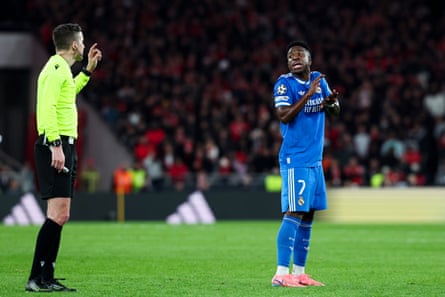
I believe Vinícius when he says he was racially abused because, unless he has grossly misinterpreted it across a distance of about four feet, to accept any other explanation is to accept a nonsensical, absurd sequence of events. That somehow a player who has spent his whole career in Europe fending off racism has somehow invented this episode for shits and giggles. That he has maliciously imagined what was said to him. That he would willingly walk off the pitch, and halt a Champions League tie being broadcast across the world, on the basis of a fiction.
And yet at the time of writing, the only person to have received any tangible, meaningful punishment for the events that followed Vinícius’s winning goal is Vinícius himself, booked for the exuberance of his celebration. “The problem in this situation is that Vinícius Júnior has not helped himself,” the former referee Mark Clattenburg said on Amazon. “He has made this difficult for the referee.”
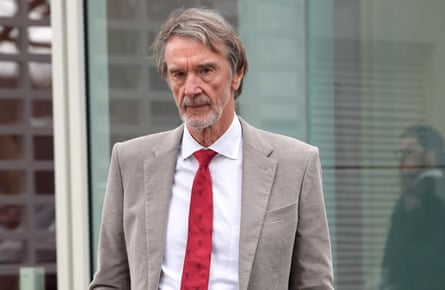
At which point it is worth recalling the words of Manchester United co-owner Jim Ratcliffe last week. In an interview with Sky News, Ratcliffe stated that the UK had been “colonised by immigrants”, citing incorrect population data to back up his view. A lot of the subsequent commentary correctly focused on the diversity of the United squad and the city of Manchester itself. But of course in so doing we end up in a familiar trap: the immigrant continually forced to justify their very existence, to defend their presence against a dominant narrative that seeks to position them as troublesome disruptors.
I’m less interested here in the false division between “racists” and “non-racists”, a division that in any case is primarily concerned less with proscribing racist behaviour than legitimising anything else that fails to meet an arbitrary threshold. But some of the immediate reaction to the abuse of Vinícius felt telling in bleakly familiar ways. Not racist, but. Not condoning what was said, but. And ultimately, what a shame we have to talk about this, rather than the stuff that actually matters.
There is a particular strain of football discourse that tends to regard racism as a reputational risk rather than a lived reality. That the true injustice is not so much the insult as the allegation. That the real victims are not the players who endure it, but the institutions forced to deny it and the neutral observers forced to talk about it. As if the correct response to abuse is strategic restraint. As if simple human dignity is conditional on decorum.
In the meantime people who have no problem linking smaller personal aggressions to larger cultural forces when it comes to – say – phone thefts or sexual grooming, remain weirdly resistant to the idea that the tolerance of individual incidents can scale to a broader societal trend. Let’s defer to the Uefa panel, who will invariably conclude that it was one player’s word against another. Let’s just ask Grok whether it was racism.
This is what links the comments of Mourinho and Ratcliffe and Clattenburg, as well as the many criticisms of Black players such as Jude Bellingham and Marcus Rashford: the insistence on perfect victims. Shall we all be good little immigrants? Not antagonise crowds, not claim benefits, not write seditious columns in the newspaper, not have difficult dads, not make defensive errors or go on the piss, not make things difficult for the referee, return respectfully to our own half after celebrating a goal? Will that save us? Will that help us win your approval?
Mourinho’s invocation of Eusébio was interesting, although probably not in the way he intended. After all, Mourinho spent his early years under the right-wing dictatorship of António de Oliveira Salazar, during which Eusébio, the indisputable star of Portuguese football in the 1960s and 1970s, played an outsized role. For the regime’s advocates, Eusébio’s sporting success and integration into polite Portuguese society was an indicator of the essential benevolence of empire: a colonial exploit run along the lines of the “civilised” and the “indigenous”. As long as you kept your head down, spoke the language, practised Christianity, erased all traces of your African identity, you too could be edified by your contact with European civilisation.
At a time when football’s anti-racist impulses have rarely felt more under threat – from the systematic online abuse of players to a men’s World Cup being held under an explicitly white supremacist regime – these questions feel more urgent than ever. Is this a sport genuinely invested in eradicating racism or one that regards it as no more than an inconvenience, a distraction, a smudge on the business model? Eusébio was tolerated only to the extent that he kept scoring goals and kept his mouth shut. As Vinícius faces his latest gauntlet of lies and bad faith, it’s tempting to wonder whether anything has meaningfully changed.