2 months ago
133
2 months ago
133
It was all smiles and warm handshakes when the two men in charge of renegotiating the UK’s relationship with the EU met in Brussels this week.
Maroš Šefčovič and the UK minister for EU relations, Nick Thomas-Symonds, sharing a stage on the third floor of the vast European parliament building, were at pains to show the cross-Channel relationship was in a good place after years of rancour.
The deep frustration about the lack of progress in the “resetting” of the relationship between the UK and the EU was evident on stage and behind the scenes.
Šefčovič, the European commissioner for trade, told MPs and MEPs gathered at the EU-UK parliamentary partnership assembly (PPA) of the need for a reboot but also hinted at the need for more ambition in the next round of talks, reminding the British in the room that an over-arching Swiss-style deal, as offered to the former prime minister Boris Johnson, was still very much on the table.
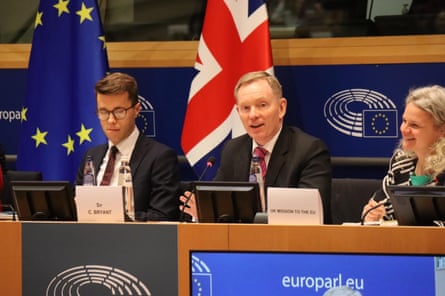
The following day, the trade minister, Chris Bryant, on a charm offensive in Paris, expressed his own frustration at the “piecemeal” approach he inherited when he was appointed in September.
Bryant insisted both sides needed to be more ambitious.
“I think we need to lift our eyes to the distant horizon and think in a much bigger, more ambitious way about what is possible,” he said, highlighting the need for sectoral regulatory alignment, which could reboot exports for both sides in everything from medical devices to chemicals.
“This is the line that I’ve been telling everybody in the department since I got into post – the [relationship] with the EU is not a series of policy decisions, it is one great big decision, which is about how much do you want to align. And how do we achieve that?”
It was a line echoed by the UK chancellor, Rachel Reeves, later that day in London when she spoke of the “strategic imperative for deeper integration between the UK and the EU”. And, in the political equivalent of three buses coming at once, a third Labour figure, the London mayor, Sadiq Khan, on Wednesday called on his party to go into the next general election promising to rejoin the EU.
Meanwhile, reset talks are in danger of stalling on the baby steps of last year’s common understanding, when the EU and UK agreed to forge a deal on youth mobility, agriculture trade, energy and defence.
The EU’s insistence that EU citizens get home fees if they attend university in the UK has brought talks on youth mobility to a deadlock.
“There is a strong political will for a deal from the EU member states, but this issue has become very thorny,” said one person briefed on the talks.
Another added: “We are still talking regularly but progress has slowed a lot because of this issue.”
A sanitary and phytosanitary (SPS) deal will make a difference, but talks have been painfully slow.
Bryant spoke to MEPs in Brussels on Tuesday and then again to French businesses on Wednesday in the sumptuous ballroom at the British residence in Paris. He noted the UK was slow, but the EU was sometimes even slower – although both sides agreed to open talks on SPS last May, the European Commission didn’t get the mandate from member states until November.
“If we can get from one in 10 British businesses exporting, to two in 10 or three in 10, like the French or the Germans, it would radically transform our economic opportunities in the UK. That’s precisely the job I’m fixated on from the beginning,” he said.
But Bryant is pushing for a more defined approach to achieve that.
“Rather than this piecemeal, oh let’s do [a deal on] SPS, let’s do tuition fees, let’s do [the student exchange programme] Erasmus. And then it takes forever, it gets bogged down and nobody remembers what we’ve done,” he said. “We are doing all these bits and pieces, policy by policy … we need to be much more focused.”
Bryant is one of many pushing for mutual recognition of professional qualifications, and a compromise for touring artists, among other issues such as conformity in sectors where public health is at stake. There is also AI regulation, and tuition fees for British students whose parents moved to the EU before Brexit – a deal on home fees runs out in 2028.
One solution is a wider integration with the EU, as Reeves mentioned. In Brussels, Šefčovič said a Swiss-style overarching deal was still on the table in the long term.
Instead of a patchwork of more than 100 bilateral treaties, Switzerland entered a series of agreements on 2 March covering health, food, space and electricity, in addition to the privileged access it already has to the single market.
“Switzerland, of course, it’s possible, but it takes time,” Šefčovič told MPs and MEPs at the PPA. The advantage of an overarching deal was that it offered a “dynamic alignment approach” in regulation so deals could be “faster” and “earlier”, he said.
Asked in Paris if this was something the UK would consider, Bryant said he suspected “that any model that works for one country won’t necessarily work for another”, adding that he was “in favour of one overarching something” with the EU.
Bryant also said he wanted to see a shared defence procurement strategy. “We need to take that seriously; we’ve done really well on cooperation, on sanctions in relation to the Russian shadow fleet, but we still haven’t got to the point where we will need to go to: defence procurement across the whole of the EU.”
The immediate pressure on the UK and the EU is to get youth mobility, SPS and other items in the common understanding agreed by July when the second post-Brexit EU-UK summit is scheduled.
But the question that faces Labour now is how far it will go after that?
There is mounting pressure on the prime minister, Keir Starmer, from his MPs to go even wider than defence and trade. In a new pamphlet for the Fabians, several Labour figures called for the prime minister to push for further integration with the EU. They included the London MP Stella Creasy, who threw her weight behind the Swiss model, and the Labour chair of the business select committee, Liam Byrne, who called for cooperation on a range of topics including critical minerals and energy.
The next reset agenda may also include talks on a customs union – something several members of Starmer’s cabinet would like to see. Starmer has so far ruled this out, as it would void trade agreements he has signed with the US and India.
EU sources, however, say they are open to agreeing a deal on sufficiently favourable terms to compensate the UK for any trade lost as a result.
Post-Brexit trade relations are not easy, as this first year of reset has shown. But the key was to look up, said Bryant.
“I sometimes worry we have got ourselves into a funk, ‘oh it’s all difficult; how are we going to survive’,” he said, quoting the Belgian rapper Stromae’s Mauvaise Journée, about someone who insists on their right to be depressed in the comfort of their own sofa.
“I think we’re a bit like the tightrope walker, we’re a bit obsessed with walking foot by foot [instead of focusing on the end of the rope]. And that doesn’t work. That’s when you fall off.”