2 months ago
82
2 months ago
82
At an age when most Olympic snowboarders have already drifted into coaching, broadcasting or nostalgia, Nick Baumgartner is still doing the hardest thing in his sport: showing up to the start gate believing he can win.
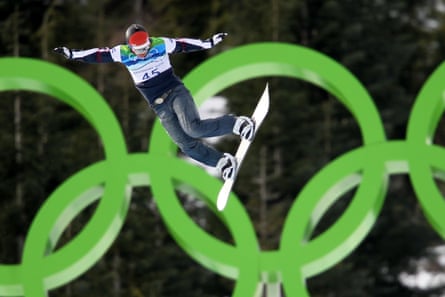
On Thursday at Livigno Snow Park, the 44-year-old American will race the men’s snowboard cross at his fifth Olympic Games – less a farewell tour than another extension of a career that has stubbornly ignored conventional timelines.
Baumgartner does not shy away from conversation about his age. If anything, he leans into it. He has watched himself move from being one of the older riders on the US team to, by some distance, the oldest. He speaks about it with a mix of pride and defiance, often joking that time is the only opponent nobody beats, even if, for now, he feels he is still holding it off.
“Some people ask why age always comes up,” he said in New York late last year. “I love it. It’s part of the story. We’re all ageing – it’s coming for all of us. Father Time is the only undefeated opponent, but he hasn’t beaten me yet. Maybe one day. But not today.”
Four years ago in Beijing, Baumgartner became the oldest Olympic snowboard medalist at the time when he and Lindsey Jacobellis won mixed team snowboard cross gold. For many athletes, it would have been the perfect ending. For him, it became something closer to liberation.
Winning stripped away the existential pressure that had defined much of his career – years of near-misses, years of fighting simply to stay funded, years of trying to prove he belonged in a sport skewing younger and more technical by the season. Now, he says, the equation is simpler: if he is competitive and having fun, he keeps going. And he believes the two are inseparable.
That mindset has carried him into an almost unthinkable goal: potentially competing at the 2034 Salt Lake City Games, when he would be 52. Not because he needs another medal, but because of what it represents.
“The longer I do this, the more people that I can inspire,” he said. “If I’m 52 years old in 2034 and I’m still doing this, you have no excuse to go chase your dreams.”
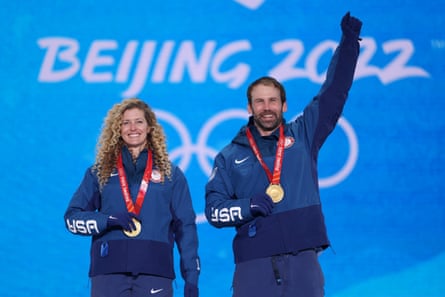
Snowboard cross, increasingly shaped by youth pipelines, sports science and early specialization, was not designed for careers like his. Some of his competitors were in elementary school when he made his Olympic debut in Vancouver. Longevity, in Baumgartner’s telling, is less mystery than ecosystem. He credits a support network built around more than podium results – sponsors, community and family who believe in the story as much as the sport.
“I have people that care about what I’m doing and believe in my journey,” he said. “I want to use my story for good. I want to use my story to inspire more stories like mine from small-town kids.”
That small-town identity remains foundational. Baumgartner still lives in Michigan’s Upper Peninsula, commuting 90 minutes to a specialized training gym in Marquette twice a week, sometimes sleeping overnight in a van to maximize recovery and training windows. He speaks about the region less like an address and more like a personality.
“I’ve been to 40 countries all over the world on my snowboard,” he said. “And Lake Superior is still the coolest thing I’ve ever seen. The people – they’ll give you the shirt off their back even when it’s 40 below zero.”
Earlier in his career, Baumgartner helped fund his time on tour by working summers for a concrete company in Wisconsin, pouring patios, sidewalks and driveways. Weeks before the 2022 Beijing Olympics, he was still taking shifts alongside his brother, working overnight construction jobs that required maneuvering heavy concrete hoses across building sites before flying out to snowboard training camps. The work was physically punishing, particularly as he moved into his late 30s, but he credits it with helping build the durability that has defined his career.
The environment, he believes, creates a baseline toughness. Survive Upper Peninsula winters and elite sport feels manageable.
The durability also comes from how differently he trains now compared with his early career. In his 20s, he trained like an NFL player – high volume, traditional lifts. In his 40s, everything is precision-engineered for explosiveness and injury prevention.
“I’m doing all fast-twitch explosive things,” he said. “Sprints, box jumps … We have a machine reading how fast I’m pushing the bar. If I can’t push it past a certain speed, we stop. We’re just smarter about how we do things.”
Snowboard cross offers one hidden advantage to ageing athletes: experience. The event is chaos disguised as racing – elbows, edges, draft lines, crashes and split-second decisions.
“I’ve seen so many kids that have all the talent in the world to beat me,” he said. “On paper they should crush me – and they never beat me. I’ve been in the trenches for too long.”
The sport’s peak age has dropped dramatically – the top riders are now often in their early-to-mid 20s. But Baumgartner had arguably his best season at 40, a reminder that competitive maturity doesn’t always follow physical prime.
Off the hill, fatherhood has quietly shaped the emotional center of his career. His son, Landon, was born in 2004, the same year Baumgartner turned professional. That means Landon has seen everything – financial uncertainty, injuries, disappointments and, eventually, Olympic gold.
“Kids don’t listen to their parents,” he said. “But they watch. He’s seen everything: the ups, the downs, all of it.”
When Baumgartner returned home to Michigan after the Beijing Olympics, thousands lined roads in freezing temperatures for a 70-mile parade. He rode through it with his son beside him – crying, laughing, filming – a moment that reframed decades of risk and sacrifice.
The physical toll is real. He doesn’t pretend otherwise.
“Body-wise, it’s good for 44, right? I definitely don’t feel the same as I did at my first Olympics at 28, but I put a lot of work in to make sure that the body holds up and the body’s strong and ready to compete against these kids.”
“Yes, absolutely,” he said when asked if he hurts more now. “If I stop moving, I’m going to be in big trouble. But if I keep moving and take care of my body, I think I’ll be fine.”
Which is why Thursday doesn’t feel like a closing act. It feels like another data point in a career built on stubborn defiance – of geography, of expectation, of ageing curves, of the idea that elite sport belongs only to the young.
Baumgartner knows time will win eventually. He says that part out loud. But until the starts slow, until the legs stop responding, until the joy fades – he will keep lining up against riders young enough to have grown up watching him.
At 44, that may be the most radical thing about him. Not that he’s still here, but that he still believes the best part could be next, whether on Thursday in Valtellina or eight years from now in Utah.
“I would love to end in the States,” he said. “Is that possible? I don’t know. Are we going to find out? Damn straight. Because I’m going to push it, and at some point the body’s going to step in, and it’s going to say, all right, it’s time to give it up, but until that happens, we’re going to keep pushing as hard as we can. I think I’m going to be there – I really do.”