1 hour ago
8
1 hour ago
8
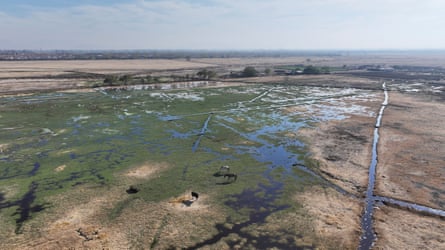
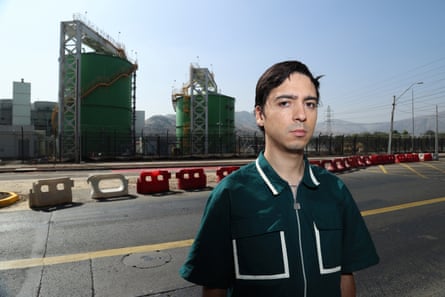
The Andes mountains frame what was once a wetland – now a stretch of dry, yellowed grass. Rodrigo Vallejos, a final-year law student, noticed the change five years ago while observing the Quilicura wetland, on the northern outskirts of Santiago. One of Chile’s largest swamps, spanning 468.4 hectares (about 1,200 acres) and partially protected, was drying up right before his eyes.
“What you see here is a wetland without water,” says Vallejos, who has investigated the causes alongside activists from the group Resistência Socioambiental de Quilicura. “I discovered that Quilicura is home to the largest concentration of datacentres in Latin America.”
Chile’s push to become the regional tech hub now faces backlash as datacentres have drained water from drought-stricken wetlands, consuming billions of litres annually. While companies such as Google and Microsoft defend their water use, residents highlight minimal job creation, high power consumption and failed environmental offsets.
With 33 centres operating and 34 more planned, experts urge sustainable solutions – such as relocating to southern Chile – to balance tech growth with ecological limits.
The datacentre boom in Chile began in 2015, when Google opened its first and largest server room in Latin America, in Quilicura. Since then, five more have been established in the district, operated by Brazilian Ascenty, Chilean Sonda and the US-based Cirion and Microsoft.
In a 2022 report, Vallejos estimated that the largest datacentres in the area – Ascenty, Google, Microsoft and Sonda – consume 1.5bn litres of water annually. Google’s facilities alone hold water rights allowing the extraction of 50 litres per second – roughly equivalent to the annual consumption of 8,500 Chilean households .
Studies show that water table levels beneath the Quilicura wetland have dropped alarmingly over the past decades due to intensive water use by the region’s growing industrial activity, against a backdrop of severe drought. “The worst part is that neither the companies nor the water authorities will say exactly how much water is being extracted from the wetland – the figures are very unclear,” Vallejos says.
The expansion of datacentres in Quilicura is part of a national plan launched last year under the government of social democratic former president Gabriel Boric. It seeks to position Chile as a technological hub for Latin America – the country ranks third, after Brazil and Mexico – by attracting investment in the tech sector.
“Chile is attractive to international tech companies developing datacentre infrastructure because of its political stability and fast internet connectivity,” says Nicolás Jara, a researcher at Federico Santa María Technical University.
Yet Jara, along with other experts, warns that the environmental costs could be high without stronger industry regulation, as datacentres require large volumes of water to cool their server networks. In Chile, this is most commonly done with water-based systems, which are cheaper than air-cooling systems.
Jara adds that datacentres for AI often use up to 10 times more water than those for storage. “We need to find ways to use water more efficiently,” he says.
Studies suggest that 10–50 medium-length responses from the GPT-3 version of OpenAI’s ChatGPT consumes roughly the equivalent of a 500ml bottle of water. Water use also varies by location: in hot, dry climates, datacentres’ evaporative cooling systems are less effective than in cooler, more humid regions.
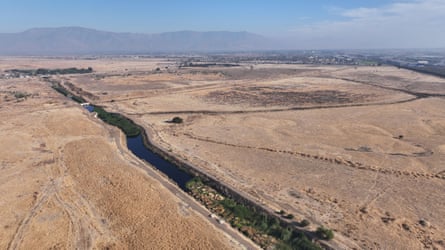
In Chile, a mega-drought has persisted for more than 15 years. “It is something we are seeing across much of the country,” says Pablo Sarricolea, a climatologist and associate professor at the University of Chile.
The effects have been most severe in the central region around Santiago, where most existing and planned datacentres are located. Sarricolea, who has extensively studied drought patterns, says the projections for Quilicura indicate a sharp decline in water availability.
“By 2070, annual precipitation is expected to decrease significantly, while average temperatures could rise from 15.6C (60F) to 17.4C. This will lead to greater evaporation and less available water,” he says. “I don’t think it is a good idea to locate datacentres in areas where water resources are already scarce.”
He suggests that southern Chile, which is comparatively water-rich, would be a more sustainable location for such infrastructure. “In Santiago, datacentres are likely to put further pressure on water availability and exacerbate the impacts of climate change,” Sarricolea says. “It also becomes an ethical problem: are we giving priority in water access for tech companies or people?”
A Microsoft spokesperson says the company’s Chilean datacentres use air-based cooling technologies, which require less water for humidification. “Microsoft is also advancing water restoration, access, and replenishment projects in the Maipo basin, including areas of the metropolitan region”, the spokesperson says.
A PR agency responding on behalf of the Brazilian company Ascenty says the company’s datacentres in Quilicura use air-cooled chiller systems, and that their annual water use is equivalent to that of 16 households. “Ascenty’s operations in Quilicura do not generate impacts related to soil degradation or pose risks to the surrounding wetland, due to the technical characteristics of its water and cooling systems,” the company says.
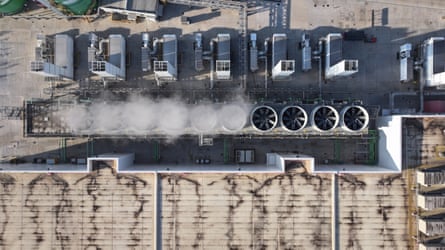
Cirion, Google and Sonda did not reply to requests for comment. According to Google’s recent environmental report, in 2024 Quilicura datacentre used approximately 461m litres of water, which the company says equals less than an annual consumption of a golf course.
Beyond water use, datacentres also raise concerns over their high energy demand. Studies estimate that by 2032, Chile’s electricity consumption could increase more than fourfold, rising from 325MW to about 1,207MW.
In places with a high concentration of datacentres, such as Quilicura, this could threaten the energy supply. Datacentres already account for 62% of the community’s power consumption. About 80% of Chile’s energy mix comes from renewable sources, with solar and wind accounting for roughly half of it. But many datacentres still rely on fossil-fuel-powered backup generators, raising concerns about their carbon emissions.
Ascenty and Microsoft allege that the electricity powering their operations is sourced from renewable energy to reduce greenhouse gas emissions. However, Chile’s electricity grid combines energy from different sources, making it hard to determine the exact origin of the power supplied.
Alexandra Arancibia, an activist and a councillor in Quilicura, says she is disappointed by the tech industry’s lack of accountability. “A decade ago, Google arrived with fanfare and slogans like ‘Google, my neighbour’, but its presence in the community has been minimal,” she says.

She says the number of jobs created by the datacentre has been limited. According to Google’s own figures, the Quilicura server room required 1,000 workers during construction and employs 208 people in operation.
More concerning for residents, she says, has been the lack of transparency around environmental impact. “When we learned about the scale of their water consumption, we invited company representatives to community council meetings and asked how they planned to address the impacts. They did not have clear answers,” she says.
According to Arancibia, Google’s main mitigation effort was the creation of an urban park in 2019, which promised to plant 1,500 native trees to offset 150% of the environmental impact of the company’s 2018 datacentre expansion. “The project has been a failure. The vegetation has dried out, the paths are not maintained, and there is no irrigation,” she says.
Quilicura’s experience with datacentres has raised the alarm in other parts of the Santiago region. In 2024, residents in the district of Cerrillos succeeded in halting plans for a second Google datacentre. “In 2019, we learned about the project in our community. When we realised the scale of water it would require, we became alarmed,” says Tania Rodríguez, a teacher who lives in the area.
Google had secured water rights allowing it to extract up to 228 litres per second – roughly equivalent to the consumption of 40,000 households – from Cerrillos’s groundwater reserves. In 2024, residents succeeded in having the project halted on the grounds that it had failed to adequately consider the impacts of the climate crisis. The company also agreed to review its cooling system.
The project is now on hold, with the environmental authority requesting further studies into its water use. “We don’t need more datacentres here taking our water so that people in the global north can draw funny pictures on AI,” Rodríguez says.
Calls for stricter environmental regulation of datacentres are likely to face resistance under the new rightwing government of the president, Antonio Kast. During his campaign, he promoted the slogan “Less regulation, more investment”. On his first day in office in March, he withdrew 43 environmental decrees.
“The weakening of environmental evaluation standards already began under the previous government, but Kast has taken it further, leaving us without a floor,” says Pamela Poo, a policy expert at the NGO Ecosur Fundación.
This is what activists such as Rodrigo Vallejos say must change. “I’m not demonising datacentres,” he says. “We all love the internet – but not at the cost of our water.”