3 months ago
189
3 months ago
189
‘It’s time to get … crazy!” DJ Compulsive Leia is yelling at us from the stage. Around me, clubbers in cat ears wave LED glow sticks and squeal in anticipation. Suddenly, an all too familiar sound: Crazy Frog’s much maligned version of Axel F, albeit remixed at an even giddier pitch and speed. “Ding, ding!”
Tonight, Vauxhall Arches in London is a hyperactive fever dream for Pixelate, a rave currently touring the UK and celebrating the 00s era of “internet cringe”. This edition is cat-themed, and a person in a giant bobble-headed Hello Kitty costume is dancing frantically on stage, soundtracked by high-octane versions of 00s memes, video games, cartoons and dancefloor hits.
Huge screens behind the stage and dotted around the venue are flashing with internet-culture ephemera that is instantly recognisable to the crowd of young millennials and gen Z who grew up online: Club Penguin. Happy Tree Friends. Salad Fingers. Nearly everyone is dressed in cosplay or emo-era scene fashion, and stacks of kandi bracelets jangle on wrists.
Themed nights have been around for decades. Excursions to crap clubs dressed as something embarrassing are a university rite of passage. But today’s immersive raves go beyond generic (and dodgy) school uniforms or foam parties and instead deploy hyper-specific memes and pop-cultural references. Take Shrek Rave, a party themed on the animated ogre movie that started in the US but proved so popular that it went global. In February last year, a Lord of the Rings rave took over Camden’s Electric Ballroom. The travelling video game-themed rave Dubtendo has more than 100,000 followers on Instagram. A Pokémon-themed EDM music festival is set to take over the O2 Arena in November.
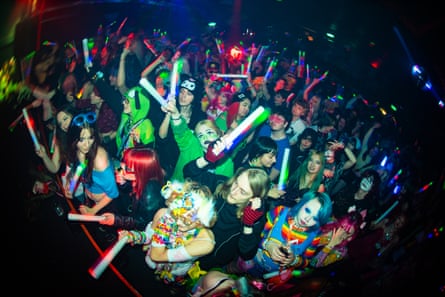
Nostalgia, sometimes for the extremely recent past, is what unites these events, along with a total lack of irony. “I always had a fascination with internet nostalgia, I never really left that era,” says Leia, Pixelate’s 22-year-old founder and Crazy Frog-spinning DJ. “Everyone kind of moved on to whatever was trending while I was like, ‘Hey guys, does anyone want to watch [2009 viral comedy web series] Annoying Orange with me?’”
Londoner Leia started raving in early 2024, but visiting a Sonic the Hedgehog-themed rave made her fall hard for the scene. The night was filled with high-BPM genres: happy hardcore, nightcore and donk. “It changed my life completely. I knew I wanted to one day do my own event – it was just a matter of when.”
In December 2024, Leia put all of her savings into her first Pixelate party at the Yard, a small venue in Hackney Wick in east London, with just a one-off blow-out in mind. She was “shocked” that 100 people attended, and they wanted more. “When I went to raves, strangers would stop me and be like: ‘When’s the next Pixelate?’” It has since ballooned in size, with sellout events in Manchester and Glasgow this year, and tonight, under Vauxhall’s railway arches, there are a dozen DJs on the lineup and more than a thousand punters primed to party.
A new song has started and everyone is screaming. “It’s Nyan Cat!” shouts a twentysomething next to me, and the 2011 meme, an animated cat with the body of a Pop-Tart, zooms above the stage. Everybody bursts into action, singing in time to the song’s frenzied jingle. It’s undeniably fun. At the same time, the combination of screens, LED lights and sensory overload feels like the living embodiment of internet brainrot.
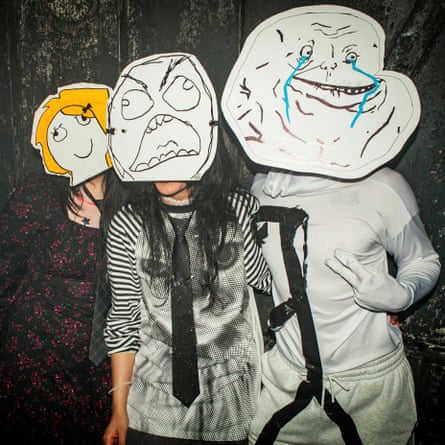
Patrick Hinton, editor and digital director of dance music magazine Mixmag, says that online culture’s reach means dance music has become “a lot less tribal. People in general are less strict or elitist about their tastes – probably due to the massive expansion of what we’re all exposed to, via the internet, softening cultural boundaries.” In some ways Pixelate feels quite tribalistic, deploying rainbow cat memes as a way to exist outside the grey mainstream – and yet for so many people, this stuff is the mainstream.
Hinton says club culture is also shifting due to “a declining capacity for viewing culture through a critical lens”. Previously you might have been pilloried for liking trance, or indeed feline anime, but amid today’s widespread mindset of “let people enjoy things”, you can get on with indulging your own particular tastes.
The UK’s cost-of-living crisis and a beleaguered night-time economy, too, have driven changes to what is considered a good night out. “It’s hard to create more challenging, innovative art when it doesn’t pay the bills,” Hinton says, and Pixelate’s sense of fun feels part of the lucrative craze for gaming bars, escape rooms and other experiential, larky nightlife. In this way, Hinton feels that immersive raves such as Pixelate exist in a different lane to what he understands to be “the dance music scene. I think people are attending them for different reasons than someone attending a club night that’s more explicitly about the music. That said, there’s a whole spectrum of dance music out there and, within it, there has always been a place for humour and zaniness.”
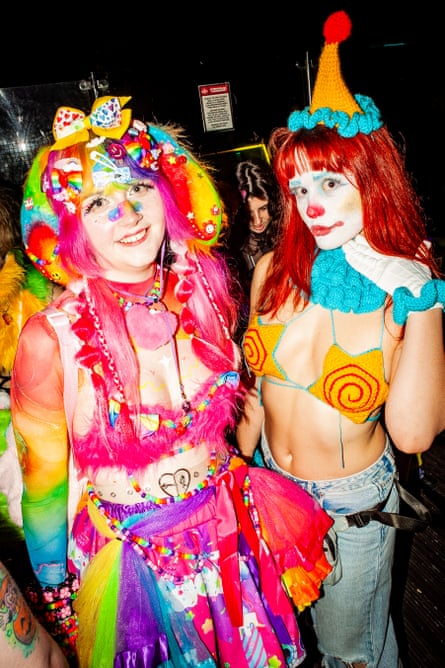
Cherry Archive, a 21-year-old student and rave clothing designer, went to her first Pixelate in September and, having “fallen in love with the whole scene”, is back for more. Tonight she is dressed in one of her designs: a very ravey take on The Very Hungry Caterpillar involving a bralette, teeny-tiny skirt and faux fur leg warmers, with acid green hair and a painted red and green face. “I’m a bit of a nerd,” Cherry says. “And when I went to these raves for the first time, I was like, ‘What the fuck, I’m surrounded by other nerds!’ You could go into the smoking area and talk to anyone, and everyone has weird and wild and wonderful interests.”
She has since become best friends with people she has partied with at Pixelate and other nightcore raves. The scene is also the antithesis to the “scary, sketchy” squat raves she started going to after turning 18. “I wasn’t very pleased, to say the least, with how I found the community there.” By comparison, this playful celebration of cringe is “a safe space for you to just be yourself, and let your inner freak out”, she says. “It’s such a nice feeling, because these are things a lot of us got bullied for when we were younger. It’s so nice to have a space where we can actually be ourselves.”
It’s true that, from what I can see, everyone is living in the moment, immersed in the unique, goofy energy of the night. “We all grew up with the same internet,” Leia says. “No matter how your life is at the minute, we can all go back. We can all relate to just being young and logging on to YouTube and finding the most cursed videos to show your friends at school.” And while looking backwards is arguably not the healthiest response to stagnation, it can be positive when it’s a means of connection.
On Pixelate’s social media feeds, videos of the night’s crazed proceedings feel purpose-built for the algorithm, with some of them garnering hundreds of thousands of views. But at the event itself, under the rainbow lasers, barely anyone is on their phone. Everyone is too busy dancing to a pitched-up mix of Barbie Girl, or laughing among themselves as a familiar meme springs into view. Leia says it’s because “we all just have that one thing in common. We want to be able to go back in time, for one night, and be like, ‘Hey guys, do you remember when we used to just have fun and watch Salad Fingers?’”