2 months ago
77
2 months ago
77
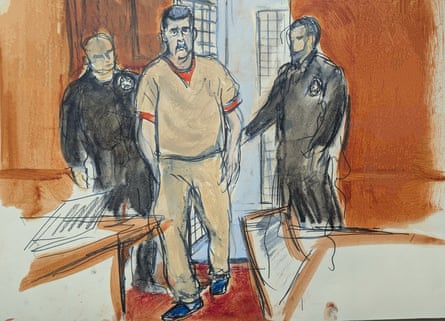
The deposed Venezuelan president Nicolás Maduro had a smile on his face as he walked into a Manhattan court with shackles around his ankles and affably shook hands with attorneys at the defense table.
But though he appeared at ease on Thursday, Maduro, who was captured in Caracas by US special forces on 3 January, faces a “narco-terrorism” indictment that could land him in federal prison for life.
Cilia Flores, Maduro’s wife who is charged alongside him, was also present at the defense table and both wore khaki jail scrubs. The former strongman had also slimmed down since his last court appearance. Maduro had a neon T-shirt underneath her prison garb and Flores, a grey long-sleeve; they both had black-framed glasses. She wore hers throughout the proceeding while he seemed to treat his as readers.
While this once-powerful couple’s appearance was at times visually humdrum, it was also a stark reminder of how quickly events in Venezuela moved when the couple involuntarily swapped life in a presidential palace for sparse Brooklyn jail cells. Their presence also touched on an overlap between domestic US law enforcement and Trump’s aggressive foreign policy that has become increasingly confusing during his second term.
Maduro and Flores’s arrest came after months of US pressure against him, including attacks on alleged “narco boats” that resulted in more than 100 deaths. The Trump administration also seized oil tankers in keeping with US sanctions against Venezuela.
With Maduro gone, the US got to work trying to rebuild links to the country’s oil industry and forging ties with the now Maduro-less Venezuelan government – not its exiled opposition.
Before court proceedings kicked off this morning, demonstrators for and against Maduro’s capture shouted on their respective sides of metal barricades. One sign stated: “Free President Maduro”. A man with an amplifier shouted: “This is not a trial! This is a judicial farce!”
But several dozen Maduro opponents sang Venezuela’s national anthem, briefly drowning out the pro-Maduro camp’s claims about injustice. Some sported Venezuela’s flag around their shoulders. Others donned caps with Venezuela’s logo.
“I’m a Venezuelan. I was raised and born in Venezuela, and I’m representing my community that wants justice for our country,” Adriana Malave said. “They have so many people that still need to be arrested in our country, and they are still in the government.
“I hope they’re in jail forever,” Malave said.
“I know that for some people, it’s hard to understand that another country has to go to your country and take the people,” Malave also said. “It sounds crazy, right? But for us, it’s the only hope that we have.”
In an unexpected twist, Trump’s recent efforts for regime change elsewhere in the world could help Maduro and Flores. The US-Israel bombing campaign against Iran has roiled global oil markets – heightening demand for petroleum outside the region.
Judge Alvin Hellerstein, who is overseeing Maduro’s case, pointed to the unfolding oil crisis as prosecutors fight to keep Venezuelan government money from funding his legal defense, with the prosecution claiming national security and foreign policy concerns.
“We are doing business with Venezuela,” Hellerstein said. “The oil interest in Venezuela has become vital particularly because of the shortages arising from the strait of Hormuz.”
While Hellerstein did not make a decision related to debate over the Venezuelan government funding his defense, the ex-head of state remained seemingly upbeat at the hearing’s end. Maduro smiled as he whispered to his lawyers and tucked papers into an envelope.
He bid them adieu with a breezy “hasta mañana” (see you tomorrow) while US marshals escorted him out of court.