3 months ago
124
3 months ago
124
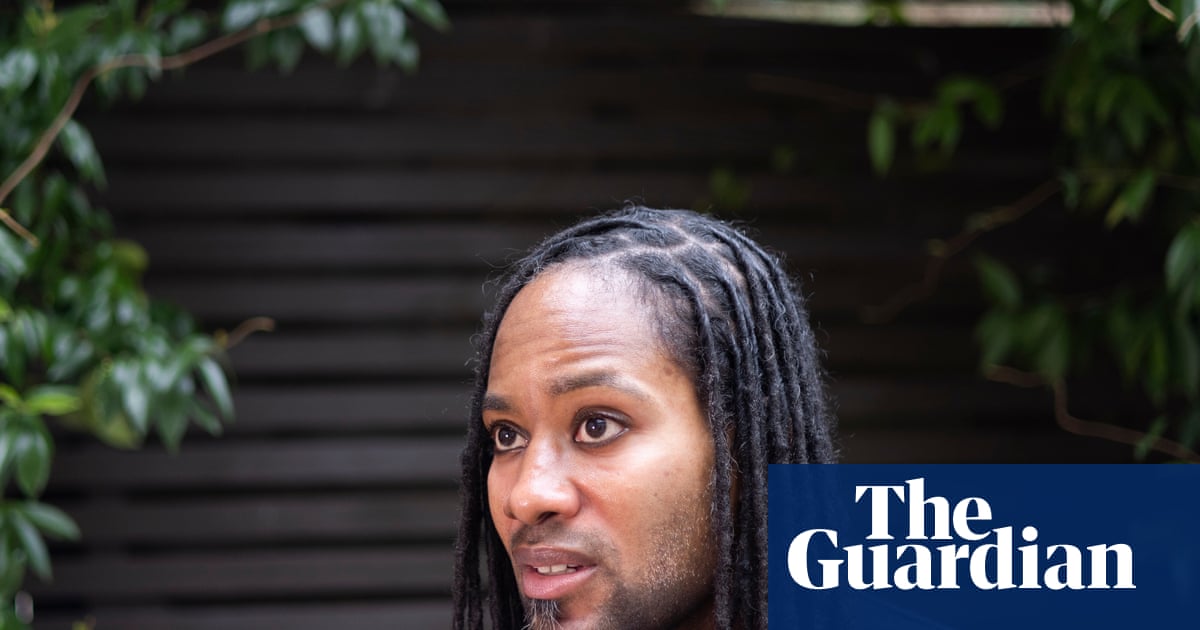
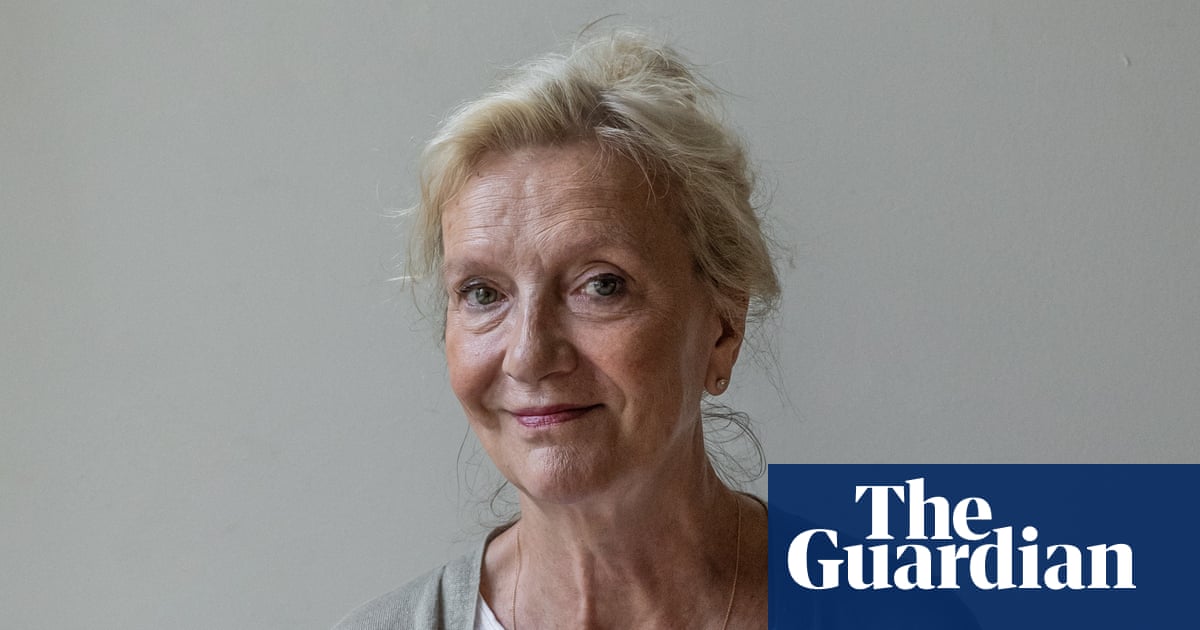
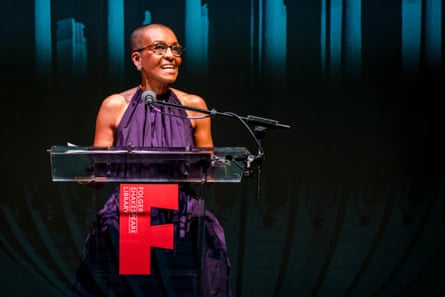
Addressing an audience at the Folger Shakespeare Library in Washington, Adjoa Andoh acknowledged that some of her work might look “Black or colour-centric” but that is only because of the silos the world forces us into. She could just as easily be Leeds United football club-centric, she added.
“I am missing two crucial matches to be here with you this week,” the 63-year-old exclaimed, prompting laughter in the theatre. “I have tickets!”
Any football fan will empathise. Andoh, a Shakespearean actor and director and star of the Netflix series Bridgerton, had made the noble sacrifice of missing an FA Cup semi-final to be take part in a new director’s residency programme at the Folger, a Shakespearean shrine – with scenes from the plays carved in marble – on Capitol Hill since 1932.
Her week’s itinerary included consulting the Folger’s collection, public programmes such as last Sunday’s lecture (which effortlessly wove together the Gospel of Luke, the transatlantic slave trade, punk rock and the Artemis II moon mission), visits to Washington schools and a screening of her 2019 production of Richard II at Shakespeare’s Globe in London.
Andoh’s week culminated with a staged reading commemorating the 90th anniversary of the Federal Theatre Project’s production of Macbeth, one of the first to feature an all-Black cast in the US, directed by a young Orson Welles. Funded by President Franklin Roosevelt’s New Deal to help yank America out of the Great Depression, the original production was a hit that provided vital jobs for unemployed artists.
The residency also included an interview with the Guardian in one of the Folger’s ornate, wood-panelled rooms, a couple of days before Shakespeare’s birthday. “I had a bit of a cry yesterday,” she confesses, reflecting on her viewing of the world’s biggest collection of Shakespeare’s First Folios and her tour of the vaults. “There’s something fantastically, energetically interesting about the Folger being where it’s placed,” in the nation’s capital, she says.
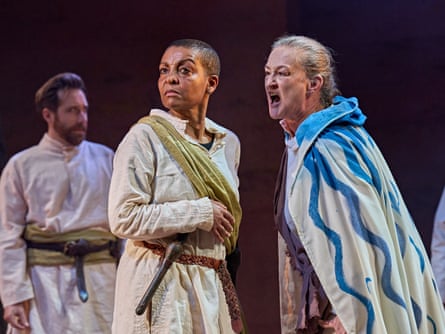
Politics were at the heart of her Richard II at the Globe, a study of what Shakespeare’s love letter to England could illuminate a time of “violent national paroxysms” in the aftermath of the Brexit vote to quit the European Union. The poster showed Andoh, a shaven-headed Black woman, against the backdrop of the flag of St George. She conceived, co-directed and starred in the first all-women-of-colour version of the play staged in Britain.
It was a deliberate statement that there is no dearth of talent, only a dearth of imagination among the hirers and firers in the industry. “We all cried because it was like, I don’t have to be the only one in the room,” she recalls. “Imagine that all the work you’ve ever done as a journalist, you’ve always been in newsrooms with writers of colour every day or you’ve been in the newsrooms where you’re the only man. You have to think of yourself in a slightly different way, because you can’t just go in and be a journalist.
“You have think about, ‘Oh, am I being too blokey?’ Just stuff that you don’t need in your head, and so I wanted us to have the opportunity to not have that in our heads. We could just go and be, and be a great stage manager, or be a great assistant director, or voice coach, or actor, or composer, or whatever it was you were doing, and also know that you were working on a project where your excellence, your stagecraft, your comedy, your line delivery, your design absolutely would be scrutinised but there would be a whole gang of you and you were all working to be great.”
But the politics of identity-conscious casting have never been more complex. In 2023 Andoh directed and starred in Richard III at the Liverpool Playhouse and the Rose Theatre Kingston with little controversy. A year later Michelle Terry, the artistic director of the Globe, faced a critical backlash when it was announced she would play Richard III, with actors and disability groups objecting that the role of the “deformd, unfinish’d” king should go to a disabled actor.
What are Andoh’s thoughts? “Richard III is somebody in Shakespeare’s original conceiving with a physical disability to which is ascribed all sorts of malicious qualities. If you punch down on somebody for something that is not of their own choosing, what happens when they punch up? All we did with our production was we said the thing that is going to be singled out is the quality which they can attach mal-intent to is going to be race rather than a curved spine.
“Keep everything else the same. Don’t change the language. Just have that person be the only person with that physical difference from the rest of the cast and interestingly, in our production, the actress playing my mum is deaf and has restricted sight. We had an actor who has a physically differently abled body and we had another actor who was very hard of hearing. But that wasn’t the story that I was telling. They were just great actors so I wanted them in the show.”
Another current debate revolves around whether LGBTQ+ characters can and should be played solely by LGBTQ+ actors. Andoh continues: “The point is that for so long gay characters were not played by gay actors. It feels like it’s a push into something much more stringent, but what it is, is just the effort to rebalance and then from there forward, everybody should be able to do whatever they’re gifted to do. But I do understand that sense of rebalancing.”
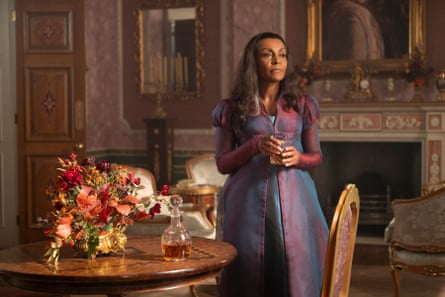
The rebalancing is evident in Bridgerton, the Netflix hit set during the Regency era in London with a more racially diverse cast than might have been found in such a show a generation ago. Andoh plays Lady Danbury, a sharp-witted feminist matriarch.
As a history-lover, and the daughter of a retired history teacher, “I always felt sad that there would be historical dramas and I wouldn’t necessarily get a shout in them,” she says. “Hooray for things like being able to do classical theatre, but it wasn’t translating into contemporary iterations of historical drama. What Bridgerton has done is change the zeitgeist of casting.”
While fictional, Bridgerton is actually rooted in histories that were “hidden in plain sight”, she continues. Andoh cites the example of Dorothy Thomas, an enslaved woman who bought her own freedom and that of 20 family members, eventually petitioning parliament over unfair taxation and having an affair with Prince William, the future King William IV.
“There’s no judgment on it. It’s just information. We need to know all the history so we’re not freaked out by the bits of history we thought weren’t history, so we don’t feel like, ‘Oh, it’s the woke brigade just slamming us with their blah blah blah.’”
But a “war on woke” is under way on both sides of the Atlantic. The election of Donald Trump in 2024 signalled a backsliding. The US president has purged diversity, equity and inclusion (DEI) programmes in the federal government and put pressure on companies and museums to do likewise. The Black Lives Matter Plaza outside the White House has been torn up and erased. Trump continues to hammer transgender rights at every opportunity.
Andoh says: “DEI has been rescinded in lots of areas in the state but also in the corporate world and in lots places. While we’re wringing our hands about Jeffrey Epstein, as well we should be, there are areas where that DEI would have been supportive of women in the workplace and maybe they’re not being so supported.
“If you live in a world where there’s winners and losers, if you’re asking for equality, you’re asking for winners to be less winny and that’s going to hurt some people and they will have difficulty with that. People always want to be in less difficult circumstances and so if the opportunity arises to ease that burden on them, they will take it.”
Andoh is co-director of the production company Swinging the Lens, which seeks to uncover marginalised histories and present familiar narratives through fresh, inclusive perspectives. Her keen awareness of the “silo of race” – what she calls a frustrating “accident of my birth” – is deeply rooted in her childhood.
Born to a white British mother and Ghanaian father, she grew up in Leeds before her father moved the family to a small village in the rural Cotswolds in the late 1960s.
Life in Wickwar in Gloucestershire was like living in the pages of Cider With Rosie, Andoh recalls – self-sufficient, quiet and deeply communal. Her father served on the parish council and played in local folk bands, but for a mixed-race girl with a thick Leeds accent, it required resilience. “You had to be a tough nut out there,” she notes, adding she survived by being “biffy” and making people laugh.
Salvation, and a vision of a future she had not dared imagine, arrived on a wet, midweek afternoon in 1979. As a 16-year-old dealing with anorexia and the painful fallout of her parents’ divorce, Andoh attended a Bristol Old Vic matinee of David Hare’s Plenty, starring Kate Nelligan.
Watching Nelligan portray a former French resistance fighter suffocating in postwar London, Andoh sat in the dark and sobbed. At last Sunday’s lecture, she recalled: “There was a magic happening in that theatre space, a conversation between the writer, the actor and me that had transported and transformed me. I came to understand that perhaps the theatre was the place I could exercise my gift, be myself, lost in other characters.
“Kate Nelligan’s performance that wet midweek afternoon matinee signalled the future course of my life and lifted me out of my deep sadness. When I teach drama students I often ask them to think of the transformational power of their gift. Never phone it in. Engage seriously in their playing because they might never know which wet midweek afternoon a soul in need may sit in front of them, in the dark, longing to connect.”