3 months ago
334
3 months ago
334
Industry is not for everyone. Mickey Down and Konrad Kay’s drama about young City bankers is zeitgeisty, iconoclastic and slightly inaccessible. “It is niche,” says Down. “We don’t write to any kind of brief. We don’t write what we think is going to be interesting to other people – or commercial.” For every 10 people that don’t understand a “reference or the thing we’re trying to do with the costume or the subtle hint we’re making about someone’s class, there’ll be one person that gets it. The show’s for that one person.”
And for that one person, Industry is hard to beat. “Not to toot my own horn,” says Myha’la, the mononymous 29-year-old who co-stars as daredevil American trader Harper Stern, “but I think there isn’t anything better than this show out there right now.”
I – and many others – agree. Since its 2020 debut, the BBC-HBO co-production has evolved from an intriguingly cool chronicle of trading floor hierarchies and after-hours hedonism into a kaleidoscopic and mercilessly entertaining study of money, status and power in the UK. Along the way it accrued huge acclaim – in 2024, the New Yorker called it “the most thrilling offering currently on TV” – and a hardcore cult following (see: feverishly updated subreddit IndustryOnHBO). Down and Kay have hypothesised that US viewers – who by series three were numbering 1.6 million per episode – appreciate its insidery portrait of British society precisely because they struggle to understand it.
Like all great modern TV shows, Industry is a star-maker. “I don’t know where I would be without Industry,” says Marisa Abela, who last year won a Bafta for her astonishing performance as Harper’s privileged Pierpoint & Co colleague Yasmin Kara-Hanani. Abela, also 29, was cast straight out of drama school and went on to lead Sam Taylor-Johnson’s Amy Winehouse biopic; more recently she featured alongside Cate Blanchett and Michael Fassbender in Steven Soderbergh’s spy caper Black Bag. Most of the unknown young actors who played Industry’s original cohort of graduate bankers are now making waves in Hollywood, including former cast members David Jonsson (a Bafta rising star award winner whose credits include Alien: Romulus) and Harry Lawtey (Joker: Folie à Deux; the upcoming Billion Dollar Spy alongside Russell Crowe). “I feel like this show is beloved by our industry,” says Myha’la, who can currently be seen in Gus Van Sant’s Dead Man’s Wire. “If I go to LA and take a bunch of meetings, this is the thing that people talk about.”
With its jaw-droppingly scandalous sex-and-drugs-strewn action and unusually complex subject matter, the show has given its excellent cast ample opportunity to prove themselves on screen. Yet, as all true heads know, the real stars of Industry are behind the scenes.
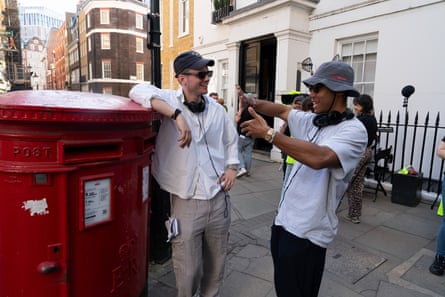
I meet Kay, who is 37, and Down, 36, on a July evening in a studio complex on the outskirts of Cardiff, where Industry’s fourth series is being filmed. The pair – who became friends at Oxford university and both briefly worked in banking themselves – possess the same profound self-assurance and jargon-littered conversational style as many of their characters (Sagar Radia, who plays hilariously crass trader Rishi Ramdani, describes them as “incredibly intelligent” and “massively high achievers”). It has been a long day on set – I’m tired, so they must be exhausted – yet Kay and Down, who is dressed in Patagonia Industry merch (a special edition just for the cast and crew, sadly – although you can buy Pierpoint mousemats from the HBO online store), betray no sign of fatigue when talking up their next chapter.
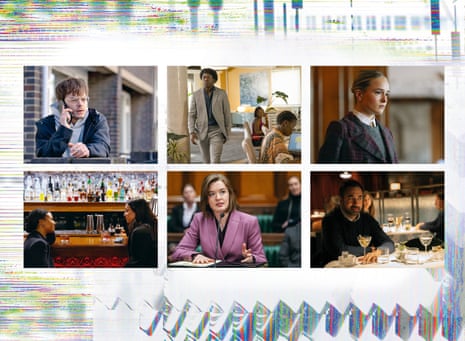
Series four, the creators insist, will be more expansive and electrifying than ever before. Considering the last outing involved Yasmin witnessing her publishing magnate father drown after throwing himself off his luxury yacht and Rishi pursuing a lifestyle so debauched it resulted in his wife’s murder, that’s a big promise.
In some ways, it’s a fresh start. Last time round, Industry lost its centre of gravity: the London offices of Pierpoint & Co were shuttered after the bank was sold to Middle-Eastern investors. Kay and Down’s first job was to ensure their dual protagonists Harper and Yasmin kept crossing paths; their solution was to introduce a dodgy payment processing company called Tender, which both women see as their ticket to establishing themselves in finance’s new wild west (albeit in vastly different ways).
It’s a setup that allows the show to ricochet between Paris, Ghana, New York, Sunderland, an Austrian castle and a London council estate, introduce a host of new cast members (including Max Minghella, Kiernan Shipka, Charlie Heaton and Toheeb Jimoh) and mull on themes including fraud, fascism (“the march of populism in Europe” had the pair wondering which characters “might be drawn to that sort of philosophy?”), investigative journalism and the current predicament of the Labour party. “The best version of Industry would be a Tony Gilroy script directed by Michael Mann,” says Kay, referring to the writer of Michael Clayton and the Bourne franchise, and the director of Heat. “And that is what we tried to do in season four.”
As Industry’s popularity ramped up, Kay and Down became figures of fascination: here were two TV newcomers who had been allowed to make a wildly ambitious drama for the planet’s most prestigious television network. Previously, their highest-profile gig had been writing on the 2015 David Hasselhoff TV mockumentary Hoff the Record. How on earth do you go from that to your own HBO show?
“A massive amount of luck,” admits Down. But also “a lot of it is grit. A lot of it is schmoozing.” Industry was commissioned at a time – now gone – when streamers and networks were throwing money at risky new programming. The pair happened to enter the orbit of British producer Jane Tranter “at the exact right time; she had this deal with HBO [to make a show about young people in the City] and there was an appetite there to do smaller stuff with creators that had no experience.” Kay and Down are patently well-connected – their Instagram stories feature them decks-side in Ibiza clubs or on shooting weekends in the country – yet this apparently wasn’t much help in the world of television. “I had loads of nepo credentials when I went into banking,” says Kay. “In TV I had to start at the bottom of the ladder.”
Kay and Down’s careers may have benefited from the whims of streaming-era TV, but they buck all its most uninspiring trends: there are no big-name stars (the only celebrity attached to series one was Lena Dunham, who directed the first episode) and no existing IP. The show is so fast-paced and elliptical that you can’t afford to lose concentration for even a second; this is not background content to second screen to. While “the hallmark of peak streaming is to take a one-hour idea and make it an eight-hour idea”, says Kay of the saggy comedies and bloated dramas that now crowd platforms. “We almost take an eight-hour idea and make it a one-hour idea.” Industry offers “a real hit of proper entertainment” at a time when “the discipline of writing hour-long TV has fallen away”.
Aside from its running time, Industry is hard to categorise. The only real analogue I can think of is Succession, another HBO show filled with worldly, machiavellian characters talking shop impenetrably. “I honestly think they’re nothing alike,” says Kay. “Succession is like an hour-long sitcom made on a very high production value.” He uses The Sopranos as an example of the kind of genre-defying TV he hopes to make. “It’s a familial saga, it’s a crime drama, it’s a satire of America.” (“I’m not comparing our show to it,” he clarifies.) Industry is just as stylistically eclectic, and the pair eagerly reel off classifications that could apply to series four: neo-period drama, pure satire, slapstick comedy, espionage thriller and “dry procedural deconstruction of finance regulation in the UK”, half-jokes Kay.
The pair are clearly uncompromising, but not exactly control freaks. Before our interview, I observe Kay and Down watching Abela assume the foetal position on a set resembling an eye-wateringly lavish Paris hotel suite. Yasmin spent Industry’s third series haunted by her father’s legacy of abuse and professional malpractice; here she was listening, masochistically perhaps, to his final voicemail. Sitting next to each other in director’s chairs, Kay and Down muttered approvingly about the framing of the shot; how the enormous set of glass doors resembled a prison or a gilded cage. At one point, Abela began to question why Yasmin was playing the message on a speaker; soon she was vociferously challenging Kay and Down on the logic behind her character’s decision to return to the voicemail in the first place.
Abela laughs when I remind her of this moment a few months later. “We did have quite a bit of back and forth. I think I was craving guidance.” Sometimes, she says, sitting at her kitchen table in a sweatshirt, the pair will “write a scene and be like: ‘We don’t really know what this is. We’re excited to see what you think it is.’ And I’m like, ‘Right …’” Generally, however, this level of collaboration “is a great thing, they trust me as an actor”. Radia agrees. “I’ve been on shows before where producers and writers don’t really want to hear from actors.” Yet with “the boys” – as he refers to Down and Kay – its “always best idea wins”.
Aside from replacing Pierpoint, series four’s other major headscratcher was Rishi. He started life spewing provocative banter in “deep background”, says Down, a way to give authenticity to the trading floor (“Get a new suit,” he tells Lawtey’s Robert in the first episode. “You look like fucking Neo”). Yet Radia’s impressive performance and flawless comic timing meant that by series three he’d been given his own intensely disturbing story arc that melded his addiction-ravaged psyche with themes of fatherhood, money and class and culminated in his wife being shot in the head by a disgruntled loan shark (People Just Do Nothing’s Asim Chaudhry). Writing the character out of this scenario was a “major challenge”, says Down. “Is he able to repair himself or has he been broken for ever? That’s his story in season four.”
If Rishi was already beyond redemption, Yasmin is in a more ambiguous place. Last time we encountered her, she had chosen an essentially transactional marriage with Sir Henry Muck (Game of Thrones’ Kit Harington) – a troubled scion of an upper-class family who dabbled in politics after selling his green energy company – over the besotted Robert. Now she’s struggling to adjust to upstairs-downstairs conventions while masterminding her husband’s next act. Yet her networking gets her into extremely murky moral territory, and Abela is struggling to empathise with her character for the first time. “I’ve always said that I completely understand Yasmin,” she says. Yet “when someone behaves in a way that you personally couldn’t fathom, you’re obviously working harder to fathom where that desire is coming from”, she says, expertly dodging spoilers.
As for Harper, she seems to be in her imperial phase, back in business as her own boss after bowing and scraping to hedge-fund bosses for most of series three. Myha’la is enjoying “a return to the jargon; I was really looking forward to getting my mouth around those words again.” Sartorially speaking, the costume department used 1990s MP Martin Bell as inspiration for this new era (I can’t say I could detect the influence, but it’s nice to know it’s there).
With Robert and Jonsson’s Gus gone, Industry has ended up being “about two young women in finance. That is not how it was packaged to the world, or probably to the network either,” says Abela. “It was a bit of a Trojan horse into finance bros’ living rooms.” In her experience, female dialogue is “nine times out of 10 the first thing to go” when time or money runs low on a film or TV set. “Mickey and Konrad are the opposite of that. They really love listening to women talk and don’t think for a second that something has more weight because a man is speaking.”
This keen sense of observation shows: at the heart of Industry is Yasmin and Harper’s twisted yet bizarrely relatable love story. The pair “need each other in a really bastardised way, a way that is really reflective of so many women friendships”, says Myha’la. There is something classically neat, almost Shakespearean, about their dynamic of mutual envy. “Harper resents Yasmin’s wealth, her status, her choice to use her femininity as a weapon,” says Myha’la. Yasmin, meanwhile, covets Harper’s “gravitas and capacity to make people hear her when she speaks in a professional setting”, says Abela.
It is also a show that is incredibly effective at dramatising the insidiousness of patriarchy, a theme Yasmin’s fancy dress repertoire (Diana, Marie Antoinette) gestures to. Her fatal flaw is her addiction to male validation – “a losing battle”, says Abela. She needs men to adore her and tell her she’s “useful. And when they don’t, she’s back at ground zero every time.”
This is the foremost tragedy of Industry, although there are plenty of others: Henry’s childhood trauma and subsequent mental health issues are the subject of a devastatingly beautiful upcoming episode.
The show is also darkly funny, although it doesn’t quite qualify as satire. While Industry’s bankers do bad things, this is not an indictment of their jobs; Kay and Down had little compunction about working in finance themselves (“the only thing that was ever grotesque for me was the idea that people could take outside risk and then lose huge and expect to be bailed out by people who have nothing to do with that business”, says Kay). In series three, Pierpoint’s sale negotiations were soundtracked by Rage Against the Machine’s Bombtrack (“Dispute the suits, I ignite and then watch ’em burn”). Some believed the show was repurposing the song “to celebrate capitalism. I think it’s such a reductive reading”, says Kay. “The show is of course a weird celebration of [these characters’] lives and the way they choose to live. It’s also a damning indictment of that business, people who go into it, the way we structure society, all of that stuff.”
Really, Industry’s most pervasive motif is what happens when the transactional nature of finance bleeds into everything else. “If you reduce everything to the quid pro quo of market logic – which is like: what can I get out of you and what can you get out of me? – then what happens to your own humanity, your ability to be vulnerable, to empathise?” says Kay.
Behind the show itself is one such reciprocally beneficial professional relationship – but Industry is so much more than just business. Kay and Down are obviously devoted to their brainchild: the only other project they’ve been connected to, a reboot of swinging 60s TV series The Avengers, is no longer happening, and they instead seem content to put all their energy into Industry. You can understand why: the show is their communal mind writ large on screen; the product of the friendship of a lifetime. “I spend as much time with Mickey as his wife,” says Kay. “Of course he annoys me. I annoy him. But what I really love is at the end of the day, I’ll get into a car with him and still be grateful that it’s just me and him and we can talk about everything.”
Series four of Industry is on iPlayer from 12 January, and BBC One, 12 January, 10.35pm.