2 months ago
110
2 months ago
110
‘This conversation’s too big for a phone call,” sings Lily Allen on her new album, West End Girl. Maybe those conversations are too big for its 14 tracks as Allen is in discussions about turning the album’s painful account of uncovering infidelity into a play. The singer has just completed a tour of theatre venues, performing West End Girl in its entirety, culminating in last weekend’s shows at the London Palladium. Those gigs give a tantalising idea of what a fully fledged stage adaptation could look like.
Allen’s semi-autobiographical album has theatre at its core – even the songs’ visualisers feature pierrot costumes and a St Martin’s Lane marquee with a tongue-in-cheek nod to The Importance of Being Earnest. The plot includes her being cast in a West End production (mirroring her assured debut in 2:22: A Ghost Story in 2021) and while she is hardly the first pop star to do theatre, it’s still refreshing to hear the line “I got the lead in a play!” on an album.
West End Girl presents not a backstage drama but the implosion of a marriage in forensic detail. And it does so through songs that reveal a mastery of dialogue, characterisation and narrative. Allen has said she was inspired by the cinematic storytelling of Mike Skinner on the Streets’ album A Grand Don’t Come for Free; West End Girl can be considered a theatrical equivalent.
The first song already turns into drama halfway through. After Allen breezily recounts settling into a new life in the US, the lush harmony begins to falter as her partner rankles at that job offer (surely she’d have to audition?). As with their ensuing phone call, we never hear him speak yet Allen skilfully makes his tone clear from the hurt and frustration in her voice, and the silences when she listens to him have an emotional charge. Later we more fully understand that he’s suggesting they open up their marriage – without being open about his philandering, as represented by the immortal image of a bag from the US pharmacy Duane Reade with “sex toys, butt plugs, lube inside” and the introduction of the mysterious Madeline.
Which leads us to the nuts and bolts of the potential play …
Dramatis personae:
Lily, performer, almost nearly 40, just shy of 5ft 2in
He Who Shall Not Be Named, manchild husband with a double life
Madeline, the other woman, giver of “love and light”
Lily’s children
Settings to include:
New York brownstone on “the perfect street”; London hotel room; Pussy Palace (not dojo).
Allen could choose to adapt the album as an intimate monologue, keeping all the immediacy of the songs, which are almost entirely addressed to her ex. In a bare-bones, stool-on-stage type setting she might either play all the roles or keep the drama in her own voice. That approach would match the concentrated force of the album, whose sense of outrage and fury at times resembles Sarah Manguso’s novel Liars – similarly written rapidly in the aftermath of a breakup.
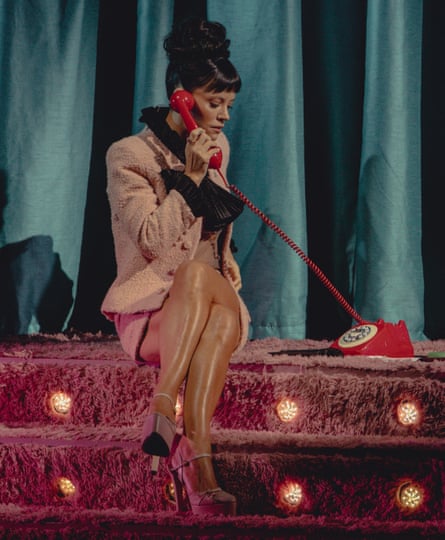
In her tour, Allen sang the album in its entirety, with the songs in sequence. That’s not unusual for musicians (especially on the nostalgia circuit) but she gave the evening a distinctive two-act structure with an interval. She sat out the first half as a series of her earlier songs were performed by a string trio (Amy Langley, Jess Cox and Klara Romac). Then she stepped out on stage from behind closed curtains, singing the title track that is stalled by the ringing of a retro red telephone.
As a regular theatregoer who rarely goes to gigs, I was taken aback by what happened next. Parts of the set encourage a singalong (“da-da-da-da-da-da-da who’s Madeline?!”) but when Allen acted out the scene – in a show based on her own trauma – she was drowned out by disrespectful interruptions (albeit with supportive messages) from the audience.
Allen’s fans have charted her ups and downs in her personal lyrics for years and they come at these new songs from a particularly intimate perspective thanks in part to the Architectural Digest video (more than 9m viewers to date) in which she and her now estranged husband David Harbour show off their Brooklyn townhouse. It is hard to hear these songs about domestic agony without picturing that garden room with the double-sided sofa, the bathroom furnished with what Harbour calls a “fridge from outer space” and a peculiarly window-less bedroom.
The West End Girl tour was designed by Allen’s co-creative director Anna Fleischle, who also created the set for 2:22 – a haunted house in the process of gentrification, peeling wallpaper on one wall and luxury kitchen on the other. Fleischle’s concert set slowly reveals itself, with a different mise-en-scene for most numbers and often a new outfit too (styling by Mel Ottenberg). There’s an elegant chaise longue, soft lighting and diaphanous negligee for the delicate, disorientated Sleepwalking and some inventive videography, with an illusory effect of arms caressing her back, for Tennis.
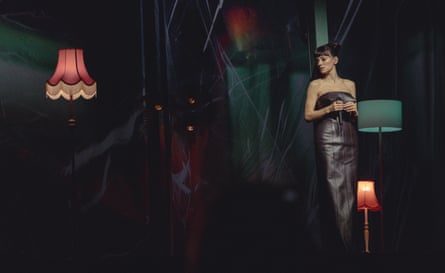
“Duane Reade bag with the handles tied” may have become a mischievous meme but when Allen itemises its contents, unpacking a luridly coloured dildo and condoms, it’s staged as an appropriately sad and grubby discovery. Mind you, there are butt plug-shaped, polka-dot USB drives on sale at the merchandise stall. The album’s sardonic humour could come to the fore in an adaptation, bringing more light alongside the shade. In her concert, the song Dallas Major – in which she uses an alias for online hookups – is a welcome blast of comedy, Allen looking at her most relaxed all night. There’s no banter in between the songs as there usually is at her gigs, which she has likened more to standup.
Some passing theatrics include gun fingers and flickering stage lights for the shots fired in the Morricone-like track Madeline. Relapse is delivered with a raw realism that’s hard to watch. And there is a spectacularly realised sequence for the song 4chan Stan with its blissfully sweet high notes and sour discoveries. She appears dressed in a huge sheet printed with receipts, after finding the credit card expenses of her partner’s affair. Ramping up that approach would give more of a performance art result.
The album’s cover art by Nieves González – now on display in the National Portrait Gallery – blends modern and baroque, which could provide another way forward. Matthew Dunster, who directed Allen in her three plays, knows his way around the classics – their last collaboration, in 2025, was a Hedda Gabler brought bang up to date. Adapting the album as a drama with supporting actors raises intriguing ideas about casting – Dakota Johnson made an airy Madeline reclining in the background when Allen performed on Saturday Night Live. Would the play keep the album’s linear narrative? Some of the best plays about breakups – such as Pinter’s Betrayal and Jason Robert Brown’s musical two-hander The Last Five Years – disrupt their timeframes.
Whenever (if?) the play arrives, it will certainly attract new audiences to theatre – always a good thing – and would be a welcome change from all the films and TV series on stage (Harbour’s Stranger Things and all). Who knows, it may even spark a trend for album adaptations. With her own skill for storytelling and characterisation, maybe we could have an Ethel Cain play next?