2 months ago
81
2 months ago
81
An artist and beekeeper from a remote corner of the Andes has won one of the UK’s most prestigious contemporary arts awards and plans to spend the £40,000 prize on building a cultural centre in the Peruvian mountains.
Antonio Paucar was declared the winner of the biennial Artes Mundi prize after presenting work ranging from a spiral made of alpaca wool to a video of him writing a poem – in his own blood – about the environmental crisis facing his region as he sits at a table high in the mountains.
The idea of the Artes Mundi prize, which is based in Wales, is to highlight the work of talented but largely unrecognised artists from around the globe and take their pieces around the country. The work of six artists is being shown at five galleries dotted across Wales.
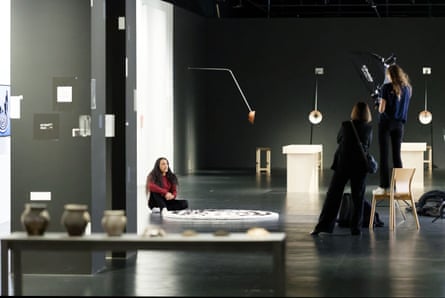
Speaking to the Guardian in Cardiff before the prize ceremony, Paucar said: “I didn’t expect it. The journey of an artist is very difficult. For me this kind of recognition is very important for my region, my country, my culture. It gives me strength to continue developing new projects.”
Paucar comes from the village of Aza, near Huancayo, in the Junín region of central Peru, where his family make traditional figures and masks. He worked as a beekeeper in the highlands of Peru before travelling to Berlin to study art.
He now splits his time between making art aimed at highlighting environmental issues and helping to preserve his culture and language – and looking after bees. “I have a countryside kind of life: we keep hens and grow vegetables,” he said.
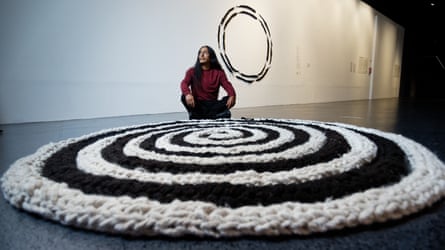
Among Paucar’s work on display at National Museum Cardiff is a spiral made out of black and white alpaca wool, La Energía Espiral del Ayni.
Paucar said: “Ayni is a Quechua word. It represents an Andean concept, a way of thinking, the idea that everything is linked. It has allowed people in the Andes to maintain a balance with nature. If the mountains give us food and life, we also have to give them life. Life is not linear like the European way of thinking. It’s not that we are born here and die here. We are circular.”
When he collected alpaca wool from the mountains, Paucar was surprised how difficult it was to find black wool. “I thought it was important to have black and white wool. It was easy to find white wool because in the textile industry there is a demand for white because it can be dyed. The black colour is disappearing.”
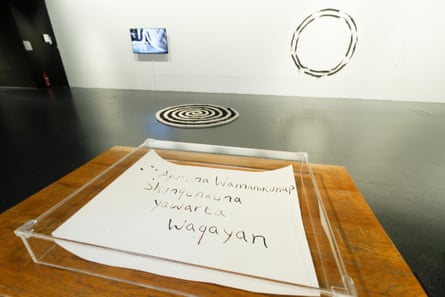
Another work, El Corazón de la Montaña , features a video of Paucar sitting at a desk in the mountains, writing with blood drawn from his body. The message he wrote highlights the climate and pollution crises: “The glaciers in the Andes are crying/With their mournful cry they melt forever.”
One of his pieces on display at Mostyn, Llandudno, in north Wales, features the imprints of Paucar’s footprints on the wall. He tramped over the nearby limestone headland Y Gogarth (the Great Orme) in his bare feet and then performed a handstand back at the gallery. His feet came to rest on the wall, leaving a ghostly imprint.
Paucar said he had seen parallels between Peru and Wales. “The Celtic culture was very linked to nature. That is also the case with the Andean culture. Maintaining the language is also important in Wales and where I am from.”
Not all of his work has been universally well received. The Guardian’s art writer Jonathan Jones was no fan of a video shown at Mostyn of Paucar burying and burning a reproduction of Marcel Duchamp’s 1913 artwork Bicycle Wheel.
Jones wrote: “A performance attacking an icon of western art only makes sense to those in the know.” Paucar said he respected Duchamp and the piece was a reference to a wheel he had played with as a child.
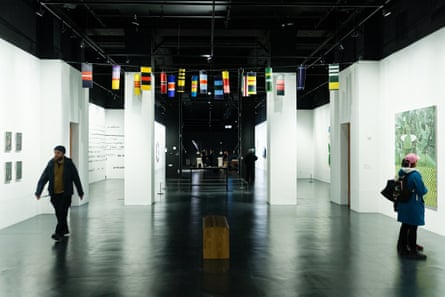
The director of Artes Mundi, Nigel Prince, said as many as 150,000 people were expected to have seen the work of Paucar and the other artists by the time the exhibition ended.
Prince said it was positive that parallels between Celtic western Europe and the Peruvian Andes had emerged. “We are really interested to focus on things that bring people together,” he said. “In today’s global context, where there often can be an emphasis on focusing on difference as a means to divide and rend apart, I actually think that opens up a sort of sharing and a dialogue.”
-
Artes Mundi can be viewed at five galleries across Wales until 1 March 2026.