3 months ago
100
3 months ago
100
At half-time in the Carabao Cup final, Arsenal’s hopes of a quadruple remained strong. They were unbeaten in 14, 11 of them won. They were drawing 0-0 against Manchester City and it wasn’t unreasonable to think that if the second half carried on as the first half had, they would eventually find a winner – quite possibly from a corner.
They had drawn a Championship side in the sixth round of the FA Cup and a Portuguese side in the quarter-finals of the Champions League. They held a nine-point lead in the Premier League. This was shaping up to be the greatest season in Arsenal’s history.
That was four weeks ago. There remains a possibility of a Premier League and Champions League double, which would be remarkable enough, but the mood is very different now. This could become the most disappointing season in Arsenal’s history, if only because they came so close to winning it all.
Something changed at half-time at Wembley: Pep Guardiola stopped his City side pressing so high. Arsenal’s defenders found themselves with time on the ball but only each other to pass to. Jérémy Doku, Erling Haaland, Rayan Cherki and Antoine Semenyo formed a sky-blue line across the pitch, denying easy passes into midfield. Bernardo Silva and Matheus Nunes sat a little deeper, poised to pressure any ball out to the full-backs. Rodri controlled everything from the centre. And Arsenal couldn’t get out. City kept regaining possession and, with Nico O’Reilly encouraged to surge forward and infield from left-back to create an extra man in attack, Arsenal wobbled.
The thought had been that with David Raya back in goal in place of Kepa Arrizabalaga, Arsenal would be able to play out more easily, his long-passing ability allowing him to transfer the ball over the press to an advancing full-back or wide player. But when Bournemouth adopted a similar pressing approach last Saturday with Raya restored in goal, the effect was similar. Arsenal became bogged down, forced to go back to their goalkeeper so often that Raya ended up attempting 59 passes; Declan Rice, with 60, was the only Arsenal player to have more.
Other sides perhaps could simply go long to evade the press – as Guardiola once did at Bayern Munich, deploying Javi Martínez at centre-forward in a German Cup game against Jürgen Klopp’s Borussia Dortmund – but there is a need for a target man to win flick-ons if others are getting up to run beyond him, or to hold the ball up.
Viktor Gyökeres simply isn’t good enough at that side of the game, either in terms of using his body to shield the ball or controlling passes hit towards him at awkward paces or heights. Play the ball long to him and, very often, all Arsenal are doing is squandering possession.
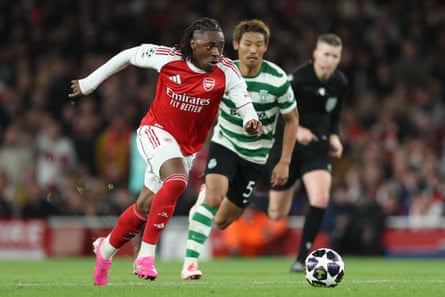
That might explain why Gyökeres was removed after 56 minutes against Sporting on Wednesday, giving Kai Havertz time to refamiliarise himself with the role of a centre-forward. He spent the first 23 of those minutes with Eberechi Eze operating as a central creator. Eze came off the bench against Bournemouth having not played for almost a month but, depending on fitness, he could be the player to restore spark to an Arsenal forward line that has looked pedestrian arguably since the win over Tottenham at the end of February (and as subsequent events have suggested, looking lively against Tottenham maybe isn’t the feat it used to be).
Arsenal played a 4-2-3-1 in the Carabao Cup final, but with Gyökeres at centre-forward and Havertz in the Eze role. That is, clearly, a risk and Arteta would almost certainly prefer to have the greater security of Martin Ødegaard in a three-man midfield along with Martín Zubimendi and Rice. But the Norwegian’s fitness is uncertain and, besides, if Arsenal have the same problems breaking the press that they did in the Carabao Cup final, adding a passer to midfield is of limited value.
Although this City are a long way from the classic Guardiola model, it feels as though Arsenal will be best served following the old‑fashioned way of setting up against a Guardiola side, sitting deep and looking to absorb pressure then striking on the break – the complete inverse of the league game between the sides at the Emirates in September, when City had only 33% of the ball, a record low under Guardiola by a massive margin.
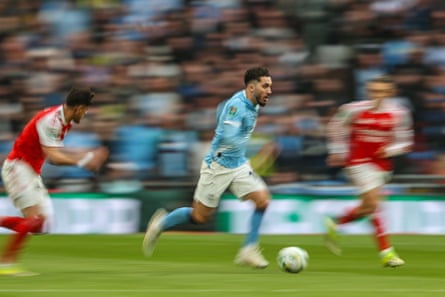
Shutting City out is key; on this occasion, given context and form, a 0-0 draw would be a very good result for Arsenal (albeit in-game events could change that assessment). And a clean sheet means Arsenal only have to be successful with one corner, the area in which they remain global leaders.
Since that game in September, City have become more focused on possession, Phil Foden and Tijjani Reijnders have dropped out of the side and Semenyo and Cherki have become increasingly prominent. Cherki, in particular, feels an unlikely Guardiola player; the City manager, indeed, has acknowledged the tension between his instinct for control and the improvisational nature of the 22-year-old, while appreciating that, for instance, the second City goal against Chelsea last week would not have happened had Cherki played the safe pass.
One of the fascinations of Guardiola recently is how he has embraced tension. The dabble with Jack Grealish has been continued with Doku and now Cherki, Guardiola apparently happy to give each new improviser greater freedom (and Grealish, for all his subsequent loss of form, was a key figure in the treble season before seemingly becoming caught in a spiral of second-guessing).
It’s Arteta now who is the stickler for control, which itself may make it harder for his side to clamber from their slough of self-doubt. Instinct has been sublimated to the blueprint, and that perhaps makes it harder for individuality, the survival reflex that can grab a game by the throat and force it to a player’s will, to assert itself.
Football is a game of almost infinite interlocking balances. Plan, or allow the players to improvise? Arteta has elevated Arsenal through meticulous preparation and by following the data, but if the strategy is safe passes and the opposition shuts down your options, what do you do? Resolving that is the key to Sunday’s clash and, probably, the title.