3 months ago
136
3 months ago
136
Ian McEwan’s novel begins with a play. It is written by 13-year-old Briony Tallis, who has a gift for telling stories. It is perhaps appropriate that Briony’s tale – the one she is constructing through the course of McEwan’s novel – has been adapted for the stage itself now, although it is a hard act to follow the magnificence of the book and also Joe Wright’s celebrated film starring Keira Knightley and James McAvoy.
The plot reflects on the healing power of storytelling but also its potential to cause damage and destroy. It opens in 1935 in an aristocratic English country home, when one evening, after seeing the housekeeper’s son, Robbie (Jasper Talbot), having sex with her sister, Cecilia (Miriam Petche), she wrongly accuses him of raping her 15-year-old cousin Lola (Yanexi Enriquez). Briony lives with the guilt of that lie long after Robbie has been sent to prison and then the frontline of the second world war.
Director Adam Penford’s production does a masterful job of transposing elements of the story to the stage through sound and design. Briony’s furtive spying on the couple is translated with a visually inspired spiral staircase and mezzanine floor on Anthony Ward’s glorious set, smothered in surreptitious shadow (lovely lighting by Aideen Malone) along with Alexandra Faye Braithwaite’s ethereal electronic score.
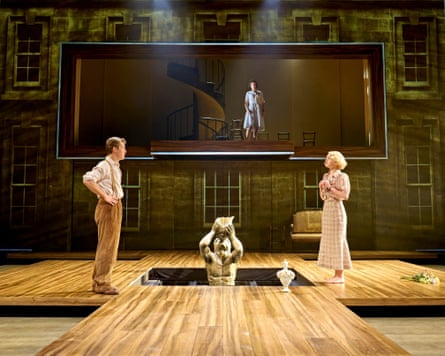
The acting is adept too; Isabella Dempster’s Briony is driven by a dangerous cocktail of imagination and self-importance, and her child’s understanding of Robbie’s sexual desire as violence or harm is well conveyed. Petche switches between vulnerability and brittleness, fully inhabiting the iconic green dress worn by Cecilia in her library encounter with Robbie when she could so easily appear like a paler version of Knightley from the film. Talbot, who last played Mick Jagger on this stage (with Alan Hollinghurst’s Nick Guest in between, at the Almeida in London) again showcases his versatility. The absence of Siân Phillips, originally cast as the older Briony but withdrawing for personal reasons, is capably filled by Jessica Turner.
None of it is quite devastating enough, though. The country-house drama of the first part flies, at least. The class difference between Cecilia and Robbie (the latter’s status wavering between servant and friend) is captured through the sexual awkwardness between them, and the sex scene in the library is done well. Class snobberies are more broadly caught with what seems like pointed casting of Black actors as below-stairs staff.
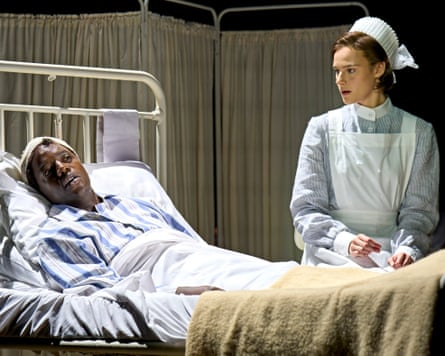
But it is harder to convey the passing of time across seven decades and the grind of war, especially the terror of Dunkirk. Briony throws herself into nursing injured soldiers as some kind of penance, but the scene in which she tries to console a French soldier who has part of his scalp missing does not carry the same power, or terror. Where Christopher Hampton’s screenplay (for Wright’s 2007 film), felt intimate, it is a little more distanced in this medium. We never get inside the heads of these characters, so do not get a full enough picture of Robbie’s rancour or Briony’s guilt, although Cecilia certainly expresses rage at her younger sister.
Explorations of truth and the consolations of make-believe seem subsumed by plot – and there is a lot of story to get through. So this production seems like a love story without a heartbeat and a synthesis of McEwan’s book, albeit a beautiful one at that.