3 months ago
146
3 months ago
146
Iranian lawmaker says Tehran will give a 'painful' response to Israel's attack on southern Beirut
Iranian lawmaker Ebrahim Rezaei said in a post on X on Sunday that Tehran will give a “painful” response to Israel’s attack on Beirut’s Dahiyeh southern suburb, after the Israeli military said it struck Hezbollah infrastructure in the area.
“We will deliver a decisive and painful response to the Zionist regime’s attack on Dahiyeh,” he wrote, going on to say that “rabid dogs must be disciplined and put back in their place.”
“Look at the sky over the occupied lands tonight,” he added.
Key events
Pete Hegseth dismissed concerns on the status of the US-Iran ceasefire while speaking to reporters.
“Of course it’s a ceasefire,” the US defense secretary said. He added that the US is “negotiating actively”.
“Things are happening, shipping is moving through,” he said. “Iran shouldn’t be shooting at it. And when they do, we take care of that as you would expect. But ultimately, we think a deal, a great deal, is likely coming soon.”
Iran's top negotiator threatens US bases and assets in the region
The US naval blockade of Iran and its green light on Sunday for Israel to escalate attacks in Lebanon make US bases and Israeli assets in the Middle East legitimate targets, Iran’s top negotiator said in a post on X.
The comments from Iran’s parliament speaker, Mohammad-Bagher Ghalibaf, follow Israeli attacks on the southern suburbs of Lebanon’s capital, a stronghold of Iran’s ally Hezbollah.
“They are neither committed to a ceasefire nor believe in dialogue, and through the naval blockade and violation of agreements regarding Lebanon they showed that they only understand the language of power,” Ghalibaf wrote, referencing the US and Israel.
Ghalibaf then claimed the latest military action turned US assets and bases in the region “into legitimate targets”.
Trump also said he and Israeli prime minister Benjamin Netanyahu remain on the same page during his Meet the Press interview, despite some disagreements arising over Israel’s military offensive in Lebanon.
“We get along very well,” the US president said. “We’ve been great comrades. We did a very, very big number on a certain country that was nothing but trouble for 47 years. I disagree with him on a couple of things.”
Earlier in the week, it was reported that Trump had angrily confronted Netanyahu over Israel’s threats to resume airstrikes on Beirut’s southern suburbs.
Donald Trump also aggressively pushed back against claims that he broke a key campaign promise to keep the US out of new foreign conflicts.
“Well, well, first of all, I didn’t guarantee no war,” Trump said during the Meet the Press interview. “Why would I have built the strongest military in the world?”
He continued: “I didn’t promise anything. I don’t like these endless wars. This is not an endless war. We’ve been doing this for three months.”
Trump did in fact campaign on promises that he would end wars rather than start them. During his 2024 election night victory speech, he said: “I’m not going to start a war. I’m going to stop wars.”
Trump also defended his military efforts in Venezuela and Iran during the interview by claiming they will not be as long-lasting as the US engagements in Iraq and Vietnam.
“We’re there for a few months,” Trump said. “And the threat is largely over. Soon, it will be over. But you cannot let Iran have a nuclear weapon, or they will blow you up.”
Donald Trump called for more “surgical” strikes against Hezbollah in Lebanon and said he is not demanding the conflict be included in a peace deal with Iran, during his Meet the Press interview broadcast on Sunday.
“I’d like to see a more surgical attack on Hezbollah. I think it should be more surgical,” Trump said, according to a transcript of the interview recorded Friday. “I’d like to see Lebanon have a better life,” he added.
Asked whether he was demanding that Lebanon be included in the Iran deal, Trump replied: “No, no.”
“Not at all. I’m not demanding,” he said. “I think they’d like to see it, but I’m not demanding.”
Trump has said previously that he would like to “separate” the discussions on Lebanon from the negotiations on an agreement with Iran. However, Tehran wants to link the conflicts.
Iranian lawmaker says Tehran will give a 'painful' response to Israel's attack on southern Beirut
Iranian lawmaker Ebrahim Rezaei said in a post on X on Sunday that Tehran will give a “painful” response to Israel’s attack on Beirut’s Dahiyeh southern suburb, after the Israeli military said it struck Hezbollah infrastructure in the area.
“We will deliver a decisive and painful response to the Zionist regime’s attack on Dahiyeh,” he wrote, going on to say that “rabid dogs must be disciplined and put back in their place.”
“Look at the sky over the occupied lands tonight,” he added.
Gaza’s health ministry said in its latest update that at least 10 people were killed and 36 others injured in Israeli attacks across the territory over the past day.
The health ministry says 961 people have been killed in Israeli attacks since the supposed ceasefire between Israel and Hamas came into effect in October 2025.
It says that 72,971 people, many of whom were women and children, have been killed in Israeli attacks across Gaza since October 2023, when Israel launched its assault on the territory following the Hamas-led attack on southern Israel on 7 October 2023, in which about 1,200 people were killed and 251 taken hostage.
Israeli attack on southern Beirut killed at least two people - report
The Israeli attack on Beirut’s southern suburbs (see opening post) earlier has killed at least two people and injured 11 others, according to Lebanon’s state-run National News agency, citing a preliminary casualty count. We have not been able to independently verify these figures yet.
IDF orders residents of Lebanon's fifth-largest city to evacuate ahead of attacks
The Israeli military has ordered residents of the southern Lebanese city of Tyre, nearby “camps” (al-Bass and Zakuk al-Mufdi) and “surrounding neighbourhoods” shown on the map below to immediately evacuate in advance of attacks against the locations.
Avichay Adraee, the IDF’s Arabic-language spokesperson, issued the social media warning, claiming the attacks are being launched due to Hezbollah violating the ceasefire agreement.
Allow content provided by a third party?
This article includes content hosted on platform.x.com. We ask for your permission before anything is loaded, as the provider may be using cookies and other technologies. To view this content, click 'Allow and continue'.
International law experts say Israel’s warnings are inconsistent and often overly broad and open-ended. Sometimes there is no warning at all before the airstrikes. More than 1 million people have already been displaced by the renewed Israeli war on Lebanon, triggering a major refugee and humanitarian crisis.
US says it destroyed two drones over strait of Hormuz
In a post on X earlier today, the US Central Command (Centcom) said it destroyed two Iranian drones “that threatened international maritime traffic in the strait of Hormuz”, hours after announcing it struck four other drones and coastal surveillance radar sites.
“American forces remain postured and ready to continue defending against Iranian aggression,” Centcom said in a short statement. It was the latest in a series of back-and-forth attacks that have strained the tenuous April ceasefire between Tehran and Washington and came amid stalled negotiations between the two sides, with neither apparently willing to make any major concessions.
Tehran effectively closed the strait of Hormuz – at least to countries it deemed “hostile” to its interests – soon after the US and Israel launched their war on Iran at the end of February. The US imposed a counter-blockade of ships using Iranian ports on 13 April.
Global energy prices have soared as a result of the effective closure of the strategic waterway, a crucial corridor for oil and natural gas shipments.
Trump says he would not unfreeze Iran's assets before peace deal is done
Donald Trump had an interview with NBC News’s Meet the Press, which host Kristen Welker said took place on Friday.
In the interview, Trump said he would not unfreeze Iranian assets or lift any sanctions before a peace deal is reached. “Comes after,” he said. “Yeah. If they behave, if they do a good job, we start talking. Yeah.“
Trump also said that he was not demanding that Lebanon be a part of a short-term deal with Tehran.
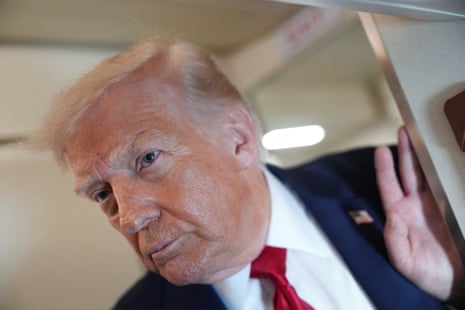
The US president also reportedly said he wants to keep US troops in the Middle East until “completion” and that the US will seize and destroy Iran’s highly enriched uranium, much of which is believed to be stored extremely deeply underground.
He said the US and Iran are close to making a deal, something he often repeats despite major sticking points remaining between the two sides: notably Israel’s continuing war on Lebanon, Tehran’s nuclear programme and the status of the strategic strait of Hormuz.
“We’re very close to a deal, or I’m going to blow the hell out of them,” Trump told NBC News.
Israel had already struck the southern suburbs of the Lebanese capital at least twice since the first agreement between Lebanon and Israel went into effect as part of the 17 April ceasefire, under which Washington sought to constrain Israel from striking Beirut in return for a halt in Hezbollah fire towards northern Israel.
Today’s strikes on Beirut are likely to derail US peace talks with Iran as Tehran has made it clear that Israel’s assault on Lebanon must stop for that conflict to end.
Despite being engaged in diplomacy with Lebanon, Israel is striking southern Lebanon and ordering mass evacuation orders on a near-daily basis.
Hezbollah, which has not been part of the direct negotiations with Israel, has fired rockets and drones into northern Israel and against Israeli troops in southern Lebanon as it rejects pushes for its disarmament and Israeli occupation of some of southern Lebanon.
Donald Trump angrily confronted Netanyahu over Israel’s threats to resume airstrikes on Beirut’s southern suburbs during a heated phone call last Monday, according to a report in Axios. It seems that the US president is, however, somewhat limited in his ability to influence Netanyahu’s military actions despite the US’s far superior military power.
At least 3,526 people have been killed in Israeli attacks on Lebanon since the start of the war on 2 March, according to the country’s health ministry. Israel’s renewed war on Lebanon was triggered in response to Hezbollah firing rockets at northern Israel after the US and Israel killed the former Iranian supreme leader in Tehran on 28 February.
Israel strikes southern suburbs of Beirut despite ceasefire agreement with Lebanon
We are seeing reports of Israeli attacks on Beirut’s southern suburbs, Dahiyeh, with at least three explosions heard so far. The Israeli military claimed about an hour ago in a post on X that it was striking Hezbollah infrastructure in the Lebanese capital, without providing evidence.
In a joint statement, Israeli prime minister Benjamin Netanyahu and the Israeli defence minister Israel Katz said the Israeli military had struck “terrorist” headquarters in Beirut’s southern suburbs in apparent retaliation for Hezbollah firing toward northern Israel earlier. This is in apparent defiance of a US request not to attack Lebanon’s capital.
Lebanon’s state-run National News Agency (NNA), meanwhile, said the Israeli attacks on the southern suburbs, where there is strong support for Hezbollah, the Iranian-backed Lebanese militant group and political party, targeted two apartments in two buildings. There has not been any official confirmation of any casualties or injuries.