2 hours ago
8
2 hours ago
8
The Berlin Philharmonic are in London tonight and tomorrow at the Proms, days after closing the Edinburgh international festival in thrilling style. It was their first visit to Scotland in over 20 years, but the orchestra and their chief conductor, Kirill Petrenko, are regular Proms visitors; their Royal Albert Hall concerts are always season highlights.
“The best orchestra in the world”, as it is often hailed, brings programmes that offer the expected and – for them – the unexpected. Tonight there’s Tchaikovsky’s Fourth Symphony paired with Elgar’s Enigma Variations, a piece that’s still an astoundingly rare visitor to this orchestra’s concerts; and tomorrow, the safety-first repertoire warhorse is Beethoven’s Violin Concerto, but it’s paired with Scriabin’s brilliantly unhinged Third Symphony.
But what does being the “best” mean? And how and why have the Berliners acquired, and held on to, their globe-topping orchestral reputation for so many decades, through changes of conductor and personnel, political upheaval and technological transformation?
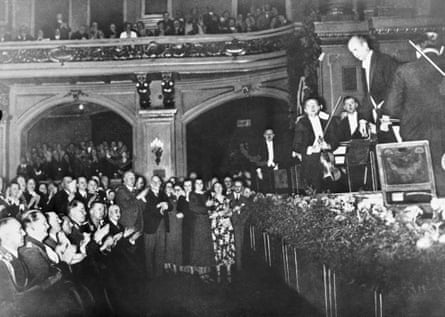
Their history is controversial. In 1933 the Berlin Philharmonic (founded in 1882) became the Nazi-sponsored Reichsorchester. Its four Jewish members, including the orchestra’s leader, Szymon Goldberg, were forced into exile. As Das Reichsorchester, its performances were used for flagrantly political ends on radio broadcasts and on film, at the opening of the 1936 Olympics and during the Nuremberg rallies. An aryanised Austro-German canon was favoured: Bach, Mozart, Beethoven, Brahms, Bruckner and Wagner, while Jewish composers such as Mendelssohn, Mahler and Schoenberg were banned. Their conductor Wilhelm Furtwängler was a public critic of the Nazi regime (you can see him shake Joseph Goebbels’ hand at the end of an apocalyptic performance of Beethoven’s Ninth Symphony in 1942 with what looks like satanic disdain), but none of the orchestra of the time can escape the facts of how it was used to underpin the myths of German cultural supremacy as the public face of the Nazis’ fascism and genocide.
What happened in the post-war years was nothing short of miraculous, in how conductor Herbert von Karajan was able to present the Berlin Philharmonic as a vision of de-Nazified modernity. He shored up the idea of the orchestra as the sound of the freedom of West Berlin – something that was architecturally as well as musically unmissable when Hans Scharoun’s futuristic Philharmonie concert hall was built for the orchestra in the early 1960s, just west of the Berlin Wall. Karajan used all the powers of technology to turn the Berlin Philharmonic into pioneers of recording and film, and put them at the vanguard of the digital age on CDs and on Laserdiscs. (Remember them? The 12-inch gold plates of the audio-visual future in the 1980s.) And the orchestra continues to outstrip its opponents technologically: its Digital Concert Hall is today a model of how orchestras can stream concerts, widen access, and generate income.
But if you’re looking for an index of exactly why this might be the best orchestra on the planet, that’s much harder to define. The Berlin Phil does not lead the orchestral world in terms of repertoire development – far from it. The coming season features its former viola player Brett Dean as composer-in-residence, but a few other world premieres aside, there’s Mahler galore and programmes that don’t stray beyond their usual 19th and early 20th-century stomping grounds. The orchestra is also far behind others in terms of diversity of performers and programmes: just one female conductor, Elim Chan, leads it during the next season, and there’s music by a mere handful of female composers throughout the entire year. And with the exception of Maxim Emelyanychev playing a fortepiano in a Haydn concerto, they are miles behind other bands in the investigation of performance practice. So what are the Berlin Philharmonic “best” at?
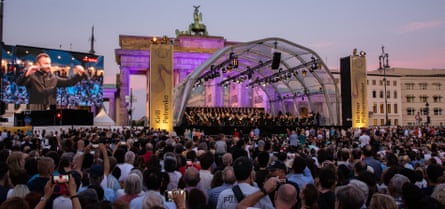
It’s the alchemy that turns a collection of musicians, each and every one of incredible ability – all of whom think of themselves as individual musicians first and members of an orchestra second; many of them with egos of justifiably gigantic proportions – into a musical collective that speaks not with Hydra-headed confusion but with jaw-dropping power and precision, and with a delirious and fearless commitment to every moment of their music-making.
Petrekno, their current music director, is the most consistently compelling conductor I’ve ever seen in how he’s able to harness these musical and sociological forces. He does it with forensic attention to detail: what seem like improvisatory flourishes of inspiration are, in reality, rehearsed to a point of fail-safe integrity. I remember a performance of Mahler’s Seventh symphony at the Proms a few years ago that revealed the piece as the most adventurous symphony of pure orchestral sensation ever composed, in which the 100 and more musicians played with the subtlety and sensitivity of a chamber group and the effortless give-and-take of a big band.
You can hear Petrenko and his players at their best on their recordings: their recent Schoenberg collection is arguably the most important of the lot, reclaiming the sensuality of this music through a relentless focus on making Schoenberg’s manic counterpoint speak more clearly than any other performances I know of. Don’t just take my word for it – the recording was Andrew Clements’ best of 2025 in what was sadly one of the final reviews he wrote.
So yes: in music-making like this, the Berlin Phil really are the “best” that they can be, and they find dimensions in the music that have been there all along, it’s just taken these players and this conductor to find them. And it’s those ecstatic moments I’m hoping for at their Proms. Get there if you can; listen on Radio 3 if you can’t.

This week Tom has been listening to: Kristen Anderson-Lopez and Robert Lopez’s songs for Disney’s Frozen on a never-ending loop – having lost control of the playlists to younger ears than mine while on a long drive. But these are miraculous songs: even on the 101st listen, there are still fractals of subtlety in these tunes and lyrics to discover. Let it Go-oo-ooo …