3 hours ago
7
3 hours ago
7
You wait ages for a brilliant pop song about film-making and then two come along at once. Following on from Charli xcx’s Camera comes Actress by Sofie Royer, with lyrics referencing rotoscoping, call sheets, screenplays, establishing shots, cinéma verité and more. “When the dust settles on your heart / I’d like to audition for the leading part,” she purrs over pumping disco, screwball-funny as she stacks up the metaphors to woo some Letterboxd-brained beau. “My mise-en-scène is flawless, don’t you know I’m quite adored / I’ll win you over in 35mm 4K-restored.”
It’s a typically smart and witty number from a singer, songwriter, multi-instrumentalist and, as it happens, aspiring actor, whose erudition and taste light up one of the best albums of the year, the forthcoming Before/After. Its lead single Cowboy Mouth is a recreation of a Sam Shepard play in song; another song makes a catchy funk-pop chorus from the word “sesquicentennial”. Her music is cosmopolitan enough to sit Italo disco next to new wave and garage rock, and across her discography there’s a big cast of cultural figures from Andrei Tarkovsky to Kenneth Anger, Luigi Mangione to Ivy Wolk, knowingness offset by her keen sense of humour.
“Maybe I’ve just spent too many years on [academic journal database] Jstor, but I love a good reference, right?” she says, having studied philosophy, psychology and English for a teaching degree. “Paying attention to references is one of the coolest things that you can do: a little keyhole into another piece of knowledge.”
Royer seems to ask me as many questions as I ask her during a bracingly intellectual video call from her apartment in Vienna, where she smokes elegant slim cigarettes in front of a tasteful array of paintings and furniture. After an unusually itinerant life, she is relatively settled in the city.
Now 35, she was born in the US to an Austrian mother and Iranian father, who were IT workers in California, then spent her high-school years in Vienna and attended a conservatoire thanks to her brilliance on violin. It left her with a musical mindset that is “very classically based”. She says she wouldn’t call herself a singer-songwriter. “I struggle with even calling myself a singer!” But, she says, “if you’re doing violin solos [as a child] you have to want to be on stage. So I don’t have a lot of stage fright – for all that I couldn’t really sing when I released my first record, I was just like, whatever, it’s like karaoke with my own songs.”
Aged 19, still long before she started writing songs, Royer went back across the world to work in Los Angeles at record label Stones Throw. Did she feel American again? “That’s a really hard question. If you come from a mixed background, and then you’re socialised in a third country, you aren’t ever really belonging to one place. I’m always just ‘part-’, right?”

She’s also aware of how a mixed identity such as hers can be parcelled up and sold. She cites a recent sarcastic lyric she admires by Charli xcx – “My heritage could give me quite the USP” – and frowns at the concept of female-only DJ nights. “I think you want to be a musician regardless of gender and heritage. I know it’s not fully possible, but I would love for some of the arts to just remain, at least in some small essence, a rare apolitical kind of structure. I love the surreal; I love things that extend beyond the imaginable.”
After LA came another move, to London, as one of the first employees at Boiler Room, which has since become one of the world’s biggest music startups thanks to its brand-partnered livestreams of DJ sets. Boiler Room ultimately took on major investment cash, and is seen as having sold out by many in the underground. “There just wasn’t a necessity to scale up in that way,” she says. “It’s a bummer because it makes you think: everything [countercultural] is kind of doomed, isn’t it?”
While working there, Royer’s mother was diagnosed with cancer. An only child, Royer quit and moved back to Vienna to care for her and start her degree (plus another one, in painting, left incomplete). Alongside state-funded therapy, songwriting became a way to process. “I was singing a lot of karaoke around that time in the basement of my art university, and then one thing led to another. It was a real way for me to escape. When I’m monkey-cymbal-clapping brain, when every sense is kind of occupied, it’s when I’m playing something and singing to it.”
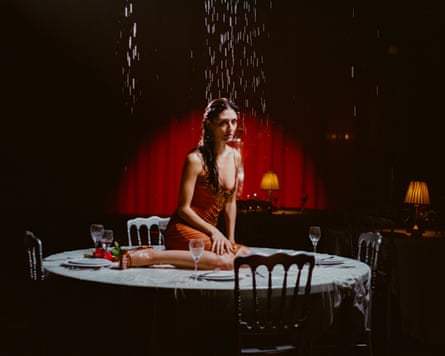
Her debut album, Cult Survivor, was released in 2020, but performing it live “was like reopening an old wound”, so she started broadening her writing. She dressed up as a pierrot character for 2022’s Harlequin, “a different persona to help me get over the fear of being perceived as a singer on stage, maybe”, and based 2024’s Young-Girl Forever on a French philosophical tract about culture’s obsession with young women. “The beauty of age is that you care less and less about it. You couldn’t pay me to go back to my 20s.” She reconsiders. “I mean, you could pay me, because I’m self-employed, so I’m down for money.”
She is much admired by her peers, with Lana Del Rey, Air and LCD Soundsystem all getting her to support them on tour, but she’s not headlining the same venues. She addresses that relative lack of financial success and fame uproariously on the new album. “Always a nominee, never a winner / The longer I keep this up the less I can afford dinner,” she sings on Sold Out the Jazz Club, just one of many references across the album to how Royer is, as that song’s chorus has it, “too pop for the art world, too indie-darling for the mainstream”.
“Very few professions are as measured in metrics as people working in the arts,” she says, “specifically music, and these metrics are publicly available” – Spotify listeners, tickets sold. “And not only that, then you’re being interviewed: ‘Where do you see yourself in five years? What does success mean to you?’ That’s what I wanted to perhaps release when it came to these songs.”
She has also released herself from therapy, singing “I spent five years on that couch, and I’m not ever going back again” on another new song, C’est la D. “I was actually in therapy for longer than five years, but it just sounded so cool to sing five instead of seven,” she deadpans.
She says she certainly needed therapy to begin with, but when she reached the cap to her free hours from the Austrian state, her therapist said she could continue, but he didn’t think she needed it any more. She agreed with him: “We as humans have a certain semblance of resilience, but there’s a lot of financial value placed in today’s market of psychoanalysis. In a lot of other cultures, that maybe aren’t as socialist as the one I currently enjoy living in, there’s more value in keeping somebody unhappy and dependent on therapy for the rest of their life.”
Finally a full-time musician (“a lot of it is an email job”), she is also branching into acting after a cameo in the 2024 remake of erotic drama Emmanuelle, playing a bar singer (though a scene opposite Naomi Watts, who was “an absolute delight”, didn’t make the final cut). She’s been making two films with Austrian director Jasmin Baumgartner, a former student of Michael Haneke: Too Hot to Die, a satirical comedy about a reality dating show, and the bigger-budget dramedy Sentimental Fail Club. “I’m not there for myself; I don’t have any demands or wishes when I’m acting,” she says of its appeal. “You’re just the paintbrush and the film is the canvas. You’re just an element in somebody else’s artistic vision.”
For all the many-layered meanings and references in her multi-faceted career, she’s also a dab hand at a straightforward love song, such as Opium, in which she compares her affection for her boyfriend to the drug’s high: “A hundred years is nothing with it, I want more,” she sings. Even here, though, there’s a dash of art-historical analysis. “That one just felt like such a direct, honest song,” she says. “And also, like, structurally dadaist. So it made the cut.”