3 months ago
142
3 months ago
142
For years, Breezy Johnson was the other American alpine skier. The one with the near-misses, the injuries, the suspension and the unfortunate timing to exist in the same stable at the same time as Lindsey Vonn and Mikaela Shiffrin. On Sunday, three weeks after her 30th birthday in the shadow of the Dolomites above Cortina d’Ampezzo, she became an Olympic champion.
Johnson crossed first in the women’s downhill at the Milano Cortina Games by four-hundredths of a second – the slightest winning margin in the event’s Olympic history outside the dead heat in 2014 – to become just the second American woman to win the sport’s most prestigious title. The only other was Vonn, who took gold in Vancouver 16 years ago.
Johnson’s winning time of 1min 36.10sec held off Germany’s Emma Aicher, earning the United States their first medal of these Olympics. Four-hundredths of a second isn’t much time at all: the blink of a camera shutter, the wingbeat of a hummingbird, the duration of Muhammad Ali’s phantom punch. But on a sun-splashed morning, it was enough to lift the skier from Jackson Hole, Wyoming, into winter sports immortality.
The extraordinary result came in a race that took on a sudden gravity almost as quickly as it began. Johnson was seated in the leader’s chair when Vonn – attempting an audacious medal bid aged 41 with a nonexistent ACL – crashed barely 13 seconds into her run and was airlifted off the mountain, leaving the race suspended and the atmosphere shaken. When the race resumed after nearly a half hour, Johnson’s marker held up for 31 more racers. And when the last of them was done, so was something else: the long, winding arc of a career that has rarely followed a straight line.
For most of her career, Johnson has existed slightly out of frame: respected among her peers since a pair of top-14 finishes on her Olympic debut as a 22-year-old in 2018, but dwarfed by the gravitational pull of global superstar teammates like Vonn and Shiffrin, who have won a combined 192 races on alpine skiing’s top flight. Johnson’s win count since joining the World Cup circuit 11 years ago: a grand total of zero. But she is now, improbably, both the world champion and Olympic champion in the most chaotic discipline of them all.
She learned the sport in the American west, growing up near the south-eastern Idaho town of Victor (population: 2,157), and training across the state line in the steep-chute playground of Jackson Hole. Weeknights meant icy, floodlit sessions at Snow King Mountain. Weekends meant powder days at Jackson Hole Mountain Resort. She grew up idolizing Bode Miller and later admired Vonn and Julia Mancuso, skiers defined as much by their tenacity as by trophies.
Even her name sounds like something from a ski-town origin story. “Breezy” was borrowed from her grandmother’s neighbor and later made legally official from her birth name, Breanna, in what now feels like a grace note of nominative destiny.
Her path to the top of the Olympic podium has rarely been smooth. In 2022, she crashed on this same Cortina course during training and tore cartilage in her knee, forcing her to miss the Beijing Games. The loss lingered. She later spoke about not fully trusting that the Olympics were real until she crossed a finish line.
Then came another setback. In 2024, Johnson served a 14-month suspension after missing three anti-doping whereabouts tests in a year, a violation that can carry stiff penalties even when no banned substances are involved. She returned determined to rebuild her form and confidence, winning a shock world championship gold in downhill in 2025 (and adding a second in the team combined). By the time she arrived in Cortina last week, she was no longer chasing validation but opportunity. “I was telling my mom, you go to your first Olympic Games to have been to the Olympic Games,” Johnson said. “You go to your second Olympic Games to win a medal. And you go to your third Games to win the whole damn thing.”
Downhill skiing is often described as controlled falling, where athletes accelerate to highway speeds while navigating terrain that punishes even a trace of hesitation. Johnson’s winning run on Sunday was defined by pace and precision rather than spectacle: clean lines, minimal correction, the kind of gliding down the piste that looks almost calm until you understand the forces involved.
Wearing the No 6 bib, Johnson seized control of the contest before most of the field had even gone off, posting a time more than a second faster than any of the five skiers before her. A brief wobble high on the course – near the opening Schuss, a 64% gradient chute hemmed in by rock walls – threatened to interrupt the run before she recovered to reach a top speed of 80.2mph (129kph) in the second section. What followed was a study in controlled momentum: speed carried cleanly off the jumps, a quick return to her tuck, and a descent that gathered time rather than surrendered it. The result was a victory measured in hundredths but built over years. “I knew I had to push, I knew I had to go harder than I did in training,” Johnson said after the race. “I had to be super clean, and I felt like I did that.”
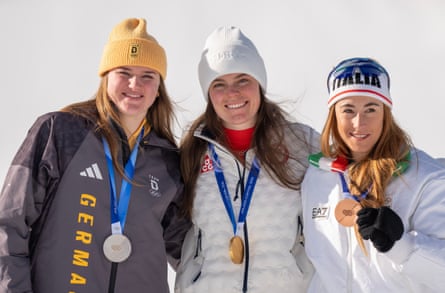
Johnson, already shaken by Vonn’s crash, became misty-eyed as the final racers finished before the waterworks finally burst while she mouthed the words of the Star-Spangled Banner atop the podium. Her US teammates called it the best run they had ever seen from her. For Johnson, it represented something nearer to closure. The course that had once dashed her Olympic dream now completed it.
Her story also offers something different for a broader audience. She is not the prodigy who dominated from youth, nor the superstar who lived permanently in the spotlight. Instead, she represents a quieter version of sporting excellence: one built on recovery, persistence and timing. In a sport where careers can be ended by a single bad landing, Johnson endured multiple knee injuries, fractures, surgeries and a suspension that she said made her “feel like a criminal”. She rebuilt herself physically and, by her own account, mentally. Ski racing, she once said, is “a beautiful and brutal sport”. That duality was never more apparent than on an emotionally charged Sunday in the Dolomites.
“People are jealous of people with Olympic gold medals,” she said near the finish area. “They’re not necessarily jealous of the journey it took to get those medals. I don’t think my journey is something that people are envious of. It’s been a tough road, but sometimes you just have to keep going because that’s the only option. If you’re going through hell, you keep walking.”
The Olympics often elevate familiar heroes. Sometimes they introduce the world to new ones. Johnson’s victory felt like both a generational handoff and a reminder that elite sport is often decided not just by talent, but by survival and perseverance. “It’s a tough road and it’s a tough sport,” Johnson said. “I think that that’s the beauty and the madness of it. That it can hurt you so badly but you keep coming back for more.”
For one morning, the math was simple: four-hundredths of a second. A lifetime of work. And a downhill racer who finally stepped out from the long shadow cast by American skiing’s biggest names and into history of her own.