3 months ago
129
3 months ago
129
What, you wonder, could possibly have prompted the powers that be to commission an adaptation of a postwar allegory that throws into dreadful relief the impulse to tyranny, the fragility of democracy and the brittleness of our veneer of civilisation in this shining year of 2026? We may never know. Did I mention it takes place on an island in which all normal social rules no longer apply and the inhabitants are protected from any punishment or consequence, no matter what appetites emerge? Hmm. Well, on we go.
Here it is, Jack Thorne’s take – after his triumphant Adolescence – on William Golding’s endlessly harrowing 1954 classic and GCSE staple for the past 30 years, Lord of the Flies. It was his debut novel and born of his reaction to reading RM Ballantyne’s Victorian classic of heroic derring-do, The Coral Island, to his children in the late 40s. That paean to noble and manly virtues from the golden age of optimism hit differently by then, so Golding asked his wife if he should write a book about what would happen if a group of boys were stranded on an island together and behaved how a group of boys stranded on an island together really would behave. She encouraged him to give it a shot. He borrowed character names and made other references to Ballantyne’s book in his own, but Golding’s story is its dark counterpoint; a suggestion that if men are left to rule the world untrammelled there will soon not be many of them, or much of the world, left to dominate. I know – what an imagination, right?
Thorne’s four-part adaptation brings a different character to the forefront in each episode. We open with Piggy (David McKenna, giving a brilliant performance in his first screen role) coming to after the crash that has stranded the planeload of boys on a tropical island. His all-important specs are intact. So far. Oh Piggy.
He meets Ralph (Winston Sawyers) and they gather the rest of the castaways. Including, alas, the choirboys led by Jack (Lox Pratt) – a child with an innate understanding of human weakness and how to exploit it. As Piggy fights to have his sensible words heard about the need to take care of “the littluns”, and to establish a signal fire, toilets and shelter, Jack establishes himself as the head of the hunters and a darkly charismatic alternative to Ralph’s unshowy leadership.
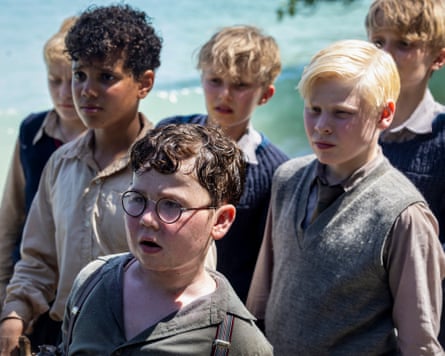
From there we move into the main pig-meat of Golding’s tale: the battle between might and right that develops as the majority of boys shuck off first their clothes and manners and then their morals to unite under bloodthirsty Jack, preferring hunting, feasts and fun to the duller work of gathering, maintaining a fire and staying disciplined. Suspicions and paranoia bloom, rogue quasi-religious beliefs take hold and one boy feels the freedom to unleash the murderous instincts that Golding reckoned we all harbour, albeit with some finding them more readily than others.
This all unfolds very slowly and remarkably wordlessly. Much of the run is given over to lingering shots of the idyllic landscape, or the boys playing, or the empty horizon with jangling strings playing over the top to heighten our anticipatory dread of the horrors to come. It all seems to depend rather a lot on familiarity with the story rather than instilling the dread in its own right. Every episode feels simultaneously bloated and thin, a feeling only reinforced by denaturing the otherwise saturated palette during the scenes of violence – primitive, you see? It feels like a gimmick trying to hide the absence of real emotion.
When the words do come, they are not great. The script is unevocative – “You’re having a jolly good time, aren’t you?” says Simon (Ike Talbut) to Jack at one point. “This is a bad camp of bad people!” cries Ralph after the boys have split into tribes – and frequently unconvincing. “He has an enviable facility,” says Ralph of Piggy’s storytelling skills, for example.
It also falls victim to the modern curse of psychology. All the main characters are explained by a neat backstory. Jack comes from a loveless household. Ralph’s alpha maleness is tempered by compassion because he comes from a secure home but his mother is ill. Simon is mentally fragile because his abusive father plays mind games with him and his mother, and so on. It reduces the elemental power of the story, along with its point, which is how much evil there is in a man and whether it can be overcome. This is the question. Not how much therapy he needs.