3 months ago
173
3 months ago
173
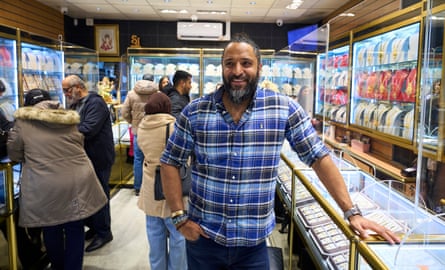
“With everything that’s going on in the economy and Donald Trump banging his chest against the world, we’re finding there’s no trust in the banks because we don’t know what’s going to happen,” Sandeep Kanda says.
Kanda is the owner of Sunny Jewellers, situated along a stretch of Leicester known as the Golden Mile, and is a beneficiary of consumers seeking alternative investments amid the uncertainty.
The business is among a dozen or so south Asian jewellers in the area that have been facing relentless demand for gold since the precious metal began soaring in value at the end of last year.
“By the end of the day we’re just knackered,” Kanda says. “We are seeing a lot of people buying and selling. As the price of gold goes up, we get busy on both sides.”
In late January the price reached more than $5,000 (£3,681) an ounce for the first time, mainly thanks to President Trump, although it has recently come back from that level.

Amid the US president’s clashes with the US Federal Reserve and his threats to invade Greenland, investors sought a safe haven from volatile markets and currencies. So private buyers and central banks across the world scrambled to acquire gold and repatriate stockpiles held in the US.
The soaring prices have driven Sunny’s customers to snap up 22-carat gold bars and coins or dig through jewellery boxes to sell off unworn jewellery.
The continuing closure of bank branches is also a factor in consumers seeking other investments despite bank deposits being protected up to £120,000. Over the past two years, Barclays and NatWest shut down their local branches on the Golden Mile. “It’s making it harder and harder to get access to your money. But if I’ve got gold, I’ve got money,” Kanda says.
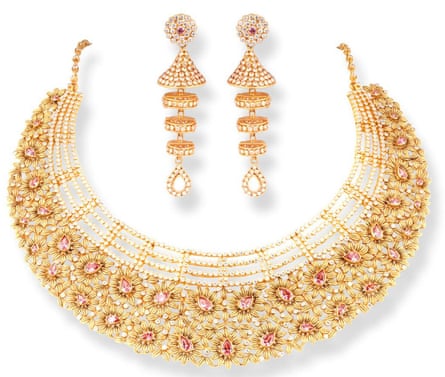
As a result, the soaring value of bullion has produced tidy profits for south Asian jewellers that specialise in high-caratage gold. The cultural importance of gold across south Asian cultures, as good luck and insurance against hard times, has maintained demand despite high prices.
Almost half of the gold mined globally has been used for jewellery, according to the World Gold Council. At Hindu weddings, brides are given a gold necklace with black beads, known as a mangalsutra, and grooms often receive a gold bracelet.
In India, the tradition of giving gold at weddings stems from the dowry system. Even after the abolition of dowries, giving gold remains a method of providing protection for women in case things go wrong, or of setting up a newlywed couple for financial stability.
“People do like the idea of buying gold as a means of maintaining cultural traditions,” says Pravin Pattni, the owner of Minar Jewellers in Tooting, south London. “And they know as well, in the back of their mind, that it is a sound investment.”
For many jewellers, the high price of gold is “a blessing in disguise”, Pattni says. “The higher price hasn’t actually subdued the demand. When there’s a wedding, it doesn’t matter if the price of gold is high. Whatever they need, they need.”
Ten to 15 years ago the average customer bought £25,000 of jewellery for a wedding, according to Pattni. “Today, it would not be a surprise if they came in and bought £75,000 to £100,000 worth of jewellery, simply because the price of gold is so high.”
Business has been booming on the Golden Mile, says Parul Visram, who alongside her husband manages Ram Jewellers, which has been on Belgrave Road for more than 50 years. “People do have trust in gold, that they are going to get the value back.”
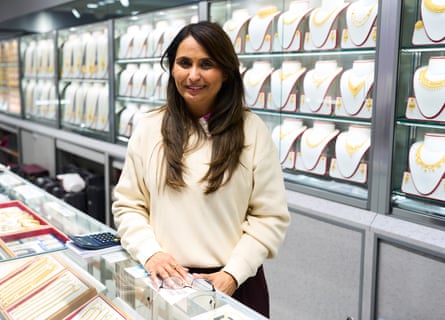
Inside Sunny Jewellers, customers Hitesh and Meera Jethwa are buying several 15g chains in 22ct gold to give to family members in remembrance of a nephew who died recently.
“With gold, you cannot go wrong,” Hitesh says. “Today, maybe it’s a high price or low price, whatever. But after three or four years, you will say: ‘Oh, it’s a good job I bought it.’ Because it’s always going up.”
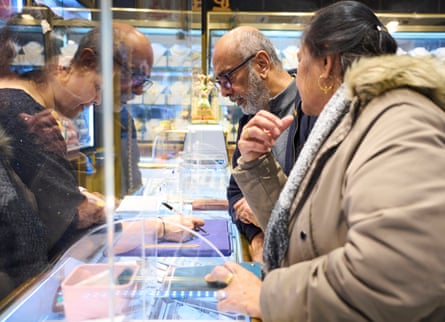
Jayant Raniga, the owner of PureJewels in east London, says customers react with “shock horror” when they first see the price of gold. “But then they accept it very quickly. It’s quite reassuring in a way. Customers are committed to buying gold.”
Younger members of the south Asian diaspora are investing in lightweight pieces that can be worn every day, or placing their savings in gold bars. Their elders, meanwhile, are selling off their heavier, traditional jewellery to financially support their children and grandchildren.
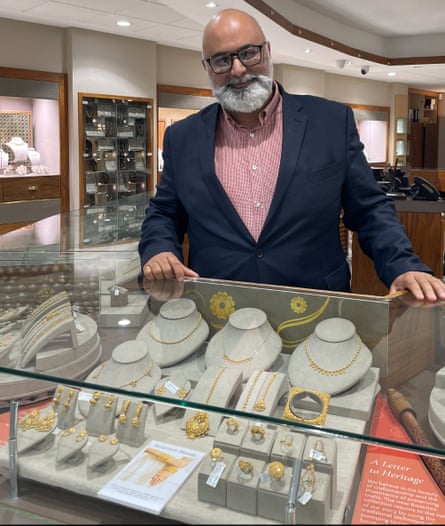
“The heirlooms, as such, people try not to sell,” Kanda says. “But life is hard at the moment. The cost of living is so high, and people think: ‘If we cash out on this, we can pay some bills off.’”
Pattni says customers are often “pleasantly surprised” to discover the value of their jewellery, often tucked away in a steel safe or jewellery box for decades.
One customer, a grandfather in his 80s, brought in his collection of gold jewellery to sell. During his young adulthood, in the early 1970s, gold was worth approximately 40p a gram. He was in disbelief to find the total value of the collection was now £200,000, which he decided would be put towards the deposit for his grandson’s first house.
“That’s the beauty of gold,” Pattni says. “Anybody who has put any money into gold, they’re just laughing because they’ve made so much more money without having to do anything.”
Months of soaring prices came to a close at the end of January. Trump’s choice of Kevin Warsh as the next Fed chair led to a sharp fall in the price of gold and silver, as investors sold off their precious metals and began to return to the US dollar. It now stands at $4,877 compared with the peak of $5,594 in late January.
This volatility of the gold price has caused uncertainty for jewellers on the right time to buy and sell stock. For jewellers creating bespoke designs, the volatility of gold places pressure on their manufacturing process.

However, for Raniga, who manages an atelier above his east London store, sticking with 22 carat gold is non-negotiable. “The malleability, its sheen, its longevity: there is no substitute.”
Many of these jewellers are run by families across several generations, who emigrated to the UK from the Indian subcontinent or east Africa from the 1960s.
Amid the volatility, Pattni has noticed a growing interest in investment gold among younger and non-Asian customers. “There’s more awareness within the [white British] population about the cultural significance of wearing 22ct jewellery. They realise it’s worth more.”
Within south Asian families, the advice to invest in high-carat gold continues to be passed on. Gemmologist Vishal Jogiya recalls a father who recently visited his shop on the Golden Mile with his 10-year-old son and explained gently to to the boy why their cash would be better stored in a 10g gold bar.
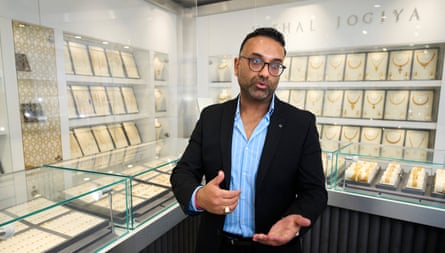
“That 10-year-old kid will remember buying this piece of gold. He’s been taught the value in investments,” Jogiya says. “While I was watching this, it just made me realise: the value in what we’re doing is humungous.”