2 months ago
99
2 months ago
99
The nine-round Reykjavik Open, which began on Wednesday afternoon at the Harpa Conference Centre and which continued with two rounds on Thursday, is an iconic event. It was first played as an all-play-all in 1964, when Mikhail Tal won, and is close to the Hotel Reykjavik Natura, formerly the Hotel Loftleidir, which featured prominently in the epic Bobby Fischer v Boris Spassky match of 1972.
The top seed in the capacity entry of 422 players is Iran’s Amin Tabatabaei, the only 2700-rated player in the field, with Romania’s Bogdan-Daniel Deac (2655) next, and the veteran Ukrainian Vasyl Ivanchuk (2624) the fourth seed.
England has a large contingent of more than 20, although most of them are low-rated amateurs. GM Matthew Wadsworth (2522) is the 21st seed, and GM Simon Williams (2443) the 39th, while WIM Bodhana Sivanandan, 11, is targeting her second WGM norm. The English trio all won in round one, including a brilliant 20-move victory for Williams. In round two, Sivanandan drew with a 2484-rated Chinese IM.
For this writer, any event in Reykjavik sparks a memory from 1973, when Fischer was still expected to return to competitive play after defeating Spassky. Clarks, the shoe firm, offered $25,000 for an event involving Fischer. The money was peanuts by his standards, but I had a plan.
I contacted Fischer’s Los Angeles lawyer, Stanley R Rader, and proposed a two-game match with William Hartston, the then British champion, plus an eight-board clock simultaneous match against England juniors. The chances seemed slim, but there were grounds for hope.
When Jim Slater doubled the Fischer v Spassky prize fund, Fischer said that as a mark of gratitude he would play his first event after winning the title in England. Both I and my co-organiser, Stewart Reuben, had played blitz games with Fischer, while I had been his partner in the only consultation game of his career, recorded for BBC radio in 1960.
My idea was that Fischer would turn down the Hartston mini-match, (“Two games? You gotta be joking!”) but might be attracted by the large payment for the simul. Anatoly Karpov, then the world champion, gladly took on 10 England juniors led by Nigel Short for a £1,000 fee in a clock simul in 1977.
The juniors to face Fischer would have been the five trained by the national coach, Bob Wade, who all became grandmasters: Tony Miles, Michael Stean, John Nunn, Jonathan Speelman and Jonathan Mestel, plus David Goodman. The other two would have been girls: Sheila Jackson and Susan Caldwell, who in 1976 won women’s Olympiad silver, and still remain survivors from the only England women’s Olympiad team ever to win medals.
There was no reply from the US for several weeks, and Clarks became fidgety, so I telephoned Rader’s office and repeated the proposal, emphasising that there was room for negotiation and that the event was still possible as a five-board simultaneous exhibition.
Rader told me that Fischer was present in his office and put me on hold while they spoke. Fischer knew me well from our BBC consultation game and his 1960 visit to my home, but would not speak directly to me. Rader told me that Fischer was undecided and that they would let me know later. After another couple of weeks, a final negative reply arrived. No surprise there!
If the match had taken place, it would have been a major boost for English chess. I think Fischer would have won it between 6-2 and 7-1. The five top juniors were all already nearing grandmaster strength, but their best years were yet to come in the late 1970s and the 1980s, while Fischer was still close to his 1972 peak.
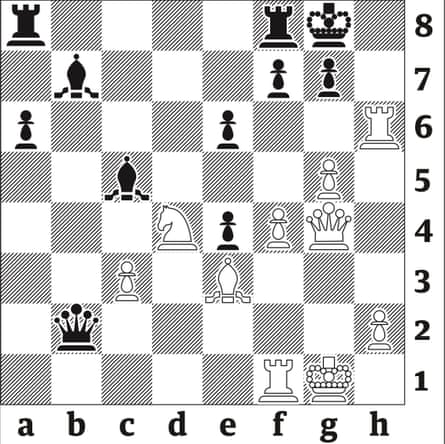
4017: 1 Rh4! Bxd4 2 Qh5! Bxe3+ 3 Kh1 f5 4 g6 and wins. If 1 …Qxc3 2 Qh5 Qxe3+ 3 Kh1! f5 4 g6. Not 1 Rh3? Qxc3 2 Qh5 Qxe3+! 3 Rxe3 Bxd4 and Black’s bishop pair are better than White’s queen. If 1 Rh5? g6! 2 Qh3 gxh5 and White’s attack is only good for a draw,