1 month ago
79
1 month ago
79
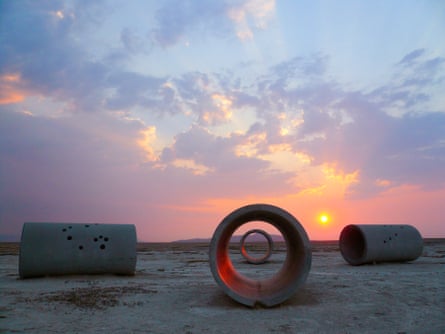
The two most prominent features of the 1960s and 70s art movement that became known as land art are the use of dramatic locations in the natural environment and monumental scale. Nancy Holt (1938-2014), one of the few women associated with the medium, and the subject of a new exhibition at the Goodwood Art Foundation in Sussex, is probably best known for Sun Tunnels, her 1976 work installed in the Utah desert in which four concrete cylinders are aligned with the movements of the cosmos.
But perhaps the key piece in the Goodwood exhibition is not outside in the 70-acre site, but instead a small sheet of paper, only 30cm x 45cm, on the wall of the gallery. In the centre sits a circle which is surrounded by the collaged words of a concrete poem “MOONSUNSTAR EARTHSKYWATER”.
“It was made before she had done any grand works in the landscape,” says curator Ann Gallagher, “but it points towards concerns that stayed with her across every medium she used for over 40 years. Circles appear frequently throughout her work. They are framing devices that give you a way of looking at the world, but they also link to her interest in systems – in the skies, on the Earth and in life – and the often circular nature of those systems, just like the poem which we have used as the title for the whole show.”
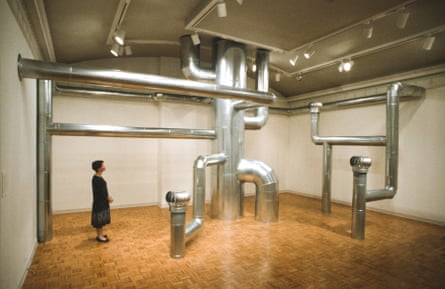
Goodwood’s is the first UK exhibition to bring together Holt’s photographic work, films and poetry as well as indoor and outdoor installations and a film about Sun Tunnels. Visitors are greeted by an installation of ventilation pipes – one of a series Holt made – that starts inside the gallery and extends out into the landscape. “It’s another system that we take for granted,” says Gallagher. “Things that sustain where we live and work but we rarely see.” A previous iteration contained oil in the pipes but this version has the air we breathe.
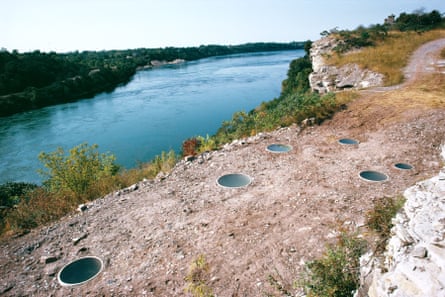
Elsewhere, there are circles everywhere. A room-sized installation called Mirrors of Light uses a single light source bounced off a row of mirrors to produce ellipses on the bare walls. Photographic works, almost abstracts, play with the shape of circular light. And a large installation in a chalk quarry on the foundation’s grounds, Hydra’s Head, features six round pools of water of differing sizes arranged according to the pattern of the Hydra constellation. “She was very concerned with cosmological systems,” Gallagher says. “Her Sun Tunnels were aligned with the solstice but also contain holes that match up directly with star constellations. The work is about making those invisible systems suddenly, briefly visible.”
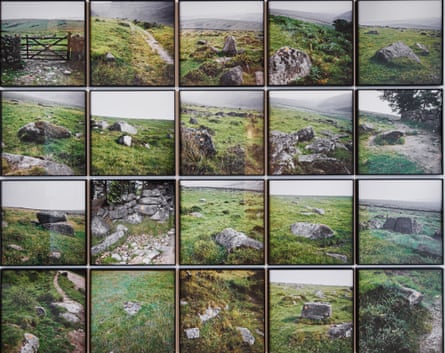
Holt studied biology as an undergraduate before moving into art. She was married to Robert Smithson, creator of the famous 1970 land art work in Utah, Spiral Jetty. Together they visited the UK in 1969, exploring Dartmoor and Salisbury where one of Holt’s photographic works, Trail Markers, documents her encounter with a nonverbal system in the landscape in the form of the small circles painted on rocks to guide hikers.
After Smithson’s death in a plane crash in 1973, aged only 35, Holt curated his legacy as well as her own career. After her death the Holt/Smithson Foundation was set up to look after both of their works, but with a sunset clause ensuring it closed in 2038, the year of their joint centenaries.
“She was very pragmatic,” says Gallagher, who met Holt towards the end of her life. “And I also remember her as being down to earth, relatable, friendly and informed. There is a slightly playful graph in the exhibition in which Holt plots the fluctuating proportion of herself that is ‘artist’, ‘feminist’ and ‘mystic’ over 24 hours. Of course, the lines move up and down. And all of this somehow comes across in a remarkable body of work that can concern itself with the largest canvases on Earth and beyond, while always being aware of a human presence within them.”
Nancy Holt: MOONSUNSTAR EARTHSKYWATER is at Goodwood Art Foundation, nr Chichester, 2 May to 1 November.
‘A preoccupation with systems and perception’: key works by Nancy Holt
Sun Tunnels
Sun Tunnels is slightly different to many major land art pieces in that there is a strong sense of human scale. The tunnels may look enormous in photographs but they snugly accommodate a standing human body, giving a sense of what it is to be human in that landscape.
Hydra’s Head
Another site-responsive work made for a location next to the Niagara River in New York. At the end of its 1974 residency, the water pools, placed to reflect the vast skies above and to respond to the tiny disturbances of insect life, were filled in with gravel.
Trail Markers
Holt’s set of photographs not only capture the system of small orange circles that guide walkers over Dartmoor, but also reflect her wider interest in human constructs within vast natural expanses.
Ventilation IV: Hampton Air
This is a site-responsive work installed according to previous iterations Holt made herself, but also responding to the gallery building and landscape. The configuration is different in every location, yet it always draws attention to systems we take for granted hidden within the infrastructure we all live in.
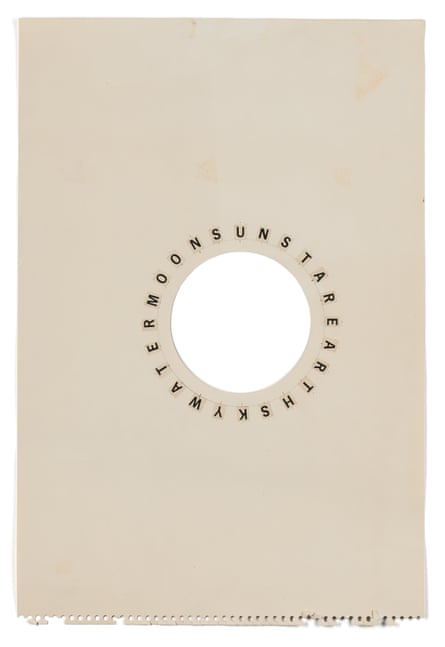
MOONSUNSTAREARTHSKYWATER
In the mid 1960s, Holt was literary editor at Harper’s Bazaar magazine and began creating concrete poems and text-based works of art. Within a couple of years she had moved into other visual media but many of her preoccupations with systems and human perception carried through for the rest of her career.