3 months ago
174
3 months ago
174
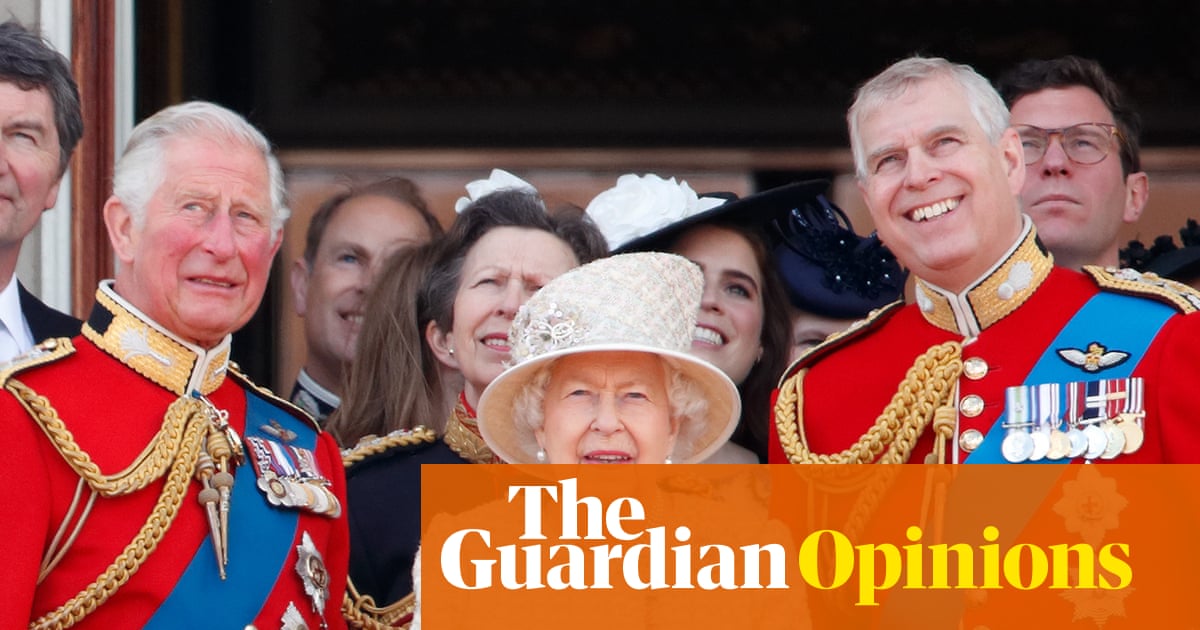
This week, for the first time since 1647, a member of the royal family was arrested in the United Kingdom, not over allegations of sexual wrongdoing but for trade-related communications with the supplier of those victims, Jeffrey Epstein, to whom he is supposed to have leaked state secrets. The public outrage in the US about Epstein forced the government to release the files, including emails between Andrew Mountbatten-Windsor and Epstein now under investigation in the criminal case.
The arrestee formerly known as Prince Andrew was accused by Virginia Guiffre with having had sex with her when she was a minor being trafficked by Epstein. He has always denied wrongdoing. Until his arrest on suspicion of misconduct in public office, only his family had held him accountable for his ongoing association with Epstein after Epstein’s 2008 conviction for soliciting a minor for prostitution. “Today our broken hearts have lifted,” Virginia Giuffre’s family stated, “at the news that no one is above the law, not even royalty.”
But while the English proceedings are yet to play out, others are still being protected from the consequences of their crimes and the voices of their victims. The simplest explanation of Donald Trump’s furious, frantic behavior since last summer is that he has a lot to hide, and US attorney general Pam Bondi has proven eager to hide it on his behalf.
Without feminism, the sequence of events that led to Mountbatten-Windsor’s arrest would never have happened. It’s a reminder that feminism is powerful and important and even transformative, which is why there’s so much pushback from those who benefit from the old inequalities and the old silences, which are pretty much the same thing.
The milestones on that road to Mountbatten-Windsor’s arrest look like this: an international surge of feminist outcry about violence against women and the misogyny around it, in general and in relationship to specific crimes and perpetrators, arose around 2013. Among the early topics were alleged abuses by Woody Allen and Bill Cosby. This became a source of intense public debate and public education about how these crimes take place, how victims are silenced by threats, victim-blaming, non-disclosure agreements, or the quite realistic anticipation that they will not be believed or if they are there will still be no consequences.
That public education about why these crimes are so often not reported or the reports do not bring about consequences created a new receptivity to stories that had long been suppressed. It’s notable that from Bill Cosby to Jeffrey Epstein to Sean Combs to gymnastics doctor Larry Nassar to Harvey Weinstein, these men had committed crimes with little consequence for decades before they were apprehended, and they were only apprehended because a society that had long refused to listen to victims was finally ready to do so.
One factor in this was due to even older waves of feminism that had put women in positions to decide who matters and what’s true, in jobs as judges and lawyers, as editors and producers, as heads of institutions and elected officials, and had also equipped a lot of men to treat women as human beings whose rights matter and who were capable of bearing witness. As a result, a handful of high-profile men have been charged and convicted, but these crimes are only a tiny fraction of the global pandemic of sexual abuse, silencing and trafficking that mostly goes unpunished.
The 2017 wave of stories and consequences dubbed #MeToo is often treated as the beginning of something and discussed in isolation, but it was the result of all that work that began earlier in the decade. It was not even the beginning of celebrity sexual abuse scandals, since charges against Epstein pal Woody Allen and many others in athletics, politics and entertainment had been aired in those years. One journalist said that her editor had spurned her attempt to write earlier about movie producer Harvey Weinstein’s serial sexual abuses but by 2017, something had shifted. Megan Twohey and Jodi Kantor at the New York Times and Ronan Farrow at the New Yorker almost simultaneously published exposes on Weinstein in the autumn of that year (after Farrow’s investigation was earlier killed by NBC.)
That opened the gates and presumably the editorial support for Julie K Brown at the Miami Herald to embark upon an epic investigation of Jeffrey Epstein, who was at large after an obscenely light prison sentence on reduced charges for his sex crimes against children. It’s the results of that investigation, a powerful series of reports by Brown, that brought about the downfall of Trump’s former secretary of labor, Alex Acosta, who as US attorney in Florida had been responsible for what’s usually called the “sweetheart deal” Epstein had received. That exposure led to Epstein’s arrest in New Jersey on 6 July 2019. Thanks to Brown, who had gained the trust of dozens of Epstein victims and made their stories matter, the public learned something of the true scale of Epstein’s crimes.
Do women deserve rights and a voice in society? That’s the conflict between the two systems that shape our society; in one of them we are, and in the other we’re not, and if the Trump administration and its allies has its way, the former will prevail. (Various members of the far right, including former Mar-a-Lago guest Nick Fuentes, and pastors in a video reposted by secretary of defense, Pete Hegseth, even assert that women should not have the right to vote, along with losing reproductive rights and other forms of equality and agency.) One way to describe Epstein’s vast network of rape and trafficking adjacent to the exploitative modeling and beauty-contest industries that he and Trump also dabbled in was as a system of treating women and girls as trophies, commodities, objects to be exchanged on the (somewhat) open market, rewards, bribes, service-providers, domestic livestock, anything but fellow human beings endowed with inalienable rights. According to Epstein’s victim Virginia Giuffre in her posthumous memoir, he “liked to tell friends that women were merely ‘a life-support system for a vagina’.”
The sex crimes at the center of all this were a ritual enactment of the idea that he and his fellow captains of industry had unlimited rights and privileges and power and that their victims had none at all, as is true of most rape. It is the enactment and enforcement of inequality. Countless other men (sometimes aided by women like Ghislaine Maxwell) have engaged in acts that are crimes under our systems of laws but are celebrations of their impunity in the culture of misogyny and inequality. One of them, who Epstein called his “closest” friend, is the president of the United States.
The Epstein files have exposed the workings of a mostly male elite concerned with self-advancement and unconcerned with human rights as they continued to pursue associations with a convicted sex offender. That many of the men at the center of this crime ring were financial industry titans makes only too much sense, because capitalism taken to its logical end transforms everyone and everything into a dead commodity and demolishes any rights that interfere with profiteering, be they the rights of workers, poor people impacted by the slow violence of environmental destruction, women, children or nature. The definition of trafficking is dealing in illegal goods, and sex trafficking turns human beings into goods. Feminism could be described as a long campaign to reclaim rights, freedoms, and dignity lost under patriarchy. This week it had an impact. The work continues.
-
Rebecca Solnit is a Guardian US columnist. She is the author of Orwell’s Roses and the forthcoming The Beginning Comes After the End: Notes on a World of Change