3 months ago
93
3 months ago
93
Progress in the Gaza peace plan has stalled over disagreements on how Hamas should be disarmed, with Israel threatening to go back to full-scale war if the condition is not carried out quickly.
The second phase of the US-brokered ceasefire, which Washington declared had begun in January, was meant to involve Hamas disarming, Israeli forces withdrawing, and a Palestinian interim administration moving into Gaza backed by a Palestinian police force and an international stabilisation force (ISF).
The 20-point plan, which is supposed to be overseen by Donald Trump’s newly assembled Board of Peace, is vague on sequencing, however.
The Israeli government is pushing for the complete disarmament of Hamas to come first and Israeli officials have been briefing journalists that the US will soon lay down a 60-day deadline for that to be completed.
“It is estimated that, in the coming days, Hamas will be given an ultimatum to disarm and fully demilitarise Gaza,” the far-right finance minister, Bezalel Smotrich, told public radio on Monday, adding that the ultimatum would come from Washington.
If Hamas did not comply, the minister said, the Israel Defense Forces (IDF) would “receive international legitimacy and American backing to do it itself”.
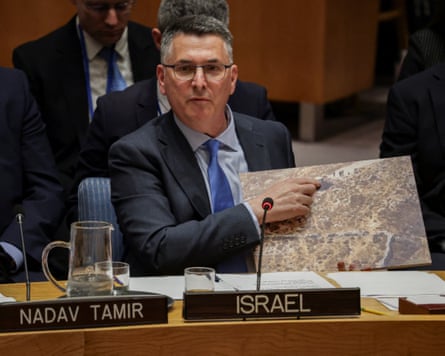
The Israeli foreign minister, Gideon Saar, reportedly told Israel’s security cabinet on Sunday that Trump would deliver his ultimatum to Hamas within days. However, the US president did not address the issue in his State of the Union speech on Tuesday night. He claimed credit for the return of the bodies of Israeli hostages and did not even mention the Board of Peace, which he had hailed four days earlier as a historic turning point.
Even if a disarmament campaign was announced, it is unclear who would be in a position to receive Hamas weapons within a 60-day period. The National Committee for the Administration of Gaza (NCAG), a collection of 15 Palestinian non-affiliated technocrats, has gathered in Cairo, preparing to manage the devastated territory, but is still a long way from stepping into Gaza.
According to a report in the rightwing Israel Hayom newspaper on Tuesday, the NCAG will present Hamas in March with a six-month plan to disarm, beginning with heavy weapons and ending with light firearms. At the outset Hamas would have to hand over an inventory of its heavy weapons, as well as a map of the network of tunnels it has dug under Gaza.
The Israel Hayom account cites unnamed sources and incorporates Israeli talking points. Rival militias, armed clans and gangs would only be disarmed after Hamas, and every other step in phase two would be contingent on its prior disarmament. The report quoted sources saying that Israel would have full international backing to go back to its assault on Gaza if disarmament is not carried out.
“It seems more wishful thinking than a serious plan,” said Michael Milshtein, head of the Palestinian Studies Forum at the Moshe Dayan Center for Middle Eastern and African Studies at Tel Aviv University and a former colonel in military intelligence.
The NCAG is far from ready to enter Gaza. Its funding has been slow to arrive and it is unable to enter the occupied territory without security arrangements. A police force is being trained to serve under the committee, but Israel is vetting potential recruits and has been vetoing those who served in the Gaza police under Hamas rule, arguing they are tainted by association. A few thousand police officers have been trained in Jordan and Egypt, but this is generally seen as an insufficient force for Gaza’s 2.2 million population in the aftermath of a devastating two-year bombardment.
Indonesia, Morocco, Kazakhstan, Kosovo and Albania have offered troops for the planned 20,000-strong ISF and preparations are being made for a large barracks in southern Gaza, but the force’s mandate has not been agreed, and troop contributors do not want their soldiers to be tasked with wresting Hamas’s weapons from them.
Analysts said Hamas would almost certainly reject the disarmament plan as described in the Israeli press as it required the group to surrender its main residual asset, its weapons, without any guarantee that Israel would withdraw or other groups would be disarmed, leaving Hamas members potentially defenceless against armed rivals during a transition to NCAG governance.
“The details in the Israel Hayom report would be promptly rejected by Hamas,” Muhammad Shehada, a Gaza analyst at the European Council on Foreign Relations, said. “It basically asks them to hand over everything gradually. Hamas is more likely to accept freezing, locking up and decommissioning its offensive weapons (eg rockets), while retaining light weapons to protect themselves against clans and gangs or should the IDF resume military operations.
“The light weapons would be under a strict policy of no use, no public display; anyone showing a gun in public would be arrested by NCAG’s police,” Shehada added.
The Board of Peace held its first working meeting in Washington on Thursday last week, but the session does not seem to have brought much clarity on the issue of disarmament.
Egypt and Saudi are said to be arguing for a decommissioning process modelled on the Northern Ireland peace agreement, with the phased disarming of all paramilitary groups, overseen by an independent commission.
Shehada said the United Arab Emirates had sided with the Israeli position in demanding the complete disarmament of Hamas as a precondition for other steps. He argued that this was a recipe for going back to all-out war.
“Netanyahu is doing everything he can to collapse phase two and resume military operations,” Shehada said. “He’s doing the same trick as in Iran, making maximalist demands to get Hamas/Iran to say no to, then persuade Trump that the military option is the only way.”
Hamas’s belief that Israel is determined to go back to war has reportedly only reinforced its determination to hang on to its weapons.
The Times of Israel cited a message from the Hamas leadership in Gaza to the politburo in Qatar, saying the group had to be “ready to fight the IDF again, as it is convinced that Israel is going to reinvade Hamas-held areas”.
The same report cited “a source with knowledge of Israel’s thinking”, saying Israel had been seeking to persuade Trump that the disarmament of Hamas could win him his longed-for Nobel peace prize.
In his recent statements, Smotrich has made clear he expects disarmament to fail, opening the door for the complete Israeli conquest of Gaza. “In the end, Israel will occupy the Gaza Strip, implement a military government and establish Jewish settlements there,” he said, adding: “It doesn’t matter if it happens in a year, two years, or three years.”
HA Hellyer, a senior associate fellow at the Royal United Services Institute, said the Israeli approach would virtually guarantee the collapse of the 20-point plan.
“The process is made to depend on Hamas disarming; otherwise, everything else is temporarily held up, until Israel decides to return to full-scale war,” Hellyer said on X. “This isn’t a situation that lends itself to positive outcomes.”