2 months ago
93
2 months ago
93
Hello, and welcome to TechScape. I’m your host, Blake Montgomery. This week in tech, we discuss a moment of divergence between Silicon Valley and everyday people; deep cuts at Meta to maximize spending on AI; writers caught using AI; and the frightening, fiery crashes of the Tesla Cybertruck.
AI agents v everyday life
Nvidia hosted a conference last week where it emphasized AI agents – semi-autonomous chatbots that can perform digital tasks for you – as the next frontier in tech. The company announced a toolkit for agents, including NemoClaw, an AI agent software suite for businesses.
Nvidia is in the business of riding the cutting edge of technology, and it sees a bright future. At the conference, CEO Jensen Huang predicted that his company would rake in $1tn in sales through 2028, which equates to 3% of the entire US yearly GDP, an astronomically high figure. The “Magnificent Seven”, of which Nvidia is first and foremost, grew nearly four times as much as the S&P 500 in the past 10 years, according to the Motley Fool.
As Nvidia and co double down on the AI race, the divide between Silicon Valley and everyday people grows wider and deeper. The novelist William Gibson, who coined the term “cyberspace”, once wrote that “the future is already here. It’s just not evenly distributed”; his dictum very much applies today. Polling released earlier this month found that 65% of Americans don’t use AI in their work at all – nary a chatbot, much less dispatching an AI agent. Pew Research’s survey also shows that Americans are wary of AI and believe both of the main political parties are regulating it poorly. Residents of other countries polled are even more skeptical, according to Pew. In my own perusal of Guardian readership numbers, I find our readers flock to stories about AI’s evils, failures and costs far more than to positive stories.
The AI industry is splitting away from the lives of everyday people. Exclusive polling conducted for the Guardian last year found that twice as many Americans believe their financial security is getting worse than better, hardly half as optimistic as Huang’s prediction.

Two developments at Meta in recent weeks illustrate the all-consuming investment the company is making in artificial intelligence at the expense of its other business units. First, Reuters reported that the social media giant was considering laying off up to 20% of its workforce to offset its ballooning expenditures on AI, which include a datacenter the size of Manhattan.
Second, Meta revealed that it would scale down its once-lofty ambitions to create a metaverse, though it later attempted to walk that announcement back. The company announced last week that it would shutter the virtual reality version of Horizon Worlds, leaving only the mobile and web-based versions of the game operable. A few days later, Meta’s chief technology officer said the game would not shut down entirely. Whatever the end result of those conflicting announcements may be, their upshot is that Meta is placing far less emphasis on virtual reality than it once did. Earlier this year, the company had already laid off members of its Reality Labs division, responsible for the metaverse. Meanwhile, it hired AI researchers at a rapid and expensive clip throughout 2025.
Meta is reallocating huge amounts of its spending to AI. In multiple recent earnings calls, the company disclosed that its spending on AI infrastructure would be larger than anticipated. Despite the continued success of the company’s ad business, that money has to come from somewhere. Reappropriating spending from a division that has never turned a profit and racked up losses larger than a small country’s budget makes sense. Reality Labs has recorded losses of $80bn since 2020, per CNBC.
The scale of Meta’s reshaping is staggering, though, and may portend what’s to come across all of tech; we have not seen a tech giant cut up to a fifth of its workforce to offset just how massive its AI spending has become. Tech giants may start spending the bulk of their cash not on human talent, once the most valuable commodity in tech, but on hardware and infrastructure that will keep them ahead in AI.
Even the CEO wants AI to do his job. Mark Zuckerberg is building an AI agent geared towards performing his work as CEO of Meta, the Wall Street Journal reported on Sunday. He’s using it to retrieve information that might be buried within layers of bureaucracy, per the Journal. Zuckerberg proudly declared that Meta would spend tens of billions to become “a metaverse company”, even renaming it to signal those ambitions in 2021. Now he says Meta is pivoting to become “AI-native from day one”.
The FBI and mass surveillance
-
Kash Patel admits under oath FBI is buying location data on Americans
-
Why is the FBI buying people’s location data and how is it using the information?
Be careful if you ride in a Cybertruck
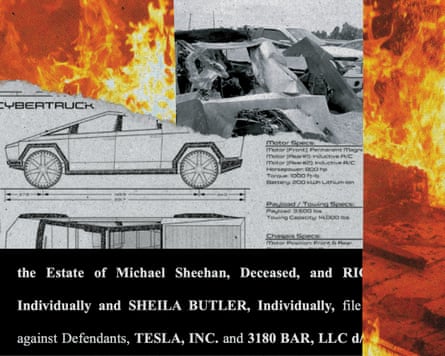
You might want to bring a window cracker if you do. Cybertrucks have locked passengers inside and burned so hot they have disintegrated drivers’ bones. Victims’ families blame what they say is the faulty design of a truck Elon Musk calls “apocalypse-proof”.
The Guardian has tracked five known Cybertruck fires – a significant number, considering the vehicle has only sold 60,000 units and debuted just two years ago. These incidents involve four fatalities, including the deaths of three college students in California, and have been the subject of four lawsuits against Tesla. In a comprehensive look at fire danger, particularly of Cybertrucks, the Guardian has obtained hundreds of pages of police, fire and autopsy reports and court filings and company manuals, and has interviewed lawyers and safety experts. They – as well as the families suing Tesla – allege the Cybertruck’s design led to these worst-case scenarios where fires rapidly ignite, the vehicle’s electric door handles won’t unlock and passengers are trapped inside.
Fires that entrap passengers are a well-documented and recurring problem with every model in Tesla’s lineup of vehicles, but Cybertrucks appear to have a disproportionate number of known deaths. Safety experts have told the Guardian that the truck’s unique design amplifies the deadly issue. The vehicles come with high-density laminated windows that are harder to break than regular car windows, making escape and rescue difficult when doors won’t unlock. And the trucks are built with materials, such as stainless steel, not commonly used in the industry, which can complicate the work of emergency responders. The Cybertruck is also the first Tesla model to entirely eliminate door handles on the outside of the vehicle.
Read the Guardian’s investigation: Inside the fiery, deadly crashes involving the Tesla Cybertruck
The wider TechScape
-
Thousands of people are selling their identities to train AI – but at what cost?
-
New crypto regulations likely to be big favor to the Trump family, industry insiders say
-
Google co-founder spends $45m in fight against California billionaire tax
-
Musk responsible for Twitter investors’ stock dropping when he bought company, jury rules