3 months ago
103
3 months ago
103
Are people born wicked? asks Ariana Grande’s “good witch” Glinda in Wicked, the musical film co-starring Cynthia Erivo as the green-skinned outsider, Elphaba. Bram Stoker’s classic story of elemental evil knows the answer to that question. Dracula, the Ur-vampire and ultimate outsider of the literary canon, is played by Erivo, along with every other character in this deliciously wicked tale of the blood-sucking count.
Except it’s not deliciously wicked in adapter-director Kip Williams’ stage reinvention. Williams has proven himself a Midas-touched spinner of old stories to new. His one-woman version of The Picture of Dorian Gray was deliriously original. His take on Jean Genet’s The Maids was punk inspired. What has happened here?
In look, Erivo makes a magnificent modern Dracula with her piercings and tattoos, first appearing on stage in vest and trousers, all sharp angles and sinews. She has the long, pointed nails for it too, reminiscent of the thin, knife-like fingers of FW Murnau’s Nosferatu.
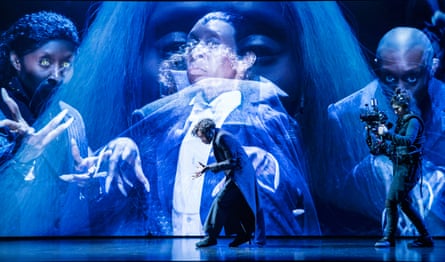
A team of camera operators transpose what is happening on stage to a gigantic screen. The live images are merged with pre-recorded footage. This use of technology has been utilised innumerable times on the West End stage, by Williams as well as others, but seems ill-suited to the horror genre, distancing us from the dread.
Erivo appears ever smaller and more vulnerable on stage and your eye is drawn away from her, to the screen closeups. Sometimes images are superimposed on each other and look hallucinatory. It shows off what technology can do but the action itself is overwhelmingly static.
That is because the story is narrated by Erivo, with only snippets in dialogue, which gives the sense of an audiobook accompanied by screen illustrations. It comprises mostly diary entries from journals and preserves the epistolary form of the book. Why, when it serves no dramatic purpose other than to remind us of the story’s original form?
Erivo narrates swiftly, with accents differentiating characters along with a quick changing of wigs and clothes. So a pink-red wig and African inflected accent for count Dracula, a pin-striped shirt and clipped British accent for Jonathan Harker, the solicitor who becomes imprisoned in his castle, a high innocent voice for Harker’s fiancee, Mina, a blond wig for her friend Lucy, who falls victim to Dracula. But despite the speed, the atmosphere stays sedate, with none of the fever required, and no peril whatsoever. And characters seem so simplistic that they verge on the comical. Most ludicrous of all is vampire-slayer, Van Helsing, who looks like a gothic version of Gandalf with long white locks and weird goatee. Erivo’s feat of narration also seems to distract her from the actual acting, too neutral in her physical and facial expressions.
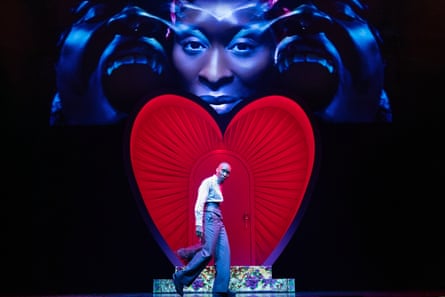
The production seeks to focus on the battle between fear and desire in the story but there is neither chill nor heat here. Dracula brings no threat, even as he begins his blood-sucking in Whitby. There is no diabolicism or dark charisma in the repeated flashes of Dracula’s fangs. His three sharp-toothed vampire-women do not bring a sense of seduction either. A giant love heart appears on stage at one point, more chocolate-box than sexually suggestive. A snow scene is more atmospheric, but there is an abounding sterility in the storytelling which undercuts the building of emotional or atmospheric momentum.
This is, for many, seen as a cautionary tale of the dangerous outsider-immigrant. Dracula travels to British shores and is likened to plague-like vermin by Stoker. This is not unpicked at all here, despite its current, real-world relevance.
Erivo gives us a tantalising taste of her singing voice towards the end and it raises your hopes but is aborted into a few – exquisitely sung – lines rather than a song. It’s sad that the production plays so little of Erivo’s strengths, which might better have been reconceived as Dracula the Musical.