3 months ago
164
3 months ago
164
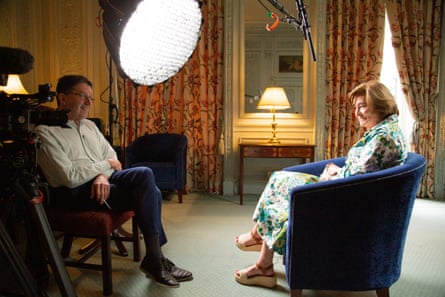
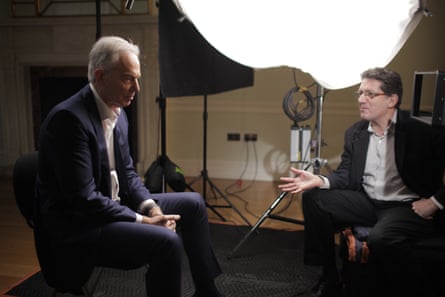
Episode one of Michael Waldman’s new three-part biography bears the subtitle “Who Are You?”. As well as the normal business of harvesting archive clips and interviewing his subject’s colleagues and rivals to build a picture of past events, Waldman has gained interviews with Tony Blair, his wife, Cherie, and several of their children in an effort to capture the character of the politician who was re-elected twice as British prime minister. The question is: what sort of man is Blair?
It is an approach that many political film-makers find impossible to resist. Detailed factual arguments can get boring, and overarching theses about the power structures that lift politicians into place would take too long to explain. But a narrative based on an individual’s psychology, where major events happen because a personality has imposed itself on the world? That is a source of readily relatable drama.
So, we go back to Blair’s childhood, where a contemporary of his at the Edinburgh private school Fettes College reports that “the school teaches you to survive – it knocks a lot of the emotion out of you”. While he was at school, his father suffered a stroke, which scuppered the old man’s dream of expanding his political activities far beyond the local Conservative party. Then, when Blair was reading law and finding religion at Oxford in the 1970s, a close friend died by suicide – interviewed here, a fellow student says Blair returned for the next new term with his long hair cut short and his cheery counter-culture leanings replaced by a steely drive to achieve.
Blair took up politics in the early 1980s and vowed not just to become a Labour MP, but to lead profound reform of the party. Waldman gets the goss on how Blair repeatedly overtook those who seemed to have superior experience: he became an MP instead of his more politically engaged wife, Cherie, who didn’t mind, and then became the leader of Labour instead of his more established ally, Gordon Brown, who did.
As well as sketching out the one-on-one battles that the ruthless Blair always won, Waldman asks about the eerily accurate premonition Blair apparently had in 1994 that the then Labour leader, John Smith, was about to die of a heart attack; he also quizzes all the Blairs on whether they felt the weight of the responsibility they bore as they moved into 10 Downing Street after Blair’s general election win in 1997. Blair reflects that, yes, it was hard to enjoy his first days in power, because of the gravity of the task, and because his mother, who had died as he was graduating from Oxford in 1975, was not around to witness his achievement.
Such emotions would be keenly felt by the human being having those experiences but, in the context of Blair as one of the leading political figures of the age, they take up time that could be spent on wider questions. You cannot become prime minister without a lot of powerful people agreeing that you should, regardless of how able and persuasive you are and what traumas underlie your ambition. But The Tony Blair Story often seems to be reporting from a world where this is not the case. Aside from a comment hinting at Blair being chosen by a pre-existing group of “modernisers” within Labour – the person making this recollection being none other than Peter Mandelson – and a section looking critically at the meeting Blair felt it necessary to hold with Rupert Murdoch in 1995, it’s all Tony, doing it for himself. With no discussion of what interests his social and economic policies were serving – that he changed Britain for the better is vaguely assumed – we focus on Northern Ireland and Kosovo, which are presented as triumphs of Blair’s unique character.
All this is building towards the pivotal second episode, a feature-length critique of the 2003 invasion of Iraq. In Waldman’s telling, Blair developed a messiah complex, believing not just that he could solve discrete problems but that he could win a grand battle of good over evil: under the febrile pressure of the post-9/11 “war on terror”, he tragically overreached. In its desire to psychoanalyse, the programme blurs a crucial distinction – between Blair thinking it was right to depose Saddam simply because the Iraqi dictator was a bad guy and him believing that the facts provided a robust justification for the war. It ends up bolstering Blair’s position that he did what he sincerely believed to be right: the Chilcot inquiry has shown that a rigorous examination of the facts throws significant doubt on whether he genuinely thought the prospectus for war he presented was an honest one, but such granular analysis is not Waldman’s style.
We do see here that Blair had the conviction to reshape political territory rather than fret about what the existing lay of the land would allow, making him fundamentally prime-ministerial in a way that none of his successors have been. But The Tony Blair Story finds the Blair cult of personality a little too alluring.
-
The Tony Blair Story is available on Channel 4