2 months ago
88
2 months ago
88
Last year I became uncomfortably well acquainted with suffering. In March I started experiencing excruciating pain in my right arm and shoulder – burning, zapping, energy-sapping pain that left me unable to think straight, emanating from a nexus of torment behind my shoulder blade and sometimes stretching all the way up to the base of my skull and all the way down into my fingers. Typing was agony, but everything was painful; even at rest it was horrible. I couldn’t play my guitar; I couldn’t play video games; I couldn’t sleep. I learned how quickly physical suffering lacerates your mental wellbeing.
I’d had episodes of nagging pain from so-called repetitive strain injuries before, the product of long hours hunched over laptops and game controllers over the course of decades, but nothing like this. A few months later, after the initial unrelenting agony had subsided to a permanent hum of more moderate pain, it was diagnosed as brachial neuritis, inflammation of the nerve path that travels from the base of your neck down to your hand. (Nobody knows what causes it, but it sometimes happens after an infection or an injury.) The good news, I was told by a neurologist, was that it usually gets better in about one to three years, and I hadn’t lost any function in my right hand. The bad news was that there was nothing much to be done about the pain in the meantime.
Traditional pain meds don’t really do much for nerve pain. And after trying out the small range of nerve pain medications – pills that act on the brain, where pain really lives – I discovered that they all sent me loopy in ways I would rather not ever experience again. So I had to figure out how to live with it. My nerves were upset; they had now learned the pain. It would take time to unlearn it.
In August, meanwhile, a small Australian developer called Team Cherry announced a release date for a game that had been in the works for many years. Silksong was the follow-up to Hollow Knight, a title I had loved when it came out in 2017: an atmospheric and enticingly challenging game about fighting your way through a corrupted underground bug kingdom. Silksong was so hotly anticipated that it became a meme; its name appeared in the comments under every gaming showcase for over half a decade, while Team Cherry remained resolutely silent about when it was coming out. Posters on Reddit started mock-ritually-sacrificing each other in an effort to manifest its release. Now it was finally coming out, and I was in so much pain that I didn’t know if I’d be able to play it.
There is an underlying narrative of overcoming the odds – of suffering and redemption – in almost all video games, but especially the difficult ones. And I love the difficult ones. Video games imbue suffering with meaning: you try and fail, try and fail, until you succeed. Perhaps, I thought, playing Silksong during a period of real-life suffering and disability might help me look at it differently.
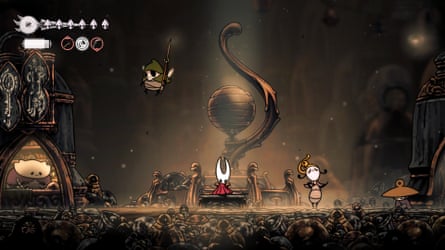
Silksong has the appearance of a very beautiful nightmare, and the energy of a horror-tinged European animated TV show you only half-remember from your childhood. Its player character, Hornet, is a masked spider in a red cloak; the other characters are oddly cute but dead-eyed bug creatures, hunched over with their own suffering. Beginning at the foot of the kingdom of Pharloom, you travel through moss-furred, luminescent caverns, moonlit temples, wind and sand-blasted wastelands, tight winding tunnels whose walls are made of cogs or tarnished bells, up towards the once gleaming Citadel at the top. Bugs have been making pilgrimages to the Citadel for untold generations but they rarely survive the journey. There is precious little life anywhere, and what there is will try to kill you. Something has poisoned their minds.
The journey mirrors Dante’s in The Divine Comedy from hell through purgatory to heaven, from cursed depths to the home of god. The piteous outpost where Hornet begins the game is little more than a shanty town; rag-clad bugs huddled in a place of temporary safety. The populace of Pharloom accepts their fate, cowering in every settlement with blank stares and sorrowful posture: this is how things are meant to be. Like any pilgrimage, the way to the Citadel involves enormous hardship before you come close to divinity. I was told this over and over by the bugs I met in between my battles with the feral beasts and corrupted priests that stood in my way – battles that often sent me back to a checkpoint, fuming, 10 or 20 or 50 times before I finally defeated them.
Except Silksong’s supposed heaven is hellish in itself. Once you get there, up to the Citadel – past the fog-wreathed swamp guarded by the vicious, flapping Moorwing, past the silk-wreathed Widow that holds the gilded town of Bellhart in a frightening state of suspended animation, past the Last Judge who guards the grand gate, swinging a flaming thurible that can end you in seconds with waves and columns of sweeping fire – you find that it has fallen, too. There is no point to the suffering of the pilgrims who come here. If they survive, there is only more suffering ahead. The highest places turn out to be some of the worst.
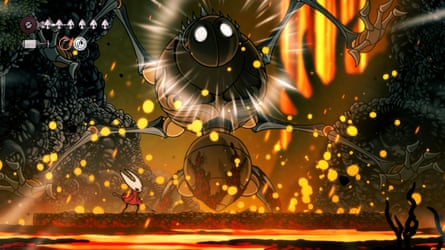
The Citadel is barely the halfway point of the game, however. Past that gate, Pharloom branches in all directions. Deep, deep below, there is a roiling furnace; in Sinners Road you find where the prisoners of the realm have been left to rot; there is an abandoned hospital, a pitiless wind-whipped mountain of ice, a museum of sorts that takes you through the realm in miniature (why is it there?). The guardians of these places become ever more punishing. I nearly lost my mind fighting Trobbio, the dancer, the flamboyant performer, trapped for ever on his stage, theatrically intoning his own name as he destroys me with pyrotechnics.
Hornet gleams silk-bright in this dismal world. Within her is the substance that holds Pharloom’s minds in thrall, the godly silk. She whips her divine power around herself like ribbons, to heal the damage done to her. She speaks with clarity and compassion, to bugs that respond in riddles or threats, half-mad. She plucks melodies on a stringed instrument that make the bugs around her turn their faces upwards and sing in disconnected couplets. And she fights: with her sharp-pointed needle, with bone-crafted boomerangs and plant-poison and flea-brew, with sharp tacks and javelin-spears and anything else she can find in Pharloom. She fights and fights, and yet beyond each battle waits another.
Hampered by pain, I am forced to explore all of this very, very slowly. It takes me months to make my way painstakingly through a game I would have rinsed in three weeks in my previous life. My pilgrimage cannot be rushed. A lot of managing pain involves cultivating a state of safety for your nervous system, minimising stress as much as possible, and it turns out that difficult video games are very stressful. The frustration of failure causes my hands to grip the controller too hard and my fingers begin to hurt. The adrenaline of victory sends me into a state of exhilarated fight-or-flight that my nerves can’t currently handle. Instead of disappearing into Silksong like I have with other games since I was a teenager, I play for 20, 40 minutes at a time, over months.
Unexpectedly, this makes Pharloom begin to feel like a parallel dimension, somewhere I can slip into not just on my Nintendo Switch but in my mind. I have to stop playing when pain starts to travel to my hand, so I keep playing it in my head.

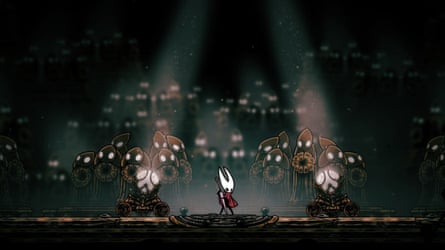
I see the Cogwork Dancers, the balletic mechanical twin bosses at the very top of the Citadel, flitting in front of my mind’s eye in their predictable attack patterns. I think about the shaft I found in a corner of the Blasted Steps and wonder whether I can get up there with the piton-like tool that Hornet recently acquired. I think, all the time, about what happened in Pharloom; the clawed grip of religion on the minds of its populace, who cling to their rosary beads even as they lose their grasp on their own minds. I think about the tall princeling I rescued from a cell, crouched over the remains of one of the Cogwork Dancers: his partner, long ago.
You can tell that this game is a work of obsession. The detail everywhere is extraordinary, even in the writhing maggots that carpet the ground in the aptly named Putrified Ducts. But also, where in most game worlds everything feels oriented towards the player – fun playgrounds laid out for your enjoyment, a daub of yellow paint here and there to show you where to go – Hornet’s presence, my presence, feels almost incidental to Pharloom. It rots away without me, bugs chanting their devotions, patrolling silk-poisoned clerics clanging their bells. I come upon a settlement and am not welcomed as a saviour, but regarded through a veil of suspicion and despair.
Indeed, some places in Pharloom aren’t fun at all. They’re places I never want to see again. Late one night I find myself in Bilewater, a fetid parkour course over more pools of writhing maggots and past bile-spitting moss-monsters. I am here to find Shakra the warrior-cartographer, whose haunting song has guided me towards her throughout Pharloom, scrabbling for rosaries to pay for her maps. Her trail is marked with bronze rings, a detail I can’t believe I didn’t notice earlier in the game, but it takes me days of spaced-out play to make the journey from the nearest safe bench to the tranquil pool where she rests. Trickster creatures follow me, setting tripwires and traps that make it even harder to avoid the gaping mouths, slashing teeth and erratic movements of the native creatures here. It brought me to the verge of tears.
Giving up never felt like an option. I’ve taken breaks from Silksong – a week or two at a time – but I have not given up, not even when I got stuck in an almost-impossible gauntlet involving waves of aggressive crows. Silksong feels like a sadistic game at times, needlessly punishing: take a hit and it’ll often wipe not one but two precious units of Hornet’s health. I’m not sure why I didn’t quit. It wasn’t pure obstinacy. I think that because I was suffering all of the time anyway, adding a bit more suffering into my days by choice at least gave me a feeling of control.
Difficult video games require tenacity and resilience. Keep throwing yourself at the problem unrelentingly until you defeat it, they teach you. There’s nothing you can’t do with enough skill and determination. You can always win. You just have to try hard enough.
This does not apply to pain. No amount of effort will persuade nerves to heal any faster, and pain is not something that can be overcome with sheer determination. I’ve carried plenty of strategies from video games into my real life before: I have applied the same bullheaded tenacity to learning languages, writing books, supporting and caring for my friends and family. But nothing I’ve ever learned from video games has helped me deal with pain. Instead I’ve had to learn how to do things more slowly, stay within my capacity, and admit my limitations without guilt or self-admonishment.
I did not know that I could do things slowly. I didn’t know that I would be able to play Silksong slowly. But I have learned how. As I have been playing through this game I have also been reading endlessly about modern pain science. At first I was doing this rather desperately, in search of a way out, a way to speed things up, to get myself out of suffering. What I learned instead is that acknowledging pain is the first step to learning to live with it, and that learning to live with it is what it actually means to overcome it. Pain is the brain’s danger signal: if you ignore it, it only gets louder. If you start listening instead, observing and acquiescing, your brain might put away the megaphone. I have learned that acknowledging pain and modifying your life around it does not mean giving up. It means you get to keep on living – keep on playing.
After four months and 40 hours, I have done almost everything there is to do in Pharloom. I am fighting the very final boss, and I have been trying to defeat her since before Christmas. I hoped I might finish this game before the end of 2025, a neat little piece of symbolism to represent perseverance through an extremely challenging year. It hasn’t worked out quite so elegantly, but Silksong has helped me look at suffering a little differently. There doesn’t need to be a point to it; it doesn’t necessarily come with a tidy narrative of perseverance and eventual redemption. But you can learn to work around it. You can make your way through.
-
Super Nintendo: How One Japanese Company Helped the World Have Fun by Keza MacDonald is out 12 February (Guardian Faber Publishing, £20). To support the Guardian, order your copy at guardianbookshop.com. Delivery charges may apply.