2 months ago
88
2 months ago
88
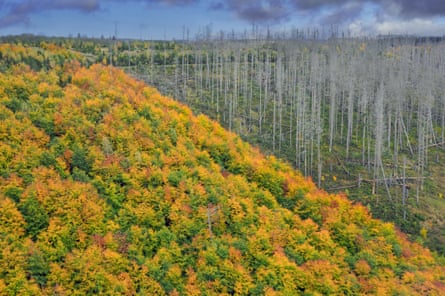
Even the intense green of late spring cannot mask the dead trees in the Harz mountains. Standing upright across the gentle peaks in northern Germany, thousands of skeletal trunks mark the remnants of a once great spruce forest.
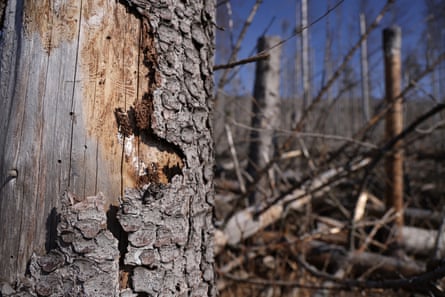
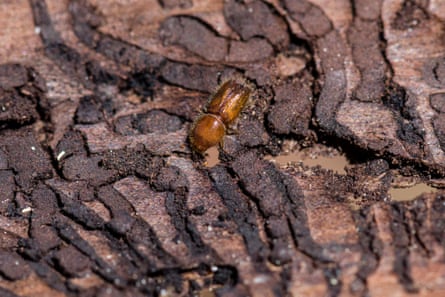
Since 2018, the region has been ravaged by a tree-killing bark beetle outbreak, made possible by successive droughts and heatwaves. It has transformed a landscape known for its verdant beauty into one dominated by a sickly grey.
The loss has sparked a reckoning with the modern forestry methods pioneered by Germany that often rely on expanses of monoculture plantations. The ferocity of the beetle outbreak means there is no going back to the old way of doing things: replacing the dead spruce with saplings from the same species would probably guarantee catastrophe once again.
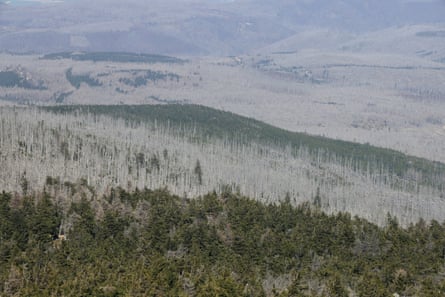
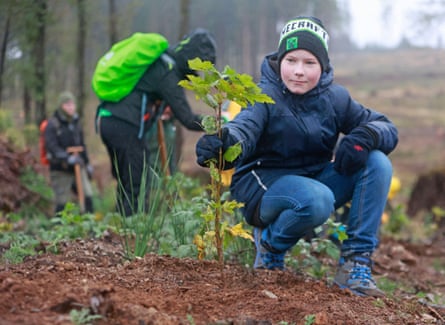
Instead, foresters have been experimenting with a different approach: pockets of beech, firs and sycamore have been planted around the surviving spruce to make sure the returning forest is more biodiverse. They hope that planting a mixture of species will make the returning landscape more resilient.
“There have been times where we did not have any confidence in what we were doing,” says Mathias Aßmann, a spokesperson for the regional forestry company responsible for this part of the range, pointing out the scars in the landscape from the top of a hill.
“You spend the whole day cutting down infected trees. The next day, too, and the next. For months. The whole year: cutting, cutting, cutting. A lot of colleagues have burnout symptoms,” he says.
The rapid loss of the trees has raised scrutiny about how nature can be used to meet climate commitments in a warming world.
Vast diebacks, such as those seen in the Harz mountains, are becoming increasingly common in Europe as the climate heats, bringing extreme weather and drought. During the peak of the bark beetle outbreak from 2018 to 2021, Germany lost half a million hectares (more than 1.2m acres) of forest – nearly 5% of the country’s total.
The Czech Republic has lost even more in relative terms and Norway, Sweden, France and Finland are experiencing changes as Europe’s ecosystems strain under increased heat and drought. New research from the UK indicates that ancient woodland is increasingly struggling to regenerate. Foresters in Greece report huge diebacks of the country’s firs, and peatlands across Europe are drying out.
The consequences are starting to filter through in official statistics. In July, scientists released a significant downwards revision of how much carbon is being removed by land in the EU, driven by the weakening forest carbon sink. Since 2010, the amount absorbed by land has fallen by a third and continues to decline.
Figures published in 2024 in Germany show a major spike in emissions between 2017 and 2022 from the bark beetle outbreak and drought, mirroring other member states. The speed of the fall in the amount of carbon removed by Europe’s forests was not expected, say experts, and is already pushing climate targets out of reach.
“The EU and Germany can set their political goals but … what we have experienced since 2018 is that forests are strongly affected by drought. It is a significant dieback. We have huge carbon stocks that are dying and which no longer contribute to a carbon sink,” says Prof Matthias Dieter, head of the Thünen Institute of Forestry, explaining that Germany is now almost certain to miss its carbon sequestration target for land.
“You cannot force the forest to grow – we cannot command how much their contribution should be towards our climate targets,” he says.
Debate about whether it makes sense to include land and nature’s role in country-level climate targets is growing among experts. Supporters say it requires governments to think carefully about their natural resources and should push them to harness nature to help absorb greenhouse gases.
Forests, oceans and other natural carbon sinks already absorb about half of human emissions – and any increase could help. But many argue that it should be separated as it allows governments to assume nature can replace decarbonisation.
“What happens is that countries use their carbon sink – or assumptions about their carbon sink – as an offset against going slower on phasing out black carbon sources like oil, coil and gas. That is very dangerous because it means that countries can use their carbon sink from forests to claim they are net zero without fully phasing out fossil fuels,” says Johan Rockström, the director of the Potsdam Institute for Climate Impact Research.
Already, countries such as Finland have become examples of the risks of this approach. The Nordic country is aiming to reach its carbon neutrality just a decade from now in 2035, using immense forests and peatlands that cover 70% of the country to draw down carbon from the atmosphere. But since 2010, the amount of carbon absorbed by them has declined dramatically and its forests and peatlands have become a small net contributor to global heating in recent years.
On the way to a hearty lunch of currywurst and chips, Aßmann and his forester colleague Ralf Krüger stop the car lower down the valley to show their vision for the Harz mountains. We wander into an airy mass of green, where a mix of species are growing. Huge oaks, maple and beech trees shoot up to the canopy, Douglas fir and spruce saplings cover the ground below. The dappled sunlight on the forest floor is a sharp contrast to the gloomy areas of spruce monoculture that survived the bark beetle.
“We use this for showing people our idea for the future,” says Krüger.
Here, instead of cutting down dead trees, the state forestry company is concentrating on using biodiversity to improve the resilience of the recovering forests by planting a mixture of species. Over time, the hope is that the species will provide a diverse landscape that they can selectively harvest while also avoiding a calamity akin to the recent bark beetle outbreaks.
Research internationally has shown that biodiversity can help protect forests against drought: a 2018 study in Nature found that tree diversity was the best protection against drought die-offs and research published in PNAS last year found that species richness protected tree growth during prolonged seasons of drought. Monocultures are far more vulnerable – not only to drought, but also to outbreaks of disease, bark beetle and wildfires, all of which are eating away at the world’s carbon sinks.
The Harz mountain range has withstood major challenges before. It has endured large-scale forest loss for mining since the 16th century. In the 1980s, it was acid rain that poured down on to the trees from coal emissions in the east, killing some of the trees here. Before that, it was the second world war – in which huge areas were clearcut to pay for British reparations in the aftermath. But Aßmann says a new approach will be needed during a time of intense global heating.
“Even if there are pests like bark beetles on spruce, it doesn’t matter because there are young trees beneath it. They can grow and the forest as a whole won’t disappear because there’s only one spruce next to a Douglas fir, next to the beech and so on,” he says.
These healthier forests, Aßmann says, can also offer hope for those disturbed by seeing the trees that are lost.
“Many people worked in these forests for 40 years and in just three years, all their work is gone: cut down and put in a truck. It’s very hard for them. So this place is good for their soul. It’s a good goal for them to work towards,” he says.
Find more age of extinction coverage here, and follow the biodiversity reporters Phoebe Weston and Patrick Greenfield in the Guardian app for more nature coverage