5 hours ago
12
5 hours ago
12
The omens for Good Omens have been bad from the start. A litany of abandoned dramatisations of Terry Pratchett and Neil Gaiman’s 1990 fantasy novel finally came to an end when Prime’s TV version debuted in 2019, but by then Pratchett was dead and the show was awkward and mannered, too in awe of the source material, yet dogged by uncertainty about how Pratchett might have altered it.
Four years later, season two told a new story that acknowledged the dominant energy of the show’s lead performers, David Tennant and Michael Sheen. Without the book to draw on or Pratchett to consult, Gaiman seemed unsure what to do with his stars, but a fan-pleasing finale converted the chemistry between Tennant’s boisterous demon Crowley and Sheen’s thoughtful angel Aziraphale to romance, confirmed with a kiss before being stymied by cosmic obligations.
Now controversy has banjaxed the third and final run, which was meant to be a neat ending, before it has begun. Gaiman has denied accusations of sexual assault and other serious misconduct made against him by several women. Three lawsuits against him were dismissed by US federal judges in February 2026. And although he still has a co-writing credit on Good Omens, his involvement has been limited and season three has become a 90-minute special instead of the six planned episodes. It was filmed at the start of 2025; for a while it looked as if Amazon might not release it at all.
The result is exactly what might be expected of a show with such a gestation: it’s a puzzling mess, its narrative abbreviated to the point of incoherence.
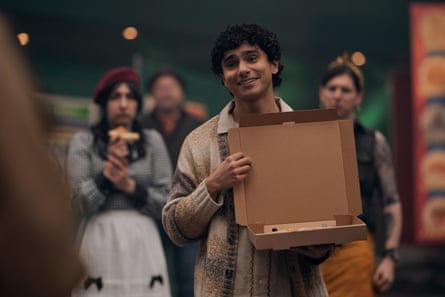
The main business is the second coming of Jesus, planned in the pristine white corridors of heaven by Aziraphale and the archangels. The joke in Good Omens is that both heaven and hell are malfunctioning bureaucracies, interfering in humanity’s business with their petty rules and institutional hypocrisy – inevitably, then, the celestial team have soon lost track of the messiah’s whereabouts, leaving him to roam Earth alone.
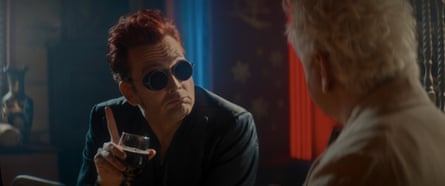
Jesus is played by Bilal Hasna as a naive innocent who has just about recovered from “the nailing business”, but who still misses that gang of 12 mates he had the last time he was flesh. In an odd and confusing storyline he befriends retired card sharp Harry the Fish (Mark Addy) before becoming a street preacher. In an effort to find and supervise the son of God, Aziraphale – who had hoped to greet Jesus with a nice cup of tea – returns to Earth and reunites with Crowley, who is now an alcoholic gambling addict filled with resentment at Aziraphale’s decision to prioritise work commitments over their relationship. “You’ve lost Jesus and bollocksed up the Second Coming!” belches Crowley at his regretful soulmate. But once Aziraphale has helped Crowley to win back his magic vintage Bentley from a crooked casino owner played by Sean Pertwee, the two are colleagues again, at least.
For a while Good Omens reverts to its stock in trade, which is a chin-waggling Tennant quipping furiously while Sheen frets. More than ever, there’s a grating smugness to the dialogue: “He likes deserts,” says Crowley, speculating on where Jesus might have wandered off to. “Or he used to. Spent 40 days in one back when I knew him!”
When archangels start dying mysteriously and sacred artefacts go missing, however, the pair forget all about Christ and investigate which of paradise’s middle managers is sabotaging the operation, a conundrum solved far too soon for the answer to have taken on any significance. Both the central storylines are non-starters.
And so we are ushered towards a final four-way verbal showdown between Crowley, Aziraphale and two supernatural beings, played by two delightful heavyweight guest stars. As they debate what it was all for, Good Omens rehearses its rather basic musings on religion, doling out standard humanist stuff about messy mortals being pretty bloody marvellous things who don’t deserve to be restricted by a fear of judgment in the great beyond. All four players in the scene are wasted: this show has possibly the biggest imbalance in TV history between dazzling cast and stale script. (Earlier, the show has committed the previously unthinkable crime of making the normally divine Paul Chahidi, as silly-voiced archangel Sandalphon, annoying.)
But the cast, particularly Tennant and Sheen, very nearly redeem it. Crowley and Aziraphale’s tearful resolution of whether their love can overcome the demands of the infinite is delivered with gusto by both, and then there’s a shamelessly lovely coda that imagines an alternative version of their characters where that dilemma doesn’t arise. It suggests that the duo would be brilliant as a married couple in an ordinary romantic drama, as different characters created by different writers: Good Omens be damned.