4 hours ago
8
4 hours ago
8
On a chilly morning at a Silvertown studio behind London City airport, the sunburst intro to Jimmy Cliff’s The Harder They Come is on repeat. Dancers run through a routine studded with reggae and dancehall moves. “Get high,” commands associate choreographer Neisha-yen Jones with a smile. “Get low!” The ensemble rise and dip. They do the bogle and whine around each other as their watchful director Matthew Xia nods along. They circle Natey Jones who breaks out the opening line: “Well, they tell me of a pie up in the sky.” In the distance, a plane leaves the ground.
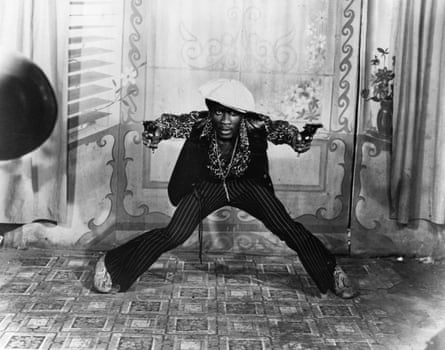
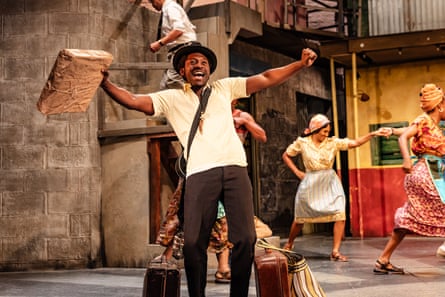
It’s eight months since The Harder They Come’s full-throttle takeoff at Stratford East, where the musical was so popular that it is now returning for a second run which will also serve as a eulogy for Cliff who died in November. Playwright Suzan-Lori Parks’ adaptation of Perry Henzell’s 1972 Jamaican film is bolstered by a handful of her own songs as well as classics including Israelites and Wonderful World, Beautiful People – plus every number on the film’s monumental soundtrack. Jones is reprising the role of Ivan (played on screen by Cliff and inspired by real-life outlaw Rhyging), who arrives in Kingston from the country and is dismissed and exploited, before becoming both a hit singer and a fugitive. The original was akin to cinéma vérité, directly evoked spaghetti westerns and veered into blaxploitation territory; Ivan’s tale has gained greater warmth, humour and protest spirit on stage. It was the best musical I saw in 2025.
“The story is a tragedy but the theatrical event is a celebration,” says Xia of his production. Twenty years ago, the film was adapted as a musical with a book by Henzell, also at Stratford East. “It all started at Ivan’s Nine Night,” Xia recalls. “There was a massive poster of Ivan on the wall, with everyone coming, and it was told in retrospect with vignettes.” Cliff was a special guest at the press night – “he jumped up on stage at the end and sang The Harder They Come” – while Neisha-yen Jones was among the cast when it transferred to the Barbican. Watching the musical in the audience one night was Shelley Maxwell, recently arrived from Jamaica.
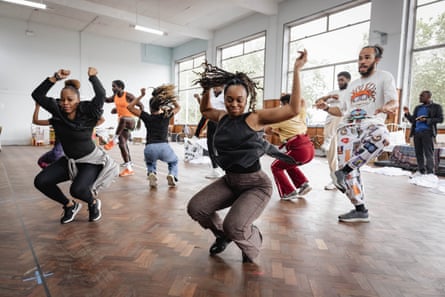
“I was up on my feet,” remembers Maxwell, who feels like she has come full circle as choreographer of the new production. She has fused the folk dance forms of revivalism and pocomania, learned in her childhood, with reggae, dancehall and moves that today’s teenagers can recognise. “I wanted to tap into the youth market,” she says. It’s brought some enthusiastic feedback from audience members who may not know the film. “Like: ‘Oh my God, they did that step I always do at a party!’ It allows them to form a connection.”
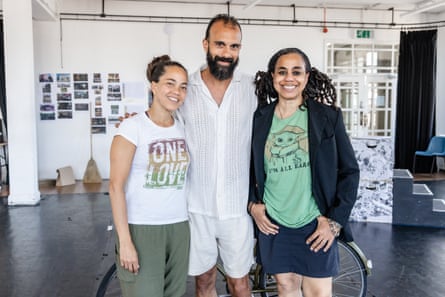
Xia, wearing trainers in the Jamaican flag’s colours, and Maxwell, whose tracksuit has the same black, green and gold trim, were intent on instantly transporting their audience to Kingston. The opening, says the director, is an “establishing shot” with characters coming and going on Simon Kenny’s magnificent multi-level set, accompanied by Toots and the Maytals’ hit Funky Kingston. To borrow from its lyrics, you really can believe everything they do. Even each move in the dominoes game we see is scripted, explains Maxwell, who mapped out the market scene with precision: “Where are you going to? How heavy is the item that you’re holding? This is the swing of the hips.”
Xia, whose father came to England from Jamaica in the 1970s, praises the freewheeling realism of the film. “Lots of the background performers are just whoever happened to be in the market that day, or walking through the shantytown. Lots of the actors were people that Perry knew, they had no training.” Henzell, says Xia, showed “the part of Jamaica that had always been hidden, people living hand to mouth”. The musical depicts a “quartet of oppression” against Ivan, as he takes a stand against individuals representing hypocrisies of the church, law, drugs trade and music industry.
The Harder They Come was both a pioneering example of independent film-making for Jamaicans and a portrait of a newly independent country. Maxwell, who grew up glued to Hollywood musicals, says it was empowering to discover a film full of the Jamaican songs she loved. “I was probably way too young when I saw it. But what I saw was the world around me.” She traces how different forms of music played a pivotal part in the country establishing its identity, moving from African forms and American R&B to mento, ska, rocksteady, reggae and the rise of Bob Marley and Jimmy Cliff. Maxwell captures that chain reaction with a tantalising question: “What’s this groove becoming?” While observing that “dance and music became a huge part of how we unified as a culture” she recognises in Ivan’s story the roots of the unemployment and wealth inequality issues, especially the “divide between lower and upper”, in today’s Jamaica. “The context is Jamaica, 1972,” says Xia. “But the story of a man who stands against the system and gives everything he’s got to succeed is for everybody.” Maxwell agrees: “It’s universal with regards to the challenges that are facing young people now and the choices they have to make.”
The musical also makes its hero’s actions more understandable. “In the film, Ivan becomes a kind of wanton murderer,” says Xia. In the musical, “he accidentally shoots a police officer when he’s under threat, is remorseful, yet also knows that if he gives himself in then that’s the end of his journey”. Another significant change is the depth given to the principal women – Ivan’s mother Daisy and Elsa, with whom he falls in love under the eye of her authoritarian guardian, the preacher. “The moral heart of the piece now resides in those two women,” says Xia. Maxwell transforms a brief sequence from the film, in which Ivan imagines a tryst with the devout Elsa, into a floor-trembling set piece when the preacher’s congregation lose their robes to indulge in lustful fantasy. The male gaze of the original scene is duly excised: “it had to be like it was both of them in partnership in that fantasy world,” says Maxwell, who adds that the nature of dancehall – “grinding, gyrating on another body” required her to use her skillset as an intimacy director. “It was for the entire company, ensuring that they were safe doing the kind of movement we were going to do.”
Xia says that when Parks saw the “indomitable spirit” of actor Madeline Charlemagne in the role of Elsa, she even rewrote the ending. When I chat to the playwright on a video call, she elaborates on strengthening the female roles: “I have a theory that when you elevate one character, all characters rise.” Like Xia and Maxwell, Parks loves the film – yet she felt that Ivan “wasn’t properly realised because the women in his life weren’t fully realised, weren’t fully sung if you will … Now we have a chance to see what’s going on in the lives of those women. To hear more from his mother and why she is concerned about his arrival in the city. To hear from Elsa and how she falls in love and gives up everything she knows.”
The result is a show that, in Maxwell’s movement, Xia’s direction and Parks’s script, manages to simultaneously hold joy and hardship. “It doesn’t have to be a downer or an upper,” says Parks. “It gives you all the feels.” She adopts a show-woman’s patter: “You’re laughing. You’re crying. You’re rooting for him. You’re scared and hiding your face. You say: go, go! You say: no, no! As a world community, I think we need to start feeling all the feelings. You need to question if you’re on his side or not. Like the folks in the town square do. Oh, he’s a hero. No, he’s an outlaw. It’s both, it’s everything. We need to start exercising those muscles again so it’s not just one way or the other.”
Parks, who also gigs with her band SLP and the Joyful Noise, says she has “been writing songs for longer than I’ve been writing plays”. She has just completed a novel “which has songs in it as well. I love writing songs – and I’m kind of looking for places to put them”. Xia says Act 1 of the musical originally ended with Jimmy Cliff’s Aim and Ambition but Parks “was so taken by the energy of the room” that she went away and wrote a new number, The Time Is Now. Parks holds up the travel guitar she strummed during rehearsals with her headphones on. “I was just playing around, watching them and going, what would suit this moment? We realised we needed a different song to end the act. It was tense because I had to get it to them by the next day … But that was one of the really exciting challenges of the show, making it stage-worthy.”
While the title number is performed as Ivan’s recording session, like in the film, there are radical new arrangements of other tunes, including Pressure Drop. Cliff’s plangent Many Rivers to Cross is moved towards the end – “it’s what we call in the States our 11 o’clock number,” says Parks, whose adaptation was seen in an earlier version at the Public theater in New York. “Every person in our show has many rivers to cross. And that’s what we’re all going to sing together beautifully.”
At the first preview in Stratford, audiences were indeed quick to sing along to the familiar set list. “I remember saying to Suzan-Lori, how do we get them not to do that?” admits Xia. “And she said: ‘Why would you want to get them not to do that? They’re singing with love.’ And I went, you’re absolutely right!” He is wary of prohibiting behaviour in the auditorium. “People saying you mustn’t and you can’t and you shouldn’t? … I think that’s the death of the audience.” He adds: “I don’t want passive spectators, I want active participants”. (At Xia’s current Soho theatre production of Dave Harris’s strip-club drama Tender, with choreography by Maxwell, theatregoers are given paddles to indicate whether they are up for a more “interactive” experience.)
Stratford East’s crowd has always been vibrant, says Xia. This former home of Joan Littlewood’s trailblazing company taught him “everything I know about theatre – in terms of who it’s for, how do we make it, why do we make it. And the continuous kind of feedback loop of inspiration that Joan used to refer to of taking community-relevant stories, putting them on stage for the community, then inspiring the community to discover and tell more stories.” He first walked in at the age of 11 and has been “an audience member, a young company member, associate director, board member for 10 years, the DJ in the bar, I’ve written songs for pantomimes, I’ve adapted plays … It’s home.”
This latest homecoming is even sweeter as The Harder They Come is receiving a victory lap rather than an anxious first unveiling. Are the nerves dialled down now? “Absolutely,” says Xia. “The cortisol was high the first time around.” Many of the original cast are back. On day one of rehearsals, “all of the harmonies were still there” he says. “And even though we ran through it sitting down, when we hit a song, all of them had a foot tapping. It was all still in the body.”
-
The Harder They Come is at Stratford East, London, 16 May-4 July