4 hours ago
13
4 hours ago
13
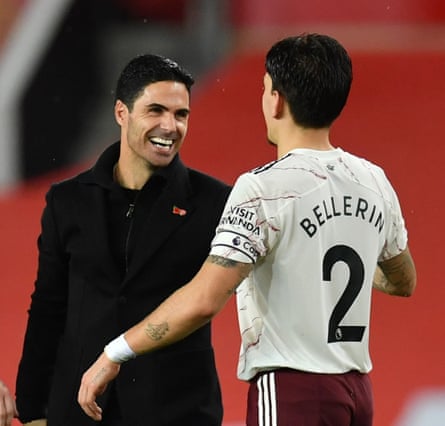
One day when he was 18 or 19, still near the start of his journey, Héctor Bellerín got a call from Mikel Arteta inviting him round. He remembers asking lunch or dinner but this was neither. “When I arrived that afternoon, he was sitting with a financial adviser and they started to ask: ‘How much do you spend on this?’ ‘How much do you spend on that?’. I was young, I’d just started to make money and spend money: on clothes, cars, the things we all do when you’re not really aware. I was pitching low. I felt embarrassed, ashamed, but I left with a lesson in humility and affection.
“Mikel was the first player who showed me that I was important to him, that I mattered. He demonstrates real care, if not through a hug. I said: ‘Thank you.’ He said: ‘If you do the same for a teammate one day I’m happy.’ The legacy he left is one I try to pass on so young players feel looked after and that’s an experience that defines Mikel very well.”
More than a decade later, it is one of many experiences, a lot of them in London, that help to define Bellerín too. Thirteen years between them, Arteta and Bellerín were teammates then; real mates, too. They have been player and coach, a shift in roles that was not always simple. On Wednesday they will be opponents. It is a pre-season friendly at the Aviva Stadium, not the Emirates Stadium, but for Bellerín it is special. The Real Betis full-back, 31 now, has never faced his former club. Only once could he have, on loan at Sporting, and then he got a knee injury – the timing so inconveniently exact that he cannot help wondering if it was in his head. He does so with his former club, led by his friend, as Premier League champions.
“I have an incredible feeling of love for the club,” he says, settling into a sofa 30 miles west of Dublin, still in his training kit. Fascinating company, he talks Serge Gnabry, Santi Cazorla and Nacho Monreal. He recalls the kindness of Tomas Rosicky telling him how to get the better of him in training, an experience he is repeating with José Antonio Morante, the 19-year-old winger who faces him daily, and the darker side of the sport, too. And he talks life and people and politics, having a voice and refusing to be silent: not because he sought one, not even because he is sure it changes things much, but because that’s the way he is, the personality built.
He talks about an industry which, he admits, often makes his “blood boil”, football becoming the “maximum exponent of greed”. About the pressure and the abuse. But he talks about how he loves the game too, how for all those other facets to him he is a footballer and always has been, how he is “addicted” to it, committed to it, and deserves his place here. On this occasion, though, he talks mostly about Arsenal, and there is warmth in every word.
“There are still players I grew up with: Bukayo [Saka], Ben White, the manager, coaches, staff. It still feels like family for me. My appreciation and affection for them is immense. I became a footballer there. I’m sure that my life, my way of being, of thinking, my conscience, all the things that represent me, were latent in me but they needed a place where they could be expressed. London gave me that space where I could explore my world, mature. There are places that could constrain you, but London was somewhere I could expand, explore life.”
It started lodging with the Twitching family in Enfield, on the Ridgeway: Donna and John and their kids, Tia and Ben. Bellerín was 16 from Barcelona. He was joined by Jon Toral, a teammate since they were eight, who played in India last season, and who embraced a new world with him then. “Roast dinner was a tradition. I didn’t understand that on Sunday you only ate once and then leftovers. That ‘journey’ was funny: last time I was in London I went to a pub to find a Sunday roast … but by then it’s vegan. Kentish Town. Elements of my personality totally come from England.
“The first thing Liam Brady, the academy director, gave me and Jon was an Oyster card. Jon would put on Sky, watch all the games, then the darts, then the snooker. We were earning €400 a month but there was a feeling of independence. I would ask Donna: ‘Where can I go?’ Camden, Covent Garden … to Brixton to play pool. We didn’t feel either overprotected or abandoned. We had to catch two buses and the tube for training. Over 12 years, I lived in all different places. I spent the pandemic living in a 17th-century farm in St Albans where the only way in was down a sand track.
“I would have loved to have been to the title-winning parade, but we still had games here. I was there in that moment of transition in Mikel’s first year as manager. But we won the FA Cup which was a key moment. One of the lovely things when they won the league was lots of people sent messages and I felt part of it. There are so many people I talk to, we’re all Gunners, and it was like a liberation, a release after so long.
“I was talking to Nacho [Monreal] and Santi [Cazorla]: it would be great if the three of us could go for a game. We were the group with Mikel. We knew that with Mikel one day Arsenal would win the league. In training he would ask: ‘What did you do at Barcelona? I would do this …’ [Later] I was with him a year and a half [as coach] and I could say that 80% of my football came through Mikel’s mind. His is a totally different vision. There’s an understanding, an observation, he sees patterns, and has a very specific language. I’d go so far as to say that he has put extra years on my career. I play totally differently to how I did at 19. That’s about experience but also a lot about what I learnt from Mikel: how to help my teammate, create advantages in my space. Bloody hell, I owe Mikel so much.”
after newsletter promotion
“Our relationship going from teammates to coach and player was strange,” Bellerín says, pausing a moment. “I’m not sure we knew how to manage the transition. But face to face there was always that past there which meant we could talk honestly. I had decided that I had to go, but it wasn’t a conversation; it was lots of them going back a year. I feel huge admiration for him. And Betis arrived in the moment that I needed it.”
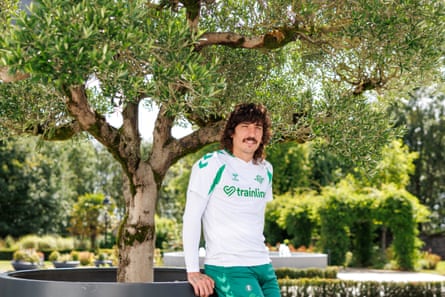
Why did you need it? There’s a pause. “There’s not a specific reason. Something happened but it’s not a thing; it’s more that there’s a kind of disconnect in which I felt that I could no longer help the club and the club could no longer help me. We managed that in the most amicable way. Maybe I needed to be close to my roots, home. It had been a long time. When you leave a club like Arsenal, it’s scary, eh. Scary. It hurts, mate: look, however much you know that your moment is over, it was your home. You were there for 10 years, you leave friends behind, a life … you don’t know what you are going to find on the other side. I was lucky.”
There is something about Betis, the club his grandmother and father supported, and about the city. Bellerín found a place. From the daily cycle into training to the writing classes, the fashion designing, the veganism and environmental activism, the commitment to sustainability and willingness to speak about toxic masculinity and the avarice of the game. The refuge from that: “What most struck me was the dressing room. There is something ‘horizontal’ in the relationship with other employees. At my other clubs that didn’t exist. That’s the essence of us, what sustains us. And it fits with my values. In Seville I have found a city that embraced me, allowed my existence beyond football.”
And the football has worked out nicely too, for him, Betis and Arsenal. “It’s been good for both of us. Look where Arsenal are. We’re in the Champions League, we won the cup. I’m in a very good moment. It was right. The Champions League final hurt but it’s important that doesn’t overshadow Arsenal’s progress. They are where they deserve to be; it’s a very sweet moment. To be able to face them now, the best team in Europe, is the business.”