3 months ago
183
3 months ago
183
It was springtime in Paris and I was floating among young green leaves and white blossom – but I was not in a park. I was on an upper floor of the Fondation Louis Vuitton delighting, wallowing in several of David Hockney’s iPad paintings of his garden in Normandy. In one room, this green oasis was shown by the light of the silvery moon: the darkened chamber was alive with shining white lunar discs, blue clouds and the shadowy fingers of tree branches.
It was early April last year and this was the opening of David Hockney 25, a blockbuster show, curated with his close involvement, covering his entire career – but with an emphasis on his work this century. What a bold and bloody-minded spectacle it was, insisting that Hockney’s later pictures of straw bales and ponds are just as good if not better than his famous early swimming pools and sexy portraits. And what a triumph! With extraordinary aplomb, Hockney made his point. You went from gazing in awe at some of his greatest early paintings, basking in their Californian and swinging London light, to suddenly standing in Yorkshire fields in the early 21st century, taking in views of emerald hedgerows and purple trees. And it all suddenly made sense.
One of my most treasured memories was a quiet dinner in a house in west London after a trip to the National Gallery. Not any old trip to the NG but an after-hours one in which Hockney, my host, used his special privilege as a modern master to go there when he liked: the only other visitors that evening were the painter Leon Kossoff and his family. Now I sat at dinner with a man who had been one of my heroes since I first saw an image of A Bigger Splash in my childhood encyclopedia. We had crisp tangy fresh lychees for dessert – first time for me – accompanied by Hockney’s passionate views on art. He elaborated on his book Secret Knowledge: Rediscovering the Lost Techniques of the Old Masters, which came out at the start of this century. We had been to see a Caravaggio exhibition in which he saw clues that this hyperreal 17th-century artist used a kind of camera obscura.
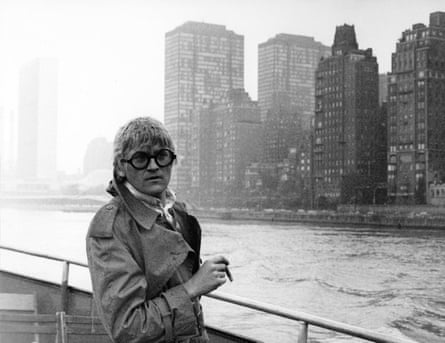
I wasn’t convinced. I wasn’t even sure why it mattered. Instead, I was trying to fathom this amazing man and look for traces of the Hockney whose glam-age, yet eerie social world is hauntingly evoked in Jack Hazan’s semi-dramatised documentary A Bigger Splash. When I recognised one of the people from the film moving about the house, I was thrilled.
Hockney in the 21st century went out of his way to be different from his famous 20th-century self. He seemed more interested in art history and theories of perspective than in male beauty or Hollywood hedonism. Well, perhaps not entirely. The very first time I spoke to him, he delivered a striking statement on the power of human beauty: “When you see a really beautiful person, it’s like a door opens …”
He also preferred the country to the city, hay bales to swimming pools. The next time I met him was in Bridlington, Yorkshire, where he was living in an old-fashioned house whose interior he’d painted in powerful California colours with a sunny conservatory. Upstairs a tiny bedroom served as his studio – or more like a store for his latest paintings, because he was doing the real work out in the actual Yorkshire landscape, with his easel set up en plein air like a French impressionist.
It was hard to adjust to this determinedly unglamorous Hockney. The first time I ever saw him in the flesh, he still had peroxide blond hair: he was taking a bow at a revival of his opera set for Stravinsky’s Rake’s Progress at Sadler’s Wells. I was up in the gods, applauding furiously. Soon, though, he stopped designing ballet and opera productions due to his deepening deafness, and let his hair become its natural grey. One Hockney seemed to have died, only to be replaced by another.
Yet if I’d thought about it harder, that production of Stravinsky might have shown me that Hockney was still the same artist, always aware of art history, fascinated by style and intrigued by how perspective creates a fictional space. For this opera, based on William Hogarth’s 18th-century visual narrative, Hockney’s set boxed the stage in deeply raked, cross-hatched recreations of Hogarth prints in vanishing perspectives. Clever stuff. When he started painting woodlands and harvests in Yorkshire, he was being clever, too.
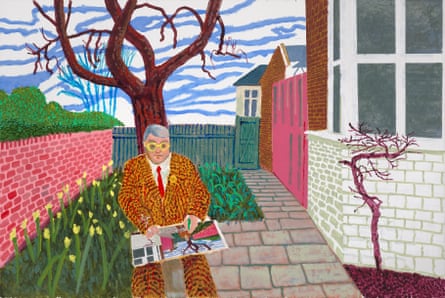
It took, however, a global catastrophe for the apparently gentle, private passions of Hockney’s late career to become urgent, public, even salvational. When the pandemic began, he was living in Normandy, where he’d found a rustic old house set amid bountiful nature. Always interested in new technologies – he even had a fax-art period – he was by now adept with an iPad. When lockdown started, he did iPad paintings of his garden and sent them out by email in a simple attempt to spread some cheer during lockdown. I somehow ended up on his address list and would wake up to find a brand new Hockney, or several, in my inbox every morning. From his iPad to mine. He was depicting the spring in Normandy – trees rustled by the breeze, rain spattering a pond – and offering these unforced observations of nature as some evidence of hope and happiness in a world that had battened down its hatches.x
At first, at least to me, Hockney’s back-to-basics decision to paint directly observed nature had seemed like his retirement. Pleasant enough, but wasn’t painting Yorkshire’s pastoral beauties the painter’s equivalent of spending peaceful afternoons gardening? Now his insistence on seeing and showing the endless variety of the seasons and the resilience of the natural world suddenly looked profound. What have we got except life, in all its forms? What matters except waking up and seeing the light and feeling the breeze?
Ping: another email from Normandy, another sunrise in vivid electric yellow over intense greens, as I drank my morning coffee.

In one lockdown email, he referred to “JP who I love”. It was a surprise because he was so cagey about his private life. I could never get him to talk about the emotional content of his art. He preferred to discuss issues of pictorial space. JP is Jean-Pierre Gonçalves de Lima, who was Hockney’s assistant before becoming his lover. I have a vivid memory of them both having a cheeky smoke outside the Fitzwilliam Museum in Cambridge, Hockney in a wheelchair as they laughed scornfully at the university’s strict anti-smoking policy. I think JP helped Hockney by making him happy. His late art seemed to bloom as their relationship grew. Hockney found love and he put it into his Normandy art, a kiss to the world.
Still, you couldn’t really put Hockney in any simple box or make him into who you wanted him to be. On that visit to the Fitzwilliam exhibition, which looked at scientific ideas in his art, I stood beside him in front of a haunting 1970s painting trying to get him to say something about its depiction of his former lover Peter Schlesinger, but he only talked about its trick perspective. And my nostalgia for early Hockney was intensely exacerbated that day by the arrival of Celia Birtwell, his muse, who was still as glamorous as she is in his painting Mr and Mrs Clark and Percy.
Let’s be honest. It will be Hockney’s paintings of the 1960s and early 1970s that live down the ages. His way of framing a scene makes him a great narrative painter whose observations of the social world are utterly haunting. But he made his point about simply looking at nature in his late work. When art seemed to have lost faith with drawing and painting was rumoured to be dead, he went back to his Yorkshire roots to assert a totally unpretentious idea of art as pure perception.
As he was getting older and his hand and eye were less subtle, he also showed how democratic and universal art can be. We should all observe our surroundings, draw and paint. An iPad is fine, you don’t need an easel. It’s the voyage of the eye that matters.
In that sublime Paris exhibition, this great late vision was victorious – and Hockney was vindicated. What a cussed, tough-minded Yorkshireman he was. His final victory lap even included a show this year at London’s hipper-than-hip Serpentine Gallery. An artist who started the 21st century far from fashion ended his life as the toast of the art world. It was one last glorious, triumphant spring.