3 months ago
54
3 months ago
54
Palestinians in Gaza already grappling with limited supplies of food and medicine face new threats to their day-to-day existence: shortages of engine oil, spare parts and gas. The knock-on effects are impacting everything from bread production to water supplies and emergency response efforts, producing one fresh crisis after another.
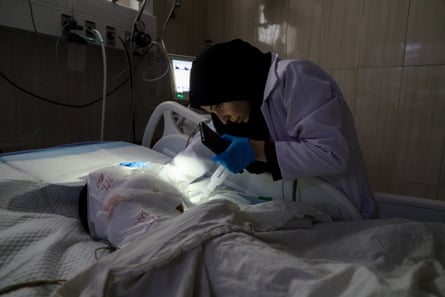
Over the weekend, the main hospital in central Gaza warned of an imminent health disaster as its electrical generators failed.
Dr Raed Hussein, director of the al-Aqsa Martyrs hospital, said: “We issued a distress call after a small generator that we depended on to support the operation of the surgery operating rooms during the morning stopped working.
“This generator used to support the 400 kVA generator that operates in the morning hours. When it broke down, we could no longer run the surgical operating rooms as usual, and unfortunately we had to close them … the available electrical capacity was no longer sufficient to handle the required load.”
The maintenance work being carried was only a temporary solution, he warned, as there was no availability of the materials needed for a full repair.
“What is happening now is ‘patchwork’ maintenance, not real maintenance, because Gaza lacks the necessary spare parts,” he said. “Even previous repairs depended on dismantling old generators and using their parts to keep other generators running for a limited period.”
Some generators are now permanently out of service while Hussein fears the arrival of higher summer temperatures will soon put those that remain under even greater pressure.
Gaza’s civil defence, meanwhile, warned its fire and rescue operations are at risk of coming to a complete halt and that it is already only dealing with the most critical emergencies. It is also facing a lack of spare parts, specifically for vehicles, along with restrictions on the entry of firefighting and rescue equipment, fuel and engine oil. This has already led to the breakdown of three firefighting and rescue vehicles, as well as two ambulances.
Engine oil – used for lubrication to reduce the wear in moving parts – may seem like a minor item, but its shortage is deepening the series of crises in Gaza. One litre now costs about 2,200 shekels (£570), compared with roughly 25 shekels before the war. Despite its extremely high price, most of the available oil is old stock and often of poor quality.
Tyres and spare parts are also a problem and one small sealing component that used to cost between seven and 12 shekels is now sold for hundreds. A cylinder head gasket, if it’s possible to find one, has increased in price from 120 to about 2,000 shekels.
“The nature of our work has changed significantly in recent months because of the severe shortage of engine oil and spare parts,” said Rafiq Hamouda, 52, who repairs engines and vehicles in the al-Mawasi area of Deir al-Balah. “Today we have seven cars that we have fully repaired, but they remain out of service simply because there is no engine oil available to run them.”
To cope with the shortage, Hamouda said he has started dismantling entire vehicles to use their parts in repairing others. “We have dismantled around six vehicles that were still relatively functional and used their engines, gearboxes and other components to save other vehicles. It has become like trying to keep a patient alive on life support.”
Large numbers of cars have already stopped operating due to the scarcity of engine oil, or have been abandoned near their homes or tents by their owners who can no longer afford them, with huge impacts on the transportation available to Palestinians in Gaza. The deaths of many animals previously used for transportation from war and famine has added yet another challenge.
“The transportation crisis has had a major impact on our lives, especially because of my husband’s health condition,” said Heba Qahman, 36, a displaced mother-of-five living in Deir al-Balah. “About two months ago, he was injured in a traffic accident and suffered fractures in his leg. He underwent several surgeries and now needs regular medical follow up.
“The hospital is several kilometres away from where we live. I often have to push my husband in a wheelchair all the way there while carrying my baby. Sometimes, it takes me nearly an hour to reach the hospital, which is exhausting for both of us.”
Meanwhile, with Israel controlling 60% of Gaza and dividing the territory along its “yellow line”, many residents can no longer access their homes, belongings or businesses to retrieve furniture and personal possessions. It has deepened the humanitarian crisis caused by the war, which has killed about 70,000 Palestinians, displaced more than 1.5 million people and destroyed over 80% of buildings and homes across Gaza.
A report last week from Unicef, the United Nations’ children’s agency, also found that Gaza’s water and sanitation sector had been affected by the shortage of spare parts and engine oil.
It said essential water systems continued to face severe pressure because of restrictions on energy supplies, chemicals and spare parts. Seawater desalination plants are producing about 16,000 cubic meters of water a day, compared with 20,000 in March, reducing water production and related services.
It has contributed to growing health and living challenges, especially with rising temperatures and the increased need for bathing and maintaining personal hygiene, particularly among children.
“The shortage of drinking water and the reduced water supply in camps and residential areas have forced us to cut water use for personal hygiene, washing clothes and cleaning household items,” said Walaa Sarsour, 46, from Beit Lahiya.
“Water now reaches us only about once every two days and in limited quantities, whereas it was more available before.”
The impact of the shortage of engine oil and spare parts is also being felt in bakeries and generators that provide electricity to businesses through monthly subscriptions.
“Some generators have stopped working, while other bakeries have reduced production because they no longer have enough oil to operate their generators,” said Abdel Nasser Al-Ajrami, head of Gaza’s Bakery Owners Association. “Some bakeries that used to produce pastries, fine bread and other products have stopped making them because they have run out of engine oil and cannot afford it at these prices.”
He warned that any disruption in bakery operations would directly affect residents. “If bakeries stop operating, families will struggle to obtain bread and will have to bake on their own using firewood or gas. But gas itself is unavailable, and firewood has become scarce due to heavy consumption. This will only increase suffering of families.”
Israeli restrictions on fuel imports since the beginning of the war in October 2023 have already forced families and displaced people to rely on firewood. But prices have risen sharply, reaching nearly $3 a kilogram, and now many families use plastic and nylon as fuel for cooking.
“The gas crisis is one of the hardest crises we have faced in these months. We now depend on open fires for cooking, which is extremely difficult, especially with the shortage of water and the harsh living conditions,” said Qahman, the displaced mother-of-five.
“Because we cannot afford to buy firewood regularly, we have had to look for alternatives, including collecting burnable waste from the streets.”
As prices of many essential goods continue to rise and supplies become scarce, people are increasingly searching for alternatives. A simple gas lighter now costs more than 30 shekels, while a toilet seat can cost about 2,000 shekels.
“We have tried to find alternatives for everything that has become unavailable or rare,” said Sarsour. “We have also been forced to give up some non-essential needs and focus only on the most necessary priorities.”