3 months ago
167
3 months ago
167
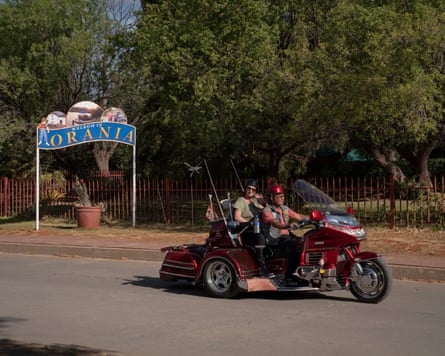
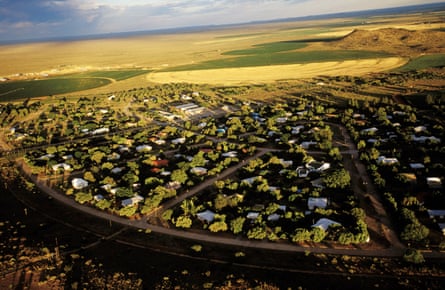
There’s a little town in the scrub in South Africa – a full day’s drive from the country’s big cities – that has become perhaps the most scrutinised place on earth, given its size. It is 9 sq km (3.5 sq miles) of suburban-style houses harbouring about 3,000 people, with a main drag, a municipal swimming pool, one gas station and some pecan farms. Nothing of consequence ever really happens there, a fact the townspeople take as a point of pride. And yet over the past three decades, dozens of English-language news outlets have made a pilgrimage to it, often more than once. The New York Times alone has run four dedicated profiles. The essays have kept pace year after year, quoting the same people over and over, even as nothing of note occurred. There’s been no war, no disaster.
That changelessness is the point. No people of colour are allowed to live in the town, called Orania. The name is a nod to the river that runs nearby – and to the Orange Free State, the apartheid-era designation for the province in which it lies. Orania’s founders established it in 1991, the year after South Africa’s best-known Black liberation leader (and future president), Nelson Mandela, was freed following 27 years in prison.
Understanding that Mandela’s liberation meant that white-minority rule was coming to an end, the founders trekked into the desert, bought a disused mining town wholesale and established a colony. Laws permitting – indeed, mandating – spatial segregation by race had just been abolished in the country, so they declared the town private property. Orania’s founders said they wanted to run an experiment: could people of European descent live in South Africa without relying on people of colour to do manual labour, pump their petrol and clean their houses? In Orania, they stressed, white residents would do such work.
Orania’s founders also foresaw a brutal race war, predicting that the population of the town would grow to 10,000 and its ideals would spread across an entire nearby province, drawing in hundreds of thousands.
I’ve lived in South Africa for 16 years, ever since I left the US in 2009. And I, too, dutifully went for the obligatory journalist’s visit after I landed. But in the ensuing years, I began to wonder why the town was a source of such stubborn fascination abroad. In the beginning, the US and European reporters that descended on the town mostly hailed from mainstream or leftwing outlets, and they seemed to buy its claims about its appeal, insisting that it was steadily attracting more and more revanchist white residents. At first I thought these reporters might have been comforting themselves: “Our societies may have failed to address persistent racial injustice, but look at white South Africans, longing to return to outright segregation! At least we’re not that backward.”
But more lately, the fascination with Orania has spread to the right wing outside South Africa. Starting in the mid-2010s, as Donald Trump was muscling his way on to the political stage, Australian, European and, especially, American conservative commentators began to talk about the town. They, too, portrayed it as thriving – because of the enormous threat they claimed white people faced in the rest of South Africa. In these years – during which a Black man was president of the US and the Black Lives Matter movement arose – it seemed as if a big shift was happening. Not only would so-called minorities seek legal equality in white-led societies but they also would take greater ownership of politics and the national story.
White Americans worried about this transition latched on to South Africa as a supposed natural experiment. After the country became a one-man, one-vote democracy, people of colour took the reins of politics, came to dominate the media, climbed the ranks of business, and refashioned school curricula to narrate a different national history. Conservative bloggers, talk-radio hosts and cable networks invited a small and vocal contingent of white South Africans – sometimes people associated with Orania, sometimes lobbyists for Afrikaner interests – to bear witness to a specific version of this transition. Although it may have been immoral, these South Africans’ story went, white-minority rule had created safe, stable and happy lives for white people. After losing influence, white South Africans became increasingly subject to discrimination, violence and even a so-called white genocide by citizens of colour bent on pursuing revenge.
The cautionary tale was this: if formerly oppressed people got enough power, they would inevitably pursue retribution – even an annihilation programme. That provided a justification for other white leaders’ efforts to retain their influence.
When Trump re-entered the White House in January 2025, his supporters’ fixation on South Africa grew exponentially as he became more willing to put policy behind his rhetoric. He’d tweeted about the victimisation of white South Africans during his first term, but in his second term, Trump issued an unprecedented executive order targeting the country. It cut US foreign assistance and made a startling exception to his general antipathy to immigrants by offering expedited refugee status to Afrikaners, the Dutch-descended white group that helped build the apartheid regime. Last May, he brought the South African president, Cyril Ramaphosa, to the White House for a kind of kangaroo trial, declaring that he felt there was “persecution or genocide going on”. Taking the hint, nearly every big-league conservative influencer in the US invited white South Africans to discuss the issue; sometimes these shows touted Orania as the only safe space left for them.
The problem is that the tale peddled about white South Africans’ historical trajectory isn’t true. They are not, as a group, subject to violent persecution on the basis of their skin colour. As of 2023, white households’ average income remained four and a half times that of Black households. Although South Africa’s devastatingly high crime rate victimises all the country’s inhabitants, white South Africans are overall less likely than Black citizens to be victims of crime. And to many white South Africans, the warped way their country is depicted abroad isn’t even the most important distortion. Spend some time speaking to some of the estimated 4.5 million white people who still live in South Africa – a number that has remained nearly steady since the early 1990s – and most will tell you that they are better off than they were under the white regime that was purportedly designed to protect them. Violent crime fell by half during the two decades after apartheid’s end; although homicide rates have risen since the late 2010s and are very high by global standards, they remain about 30% below their 1993 peak. The rule of law largely operates, elections are free and fair, and white politicians hold major cabinet ministries.
Why are people who live in white-majority countries so uninterested in the real story, even unwilling to believe it? It isn’t only rightwingers who believe that racial hatred will inevitably reassert itself in some form. I felt that the leftwing reporters who flocked to Orania were searching for evidence to feed a form of the same conviction: that white people will never give up their sense of superiority. That wielding raw power over another group is terribly alluring, that the desire for it is so baked into human nature that efforts to trade it for equity and diversity will probably fail. This idea now passes for sophisticated thinking, even among self-identified progressives who wish for a more just and equitable world but often seem to have given up on it.
This loss of faith is sad, because the real South African story has a different lesson. What is often overlooked in the fascination with South Africa is the violence the apartheid regime wrought on white people. They were not its main or intended victims; they were supposed to be its beneficiaries. But the apartheid regime became a police state that heavily circumscribed its white citizens’ lives, too. School curriculums were sanitised; the press was cowed. White teenagers were drafted into a brutal military that was perpetually mobilised to fight.
The world that Trump and his acolytes have said they want to build, in fact, bears many striking resemblances to the unbearable policing that happened under apartheid. But the message from the vast majority of South Africans to people in the US is: you won’t like it.
Ever since Europeans began to settle the southern tip of Africa, they sought to segregate the native populations. To maintain white people’s political and economic clout as South Africa’s Black population grew during the 20th century, the Afrikaner government that came to power in 1948 drew overt inspiration from Jim Crow, sending emissaries to the American south to study its “separate but equal” schools, buses and water fountains. Apartheid’s so-called architect, Hendrik Verwoerd, was an authoritarian conservative. According to his biographer, he had a “dominating personality” and “those who came under his influence found him irresistible”.
Trained as a psychologist, Verwoerd justified apartheid – which created sprawling, geographically incongruent “native reserves” and largely condemned Black people to manual jobs, even prohibiting them from walking in white neighbourhoods without a “pass” – by maintaining that multiracial communities were, by definition, a recipe for “resentment and revenge”. White South Africans, he added, could not accept the consequence of a multi-racial state unless they were “prepared to commit race suicide”.
But apartheid brought immense unhappiness and misery to white South Africans, too. The apartheid state was a police state. Free speech was proscribed. As the 1950s rolled into the 60s, more and more African countries were freeing themselves from colonial domination; this fuelled the growth of liberation movements in South Africa and anti-apartheid protests. At such protests, white policemen often saved special acts of brutality for the few white demonstrators. White newspaper editors were imprisoned or forced to become police informants. Top government, military and intelligence officials harassed newsrooms, walking through them unannounced. In 1990, when one Afrikaans-language newspaper became too critical of the government, a defence ministry operative bombed its offices. The state routinely seized the passports of white politicians, journalists, artists and students.
In 1960, the country’s most famous novelist, Alan Paton, the author of Cry, the Beloved Country, had his passport seized, forcing a choice: remain permanently trapped in South Africa, hobbling his ability to build a literary career, or be stripped of his citizenship and become a stateless person. A few months after Trump re-entered the White House, Tucker Carlson dwelled on the idea that Black South Africans may, like Hutu leaders during Rwanda’s genocide, come to see white people as vermin. This was a hypothetical. But the apartheid government actually did see white citizens who didn’t toe the line that way. John Vorster, South Africa’s prime minister from 1966 to 1978, explained the government’s philosophy: when a fly is troubling you, you either swat it or let it fly out the window.
Psychiatrists employed by the state used bureaucratic interactions such as the military draft to hunt for people who might be gay. Those who came under suspicion were taken unwillingly to a military hospital, cut off from their families, and subjected to electric shocks. Nearly 1,000 men and women whose behaviour failed to “correct” itself were subjected to forced sex-reassignment surgery.
But the system didn’t target only white people who dissented from a norm. It kept the vast majority of white South Africans fearful and uncertain and gave them little room to manoeuvre. Television was banned altogether until 1975. A harsh censorship regime – you couldn’t buy a copy of Das Kapital in the country, and the radio couldn’t play Bob Dylan – kept white citizens artificially ignorant, relatively unaware of events both inside and outside their country. In 1986, a US News & World Report journalist wrote that during an interview with a white construction worker – who was “holding a copy of a leading Johannesburg newspaper” – the interviewee begged him for real news: “What’s really going on in this country?”
The government harshly policed interracial relationships. In 1972 alone, more than 500 people were prosecuted under the Immorality Act, which forbade sex across the colour line. White families nonetheless “had enormous proximity to Black people, particularly in the domestic realm,” David Bruce, a 62-year-old white South African criminologist, told me. This led organically to feelings of love for one’s Black nannies and friendship with their children, but this warmth had to be suppressed.
It is sometimes said that white South Africans were, at least, insulated from apartheid’s physical violence. That is not true. In 1978, the then prime minister, PW Botha, defined the white South African condition as a perpetual battle against “a psychological onslaught, an economic one, a military one, a diplomatic one – a total onslaught” by Black “terrorists”. That concept caused many white people’s lives to be pervaded by both actual violence and the fear of it. In school, white children learned to handle semiautomatic weapons to, in the words of the South African military’s magazine, instil an “awareness among schoolboys of the nature of the onslaught” by “malevolent revolutionary forces”. An abiding fear of the swart gevaar, or the “Black danger”, was drilled into them.
Amos van der Westhuizen, a 56-year-old financial adviser, had a father who served in the government. Even so, he told me that this sense of onslaught made childhood constrained and scary. He remembered when a gust of wind broke a window at his school. “They” – Black people – “are on us!” he and the other white boys thought, panicked. He loved to play cricket and rugby, but the segregationist apartheid regime prevented him from testing his mettle with talented Black athletes. The government disallowed even elite white sportspeople from playing with Black sportspeople, which meant white athletes could rarely compete abroad.
In the 1950s, South Africa established mandatory conscription for every white teenage male, and in the mid-1970s the country went to war with multiple neighbouring countries. If draftees declined to serve, they could be imprisoned. The army was callous: by the mid-1980s, hundreds of conscripts were attempting suicide every year.
Mark Joseph, a 52-year-old mental health and mindfulness educator born in Johannesburg, told me that as a teen, he’d bought into the apartheid state’s claims that Black people “were our enemy, were going to kill us all, and have no respect for life”. When he joined the military, however, he began to feel that these claims were truer of his own white superiors, the white state’s authority figures.
In basic training, he and fellow conscripts were deprived of water “to toughen us up”. His corporal regularly beat him. “We had industrial ceiling fans, and I recall boys would put their hands in the fan” to break their fingers, Joseph said, so that they would be taken to the hospital and away from the horror. Many feigned mental illnesses just to leave the barracks.
The toll was measurable outside the military. A 1982 study in the Journal of Public Health Policy compared the health of white South Africans with residents of England and Wales. It found that although white South Africans were economically better off than the English and Welsh cohorts and mostly just as healthy, they had a much higher rate of what are now called “deaths of despair”: white South African men were at triple the risk of suicide, and white South Africans of both genders were at more than four times the risk of death from liver cirrhosis, a disease associated with alcohol abuse.
Many white parents beat their children with the same whips the apartheid police used in Black neighbourhoods. During the 1980s, South African newspapers reported on a sharp rise in “family murders” in which white men killed their wives, children and themselves. Early in that decade, when one white South African friend of mine was 12, the father of one of his classmates, despondent over the bankruptcy of his business, killed the boy with a crossbow. That friend told me he came to fear white adults because he felt that they had embodied the very anger and brutality they claimed Black South Africans possessed – either unconsciously or out of the belief they would only prevail if they learned to match their enemy’s purported viciousness.
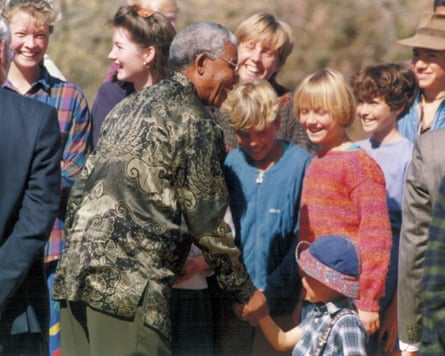
For many white South Africans, the pain they experienced under apartheid lingers. During his insulated schooling and military training, nobody told Joseph that South Africa’s white civilian leaders were beginning to negotiate with Mandela. When Mandela became president, Joseph was “convinced there was going to be a civil war”. All the time, they were told that Black people “were going to kill us all and murder our families and rape our women and take our homes”. Joseph’s father would say: “If Mandela gets out of jail, we’re dead.” Later, realising how thoroughly he had bought into a false view of his Black compatriots, he felt tremendous guilt. He took up Buddhism to exorcise his demons. But, he says, “I still have rage issues. My marriage ended because of it.”
South Africa faced waves of white flight in the early 1960s, during the late 1970s, and throughout the 1980s. A 1977 survey done at Johannesburg’s all-white University of the Witwatersrand found that 64% of graduating seniors said that they intended to “permanently settle in a country other than South Africa”. By 1985, 40% of white medical students and 45% of white business school students at that university left the country immediately after graduating. South Africa faced a skills shortage and business bankruptcies soared. In 1985, the US consulate in Johannesburg reported that it was receiving, on average, 50 inquiries a day from people considering emigration.
As decades of repressive segregationist rule wore on, South Africa’s statist economy offered fewer opportunities to its white citizens. By the 1980s, it had become nakedly corrupt; come 1985, it was facing a sovereign-debt default. The currency collapsed, driving an inflation rate of nearly 20%. The construction industry laid off 40% of its workforce. Jokes went around: what is the definition of a South African patriot? Someone who can’t sell his house.
But emigrants often told newspapers that the reason they were leaving was not only economic. Apartheid had become unbearable. “I just want to live, and more than that, I want my children to live in an environment free of the racial hatred that is poisoning my country,” one told the Guardian. In the end, in 1992, more than two-thirds of white people deserted the apartheid regime. In an all-white referendum on constitutional change, 69% of the electorate chose to establish a full democracy in which they knew they would have a minority of votes.
Mass revenge simply did not happen. That seems hard for people who never experienced such a total upending of a political hierarchy to understand. But in my years in South Africa, living in rural Afrikaner towns as well as in cities, I’ve heard much more about the shock white South Africans felt at how warmly their neighbours and colleagues of colour have treated them than complaints about the opposite.
An overwhelming number of South Africans of colour understand that white people’s lives were not blissful under apartheid either. In 2021, Jamie Gangat, a former anti-apartheid activist of Indian descent, found himself working at a rehabilitation programme for ex-soldiers in a rural town, where he estimates that 10,000 white veterans have sought treatment over the past 20 years. Under apartheid, these men had been his enemy. Thanks to its liberation activism, his family had to flee South Africa when Gangat was six months old. The degrading sense of being hunted affected his family long after they’d escaped.
He was not expecting to feel sympathy for white ex-soldiers, but he did. They often said “they had a ‘demon’ in them,” he said. “My background, ironically, opened the doors for them to reveal their trauma. We realised we had much more in common than not.”
Don Lepati, a 69-year-old Black writer, spent his childhood under apartheid, but even then he felt aware that his fellow white citizens were also the system’s victims. “The Immorality Act forced some white people to live like hunted animals,” he told me. “Those who showed even a semblance of humanity toward Black people, including preachers, were punished. White sportspeople suffered under the very apartheid laws their society had created.” Apartheid, he said, “was not comfortable or happy for many white people”.
When we consider cases of asymmetric power, we tend to assume that powerful people are essentially unaffected by the stark duality in which they participate. That they have it good. This certainly wasn’t white South Africans’ experience. Few could escape the psychological distress apartheid generated. White South Africans have ceded some privilege: the Black-led government renamed some towns and streets for Black historical leaders, instituted affirmative action for government contracts, and shifted the primary language of instruction from Afrikaans to the more universally understood English in many public schools. And like most South Africans, they worry about their country’s high unemployment, infrastructural neglect and governance defects – and that rejuvenating the starkly unequal economy might someday demand more sacrifices. But sharing their world has not been as traumatic as many outsiders presume.
The South Africans who go on US cable news to talk about what they see as the disastrous situation in their country represent a small minority. They typically belong to two South African lobby groups that, over the past decade, have run extensive public-relations campaigns abroad, pushing the idea that when people of colour take the reins of governance in multiracial societies, they will end up violently persecuting their white neighbours. In 2017, the Suidlanders, a rightwing extremist group that has long predicted that a race war is imminent in South Africa, sent two charismatic speakers to the US for a six-month madcap media tour. They appeared on Alex Jones’s radio show; livestreamed with Mike Cernovich, a rightwing commentator whom Donald Trump Jr has said deserves a Pulitzer prize; and showed up at the infamous Unite the Right rally in Charlottesville, Virginia.
They barely advertised their tour back home, but the ideas they seeded soon leached into the US rightwing mainstream. Beginning in the mid-2010s, AfriForum, an organisation dedicated to protecting the rights of Afrikaners, launched its own massive overseas PR campaign targeting major rightwing shows. The hope was to pressure the South African government to drop affirmative action and pay extra attention to crime against white people. Appearing on Fox News in 2021, Ernst Roets, AfriForum’s spokesperson, said: “In a way, the future has already happened in South Africa. And what I mean by that is that there are certain policies that people in the west, people in America, and so forth, are flirting with that have already been implemented in South Africa, and you can see the consequences.”
In South Africa, white South Africans mostly lampooned these efforts – and the handful of “refugees” that have taken up Trump’s offer. (An actor posted a TikTok video about the “pride” South Africans feel for generating “the best-fed, wealthiest refugees the world has ever seen”.) They objected bitterly to AfriForum’s depiction, noting that it had already made the overwhelming number of white South Africans who want to stay in their country suffer as Trump imposed punitive tariffs.
The real lesson from South Africa is that a police state wounds the people it claims to protect. A society that targets newspapers, universities, migrants and protesters ultimately makes its supporters’ lives miserable, too. Often, moving toward a more just society is presented as the hard road. The arduous path. For so many white South Africans I have come to know, it was the easier one.
This piece originally appeared in the Dial. It will be included in the Dial’s forthcoming collection How We See It: The World Looks at America in the Age of Trump