2 months ago
117
2 months ago
117
I’ve always wanted to try skiing, but it’s not a cheap holiday and I have always had a lingering suspicion that some resorts are like Las Vegas in the mountains, with artificial snow, damaging infrastructure, annihilated vegetation and air-freighted fine dining – in short, profoundly unsustainable.
However, if there’s a way to have a green family ski holiday, then sign me – and my husband, Joe, two kids and my mum – up. Here’s how to do it.
Choose how you get there
Travel usually makes up the largest part of your ski trip’s environmental impact. “The greenest ski resort is the one you get to without flying,” says Dom Winter from Protect Our Winters UK, a charity whose mission is to rally the outdoor community to take meaningful climate action. You can get to the French Alps by train, so that’s where we’re heading.
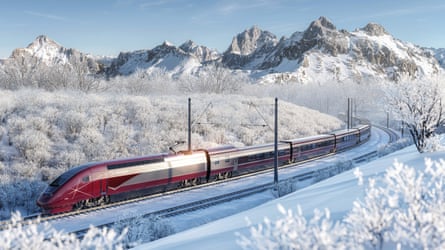
We hop on the Eurostar Snow train in London at 9am on Saturday, and change at Lille to the high-speed TGV that reaches many of the leading French ski areas – Val d’Isère, Tignes, Les Arcs, Courchevel, Méribel, Les Menuires, Val Thorens, La Plagne and La Rosière – by evening. If you don’t fancy a whole day on the train, there’s also the option to go to Paris for the day, then jump on the ski sleeper train after dinner and let it zoom you south to the mountains by morning.
There are many benefits to the train – more space to move around, play, snooze, and no limits on weight for regular-size bags (provided you can carry them), liquids or picnic goods, provided they are consumed during the journey. And, of course, there’s the visceral sense of going somewhere. The fields, lakes and towns of France whiz by and our kids marvel at the distance on the map. As sunset approaches, we see snow-capped mountains – at first hazy, then crystal clear.
We step into chilly evening air at Bourg Saint-Maurice, the terminating station. It’s staggering to know that the carbon footprint (CO2e, or carbon dioxide equivalent) of our journey from home is only 4.7kg (10lb 6oz) per person (UK train from Hertfordshire to London St Pancras, Eurostar to Lille, French TGV to Bourg St Maurice). If we’d taken a taxi to Gatwick airport, the plane to Geneva and a coach transfer to the ski resort, we’d be weighing in at 110kg of CO2e each. The bottom line: sustainable skiing is flight-free.
Rent your kit
Renting skis, boots, poles and helmets at the resort is a no-brainer. But what about clothing? We do plenty of outdoor adventures but don’t own specific snowsports clothing. I don’t want to spend hundreds on kit that we’ll only wear for one week a year, nor buy cheap, poor quality gear.
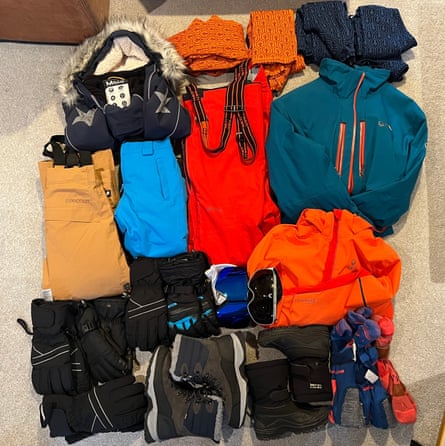
Enter Ecoski – an award-winning skiwear rental company. You can hire everything from gloves and goggles to snowsuits and even ski socks. It stocks dozens of high-performance brands, from sizes XXS to 4XL, and all of it is cleaned and sanitised, fully waterproofed and sent direct to your home a few days before you travel. When you get back, you stuff it all back in the box – no need to clean anything, not even the socks – and return it so that it can be cleaned and used again by someone else the following week. If you love your kit and want to keep it, that’s an option as well – so it works as a “try before you buy” service.
I select jackets, salopettes, goggles and gloves bundles, and add in several pairs of socks, winter boots and base layers. The next morning, the team are in touch to get our exact measurements and even colour preferences. They can also send items early so you can check the fit and try alternatives if necessary.
Go high and choose sustainable
Climate change is transforming the Alps. The snow line has edged higher and, at last count, 186 French ski resorts have closed. Some resorts are ramping up artificial snow-making – which demands copious energy and water. Some even use helicopters to drop snow. Other places have made the strategic decision to step back from unsustainable management practices. These are the resorts to pick – and aim for higher altitudes, where they’ll probably need to make less snow each season.
In France, the Flocon Vert (green snowflake) scheme certifies ski destinations that meet exacting sustainability criteria across resource management (water, energy, soil, biodiversity and waste), governance, sustainable employment, and social and community aspects, including accessible tourism and support for local needs. The focus is on concrete actions and long-term collaboration. So far, 18 destinations have achieved 1 Flocon Vert, 13 destinations have achieved 2 Flocons Verts. With help from the travel company Inghams Ski – which has a target to halve its emissions by 2030 – I pick the 2 Flocons Verts and B Corp-certified Les Arcs, which is at the forefront of sustainable skiing.
Marie Clémence Vallier is in charge of quality, safety and environment at ADS, the company that operates Les Arcs and Peisey-Vallandry mountain resorts.
“We’re committed to managing the mountain respectfully. We’ve set ourselves a limit on how much water we use to make snow each season. When the water’s used up, we’ll stop. And we’ve pulled back from grooming some routes. Our visitors care about this place – they understand why we’re doing it,” she says.
ADS produces 10% of its energy using meltwater hydroelectricity, has improved the affordable accommodation for seasonal staff and is investing in summer tourism, too, including hiking and mountain biking using ski lift infrastructure. “Our visitors have fun, and go home knowing that their choices make a difference and that every small action helps. We’re doing it together,’ Vallier says.
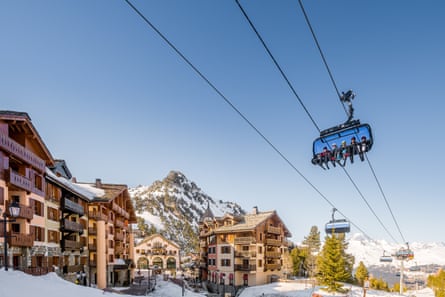
Les Arcs boasts a quick transfer from Bourg train station (by free funicular and shuttle bus, or by minibus), and the resort villages, at 1,600 metres, 1,800 metres, 1,950 metres and 2,000 metres, are all car-free and offer access to 265 miles (425km) of ski runs – from wide green beginner slopes to off-piste black runs, all open when we visit in December.
We opt to stay at Arc 1950, where the majority of accommodation is self-catered ski-in/ski-out apartments, clustered around snowy, skiable lanes and a quaint village square, complete with clock tower, artisanal bakery and twinkling fairy lights. It’s all purpose-built, but rather than feeling inauthentic, it simply feels well designed to make things easy, cosy and connected.
Learn and enjoy
There’s an old adage: you look after what you care about, and you care about what you know. It’s true of nature and our environment, and I’m excited my kids can experience fun and wonder in these beautiful mountains. Our first morning is an excited rush to Precision Ski, where we collect boots, skis, poles and helmets. Then it’s a snowball’s throw to the meeting point for our ski lessons with Evolution2.
My beginner group instructor, Louise, has us quickly scooting about on one ski, then two, then sliding down a tiny slope. I fall over. Twice. “Very good!” calls Louise as I clamber to my feet. “You’ll learn quickly if you don’t mind falling. Keep your weight forward!” I lean into the fronts of my boots, where my shins are already tender. And for a few seconds I’m balanced on my skis. I remember to breathe and look forward rather than down and slide to the bottom of the little slope without tumbling or flailing my arms. Louise grins and high-fives me. We’re off.
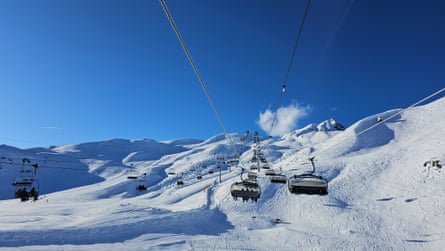
We finish two hours later and I’m exhausted – I remind myself that learning new physical skills is rocket fuel for a healthy brain. I rendezvous with the family: my mum has had a fun morning sketching the mountains, my kids are grinning and Joe looks alive and joyful. After a 25-year break from skiing, he has remembered how much he loves it, and his intermediate level group is going to spend the week finessing skills and exploring routes across the mountain.
We’re all ready for a good feed. Lots of the restaurants and cafes in the village offer fresh-made regional specialties – from soups and stews to fondue made from the region’s cheeses.
The next afternoon, Mum, my four-year-old and I meet mountain guide Michel to go snowshoeing. We trace a slow and gentle line through the forest, bum-sliding down the powdery slopes and looking for animal tracks – we spot deer and fox footprints, and hear about the wolves, marmot and bearded vultures that also live here. Mont Blanc is resplendent on the other side of the valley and, when we all stop, the deep hush of the snowy forest envelops us. It’s magical.
At the end of the week, ski instructor Louise takes our exuberant group for hot chocolates and awards us achievement badges that are normally reserved for the kids’ lessons. I’m delighted to be awarded a “Yeti 1” level, celebrating my very basic beginner’s competence. It’s been a joyful week in these beautiful mountains – ethical, sustainable and adventurous. Green skiing – for as long as the snow lasts – is the future.
The trip was provided by Inghams Ski. A seven-day ski train package, including travel, transfers and accommodation in Arc 1950 costs £999pp; lift passes, ski rental and ski lessons can also be arranged at discounted rates. Mary-Ann’s Ecoski rRental costs covered by Ecoski and Inghams; £130-200pp for a week’s clothes and boots rental