2 months ago
116
2 months ago
116
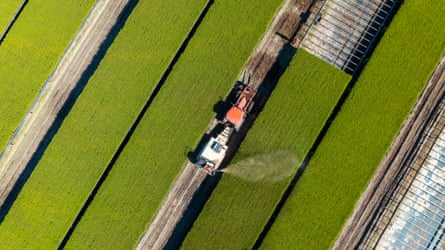
At a commercial tree nursery near Evans, western Louisiana, 5m pine seedlings are packed on to 12 vast circular irrigation tables, each as wide as a football field. Last September, many of these young trees were sprayed with what looked like muddy water.
The substance was in fact a liquid extract teeming with hundreds of species of wild soil fungi. Brad Ouseman, the nursery manager, is confident he will see results from this fungal inoculation, which is intended to improve yields and reduce the need for artificial fertilisers.
“By the time January gets here, you’ll tell the difference between that seedling and this seedling,” Ouseman says, pointing to separate rows of sprayed and non-sprayed pines.
Colin Averill, the founder of Funga, the startup company that supplied the spray, likens the treatment to a faecal microbiome transplant for young pine trees.
Where medics now successfully treat certain bowel conditions by transferring gut microbes from healthy donors into patients, Funga treats young pine trees with wild microbes derived from the soils of thriving pine forests.
“We’re not trying to isolate individual pieces of the soil community; we’re taking the whole thing,” Averill says. “As a result, we get all the complexity and all the interactions that come with it.”
The goal: trees that grow fast, drawing down more carbon dioxide, with less reliance on artificial fertilisers.
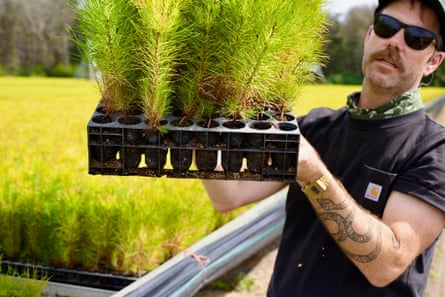
The Evans nursery supplies the huge network of intensively managed pine plantations that covers more than 12m hectares (30m acres) across 13 southern US states – an area known as “the woodbasket of the world”.
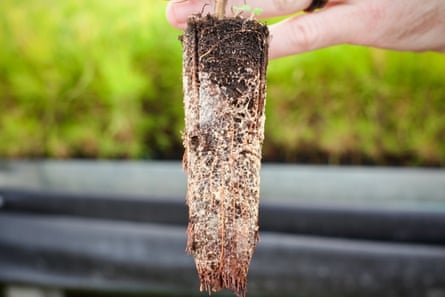
The fast-growing loblolly pines raised at Evans, a species native to the US south-east, depend entirely on underground fungal partners. Ectomycorrhizal (ECM) fungi weave into pine roots to form what Kabir Peay, a Stanford fungal ecologist, describes as a “hybrid organ” – part plant, part fungus – that works like a trading floor for growth-critical nutrients.
The fungal networks extend into the surrounding soil, scavenging nitrogen, phosphorus and other nutrients and then supplying them to the tree in exchange for energy-rich sugars. Pines and ECM fungi need each other, says Peay: “We really don’t find one without the other.”
Peay’s research suggests the biodiversity of soil fungi is essential for healthy trees and forests. An individual tree may associate with hundreds of fungal species, each accessing different nutrients under different conditions. In a 2018 study, he showed that even a two-month delay in seedlings acquiring the right fungi can significantly set back their growth.
Across the southern pine belt, every clearcut timber harvest severely depletes the fungal communities that young trees need most. As a result, Funga argues, growth is often sub-optimal and dependent on artificial fertilisers.
Funga’s own genomic surveys suggest that about 75% of ECM fungal diversity disappears after felling – a figure consistent with studies from Scandinavian and Canadian pine forests. It says recovery takes about 30 years but trees are harvested on 15- to 25-year cycles, implying that some pines may never experience fully mature ECM networks.
Rachel Cook, a forestry professor at North Carolina State University, cautions that the timescale of ECM fungus recovery is an unresolved scientific question. She agrees that major disruption is real but suspects warmer southern soils mean recovery is significantly faster than Funga’s estimate.
Even so, Funga argues that trees stand to benefit from exposure to the most productive ECM fungi from the very start of their lives. To achieve this, the team surveys forest soils across the south-east. When they identify thriving fungal communities, they use them as inoculants in small trials. Promising communities are then cultured, using natural organic matter as substrate – essentially building in-forest compost heaps – before extracts are applied at scale at industrial nurseries.
Founded in 2022, the company inoculated about 500 acres in its first year of operations. By 2025, that had scaled to about 25,000 acres, with Averill estimating that his startup treated one in 40 of all loblolly pines planted in the south-eastern pine belt last year.
Early results are promising. “We’ve seen growth responses in excess of 100% in some locations,” he says. “Overall we target 30% [growth boost] on average. We believe we’re about to achieve that.”
Cook, who is also a co-director of the international academic-industry forestry research body Forest Productivity Cooperative, says a 30% jump from fertilisation is “kind of normal”. In other words, Funga’s biological treatment may be approaching gains that currently demand expensive chemical inputs, which is precisely the company’s aim.
“I really think this could be a next big step in managing forests in the south-east,” Cook says. “I am optimistic, but I’m cautiously optimistic, because we need more data.”
Many of the soils beneath southern pine plantations are deficient in key nutrients – in part, a legacy of decades of intensive tobacco and cotton agriculture before commercial forestry took over in the 1930s. Under nearly a century of continuous forest cover, these soils are slowly recovering, but nutrient shortfalls persist.
Though the serried ranks of “pines in lines” across the south-east invite comparison with agriculture, Cook says the resemblance is misleading. Pine stands are fertilised at most three times in 25 years, with soil disturbed only at harvest. “Our ‘intensive’ is minuscule compared to agriculture,” she says.
But Averill hopes fungal inoculation could eventually replace chemical fertilisation altogether – a low-cost, self-sustaining alternative to fossil-fuel dependent inputs whose prices have spiked in recent years.
Previously in academia, Averill’s research had shown the composition of soil fungal communities predicts forest growth and carbon sequestration as strongly as rainfall – a finding with huge implications.
He founded Funga in 2022, betting that environmental markets, including the carbon market, were emerging as the new “financial engine” that could translate promising research into practical responses to the climate and biodiversity crises. Last year, Funga signed its first major commercial contract: an 11-year, multimillion-dollar carbon removal deal with the streaming firm Netflix.
Carbon markets face serious questions. A comprehensive 2025 review concluded that most offset schemes have so far been plagued by intractable problems and have failed to deliver real emissions reductions – though it noted that high-quality projects do exist. The most common flaws include non-additionality – crediting projects that would have happened anyway – and impermanence, where carbon stored in trees is later released by fire or breakdown of short-lived forest products such as cardboard.
Averill acknowledges the challenge. “Greenwashing is absolutely real,” he says. But he argues Funga’s model directly addresses those weaknesses. Credits are based solely on the additional growth of trees, relative to matched, untreated control plots. And, by contractually requiring landowners to grow trees to saw-log size before harvest, Funga’s projects channel timber towards lumber and construction – relatively durable carbon stores – rather than pulp or biomass.
Because Funga’s treatments are funded by carbon revenue, landowners pay nothing to participate. But fungal inoculation will eventually have to prove its worth against fertiliser and other interventions for land managers with tight budgets.
Funga’s ambitions extend well beyond southern pine. “Our next big target is Douglas fir in the Pacific north-west,” says Averill, who is also involved in field trials inoculating both broadleaf trees and sitka spruce in Wales.
Whether or not fungal inoculants revolutionise southern pine forestry, Peay believes the deeper enterprise – deciphering the ecology of organisms that science has barely begun to catalogue – is the real prize. If Funga can identify optimal fungal communities and transfer them efficiently on to receptive young trees, he says, “that would be a really big breakthrough”.