6 hours ago
10
6 hours ago
10
At a last-minute surprise show in London, the British punk duo Lambrini Girls are sharing their stage with a continuous tide of crowd surfers. They move almost as one, a jumble of limbs rippling over a sea of bodies – emboldened, perhaps, by the band’s vow to double up as security guards. “If you don’t feel safe, tell us and we’ll punch them in the dick!” shouts Phoebe Lunny, the lead vocalist and guitarist.
She also requests that people pick up anyone who falls over in the moshpit and goes around with the mic asking fans to introduce themselves if they are “queer legends” (there are many). “This show is as much yours as it is ours,” Lunny announces, before she and the bassist Selin Macieira-Boşgelmez pummel everyone with shouty rants, furious beats and sludgy grunge.
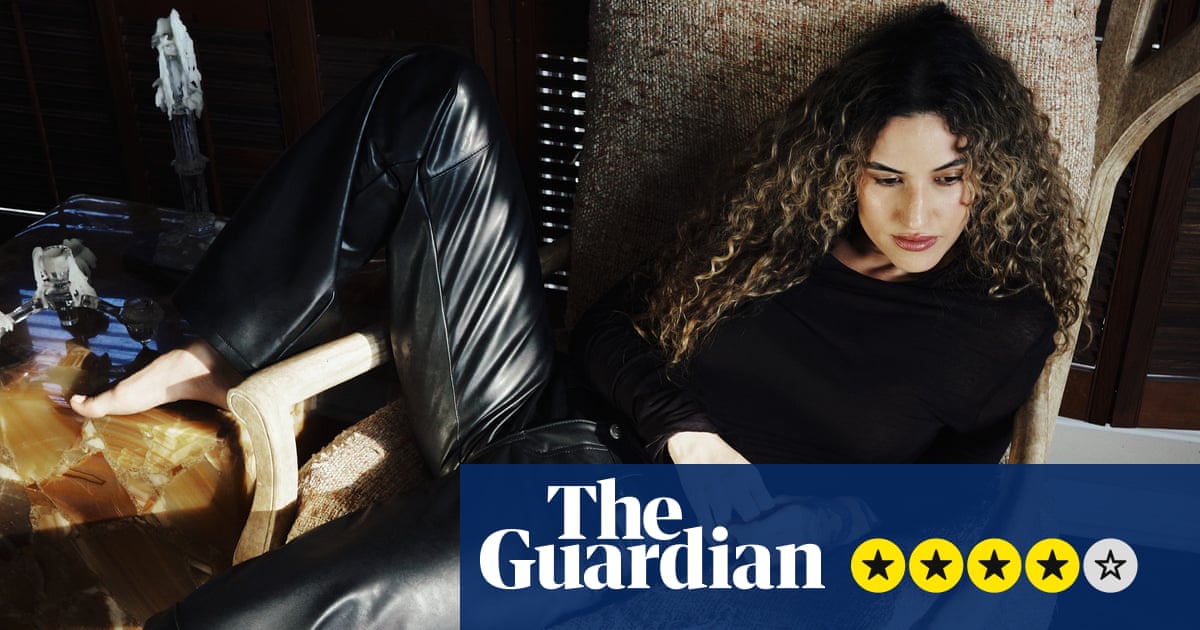
Backstage, before the gig, the two Lambrini Girls are sitting on a battered sofa. Lunny, 29, is the chattier of the two, with bleached-blond waves and broken Mary Janes. Macieira-Boşgelmez is a year older, with red hair and a quiet poise, that seems at odds with her headbanging stage presence. They’re not long back from a European tour where their visuals made their politics plain. In France, the screen read “Fuck Marine Le Pen”. For London, it’s “Fuck Nigel Farage”.
“The issues we address are not specific to the UK,” says Macieira-Boşgelmez. “Oppression is growing. People’s anger is growing.”
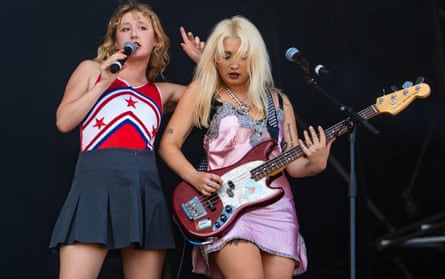
Their second album, No Refunds, was announced this week, capping a successful few years for the band who formed in Brighton in 2019. There have been magazine covers, support slots with Iggy Pop, Idles and Amyl and the Sniffers and a remix by the queer idol Peaches. In January 2025, their debut album Who Let the Dogs Out charted at No 16 – not bad, given that it contains a song called Cuntology 101. Recently, they’ve been able to pack in their 9-to-5s, although they feel a little ashamed about it. “The guilt is extremely prevalent,” says Macieira-Boşgelmez. “It is on my mind every single day. You watch your friends work so fucking hard …” Lunny agrees: “The system is so unfair.”
The band has a sense of humour – their debut EP featured a cover illustration of a giant flaming turd and one early song is effectively just a call-and-response of “Craig David” – but they’re serious about confronting that unfair system. At the London show, their touring drummer, Misha Phillips, delivers an impassioned speech about transgender liberation before they unleash one of their most popular songs, Terf Wars. These biting calls for social justice mean they’re often compared to riot grrrl bands such as Bikini Kill (for whom Lambrini Girls will be opening next week in Brooklyn). As the duo have evolved, so has their mission to represent “the disenfranchised, disaffected and disillusioned”, Lunny says.
Lunny was raised in Sussex by a single mother, a primary school teacher and socialist, who politicised her. Lunny did a music BTec: “I didn’t pass and went to the University of Burger King.” Macieira-Boşgelmez, who is of Turkish and Portuguese heritage, moved to the UK to become a musician and says she has always had “a really strong sense of justice” from growing up “financially privileged. My parents made sure that I knew that.”
In September 2025, just as Lambrini Girls were really popping off, Macieira-Boşgelmez took time out from touring (a friend stepped in to cover her). She had been diagnosed with autism and bipolar disorder four years prior and wrote a candid, moving social media post about the distressing effect of touring on her health. “It was slowly accumulating and gradually getting worse and that was influencing my behaviour and me not being aware of my limits,” she says now.
When Macieira-Boşgelmez returned in February 2026, the duo went to play Australia for the first time. During one gig, Lunny leapt from a balcony and injured herself. She was told it was “just whiplash”. It was six weeks before she discovered what was up. “It was only when I was in a hotel at 2am, fitting and passing out on the floor, that it was obvious that something was really wrong,” she says.
Lunny had a small bone fracture in her neck, which had punctured a hole in her brain membrane. Fluid had been draining out. “So now I have a lopsided brain,” she says, matter-of-factly.
She was forced to rest for nearly four months, but being laid up in bed wasn’t her style. “So then I started touring with a hole in my brain. It was the hardest thing I’ve ever had to do.” She took flights in a wheelchair. “I had to lay side of stage, force myself up with willpower and rely on adrenaline to carry me. As soon as I was off stage, the pain would disorient me to the point where I didn’t know where I was. The thing is, I insisted on touring as it offered me 40 minutes of feeling like myself again. I don’t regret a thing.”

She had two rounds of surgery in July this year and feels as if she is finally recovering, but says: “I’d kill to have a body that was capable of what it was able to do before.” The new album includes an acoustic track, Spilt, an unwavering look at her booze-fuelled party era. “I feel very fortunate that I can’t really relate to that song any more and that’s testament to growing up a bit,” she says. “I’ve had so many health scares. I’m very restricted with my drinking.”
But, for the most part, No Refunds is bigger and beefier, railing against fascism and “the ruling class”, Lunny says. “We’re trying to shake people and say fucking get off your asses. The world is a far darker place now than it was two years ago. Even though we thought it couldn’t get any worse, it has.”
Musically, it strikes a balance between corrosive grunge low-end, bristling punk intensity and the arch delivery of Britpop, with some of their peppiest songs yet – although a suggestion of Elastica, a female-fronted band, elicits the subtlest of shared sideways glances. “The majority of my influences from that era, because it was so male-dominated, are men,” says Lunny. “I’m a huge fan of Blur.”
There is some classic Lambrini Girls sarcasm, such as Is This AI?, Don’t Talk to Me Till I’ve Had My Abortion and the lead single Cult of Celebrity, which references the Epstein files (“Oh, how the other half live / … on Lolita island”). But the fun-poking has largely been replaced by fury; the lyrics are less direct, more conceptual. “I don’t want to go through a list of societal ills and be like: right, we’ve done that,” Lunny says, mimicking ticking off a list. “Because I feel like that trivialises it.” A lot of the last album was “I don’t like this and here is why”, but No Refunds is more about “trying to build a world”.
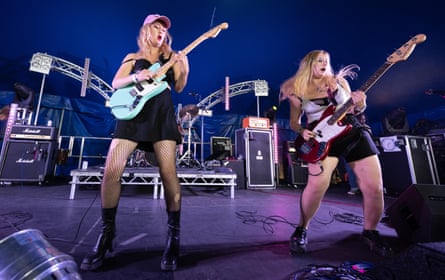
Regarding another new song, Gaza Beach, Lunny says she “wanted to write a song about Palestine for years, but I couldn’t do it. Obviously, to encapsulate a genocide is incredibly difficult to do in a way which doesn’t sensationalise the suffering of hundreds of thousands of people”. But seeing an AI-generated video of how a glitzy new resort in the territory might look gave her the idea. “I started thinking: well, what would that actually look like? I felt like I was able to convey the moroseness and the insidiousness of this genocide [but also] encapsulate the imperialist settlement, which was really important to do.” She is encouraged to see more artists speaking out about it, too. “You don’t have to write a song about it, but you have to use your voice.”
Macieira-Boşgelmez cites Macklemore being criticised by Pink for his pro-Palestine comments on Ed Sheeran’s tour (we spoke before Macklemore was kicked off the tour and Sheeran faced a retaliation of his own). “Even though there are some artists that are speaking out about this, the backlash you face is still incredibly disproportionate,” she says.
In April, Lunny revealed that she was once arrested for harassment and faced a possible six-month jail sentence after she emailed promoters to warn them about booking an allegedly “dodgy” male musician. The case was dropped, although Lunny was made to write a letter of apology to the man. “It was a long time ago; I can’t say specifics,” she says now.
Abusive men and abuses of power are recurrent themes on No Refunds, including one track that is specifically about the manosphere (The Basement).
“We talk about male violence a lot, we talk about the oppression of women a lot,” she says. “Do we get branded misandrists? Of course we fucking do. The people that brand us that are ‘incels’. We are not misandrists. We both have a lot of male friends that we adore.” It’s more, they say, about taking aim at the “capitalist patriarchy”.
It’s a grim world, but Lambrini Girls aren’t without optimism. “There is still a lot of value to be found in community,” Lunny says. “When I feel hopeless about the rise of the far right and us edging towards a new iteration of techno feudalism and that AI might kill us all, I have strength and security in my friends around me. I look at Selin and she gives a real fuck. That gives me hope.”
The community at Lambrini Girls’ shows is just as strong. Towards the end of the London gig, a fan scales a large circular rig in the centre of the space. For a moment, their legs dangle down precariously, hovering above the pit. There is a collective sharp intake of breath. But soon hands are thrust aloft, fingers clasp around their ankles and the lone ranger drops into a throng of arms.
“Solidarity will prevail in times like these through listening to each other, uplifting each other, supporting each other,” says Macieira-Boşgelmez. “As much as you might feel it, you are not alone.”