2 months ago
87
2 months ago
87
I often write the first paragraph of a story in a notebook, add to it every so often or leave it there to see if something might emerge from it. In 2008, in San Francisco, I went with three friends on a hike near Muir Woods overlooking the Pacific Ocean. At the summit, there was a kind of lodge where you could get a bed for the night and use the kitchen to make your own dinner. The view was spectacular.
As we climbed, I began to imagine a character, an Irish guy who had made up his mind to go home. This was his last big outing in the landscape. He had been working as a plumber. Dotted in the Bay Area were houses where he had repaired pipes and installed new sinks and toilets and washing machines. This was his legacy in America. He was someone who could be depended on in an emergency. But he was illegal and he was going home.
Over the next few years, the story became more solid. If my character left America, he knew that he would never be allowed back. He had a daughter from a marriage that had ended. He was crazy about her. If he left, he would lose the connection with her. I imagined him having one last day out with his daughter in that beautiful place. I wrote some more of the story and then I left it aside.
Sixteen years later, the story came back into my mind. It occurred to me that the election of Donald Trump for the second term and the prospect of him taking it out on illegal immigrants would be the actual spur to make my character really decide that he had to go home. He would leave on Monday 20 January 2025, the precise date of Trump’s inauguration. The hike with his daughter, almost a teenager, would take place on Saturday 18 January.
I worked it so that I would write the story of the hike on the very day it took place. I was in the same time zone. The inauguration was looming. ICE was coming towards us. Trump was getting louder and more ominous. As my protagonist and his daughter set out from the city, I was writing what they might say and do at the same time of the morning in question. They didn’t know (as I didn’t know) how they would find a parking space. But then it became easier than they (or I) had imagined. The aim was to finish this section that day. I could make changes, but they would be small. I would try to make it stick, so that I would not have to rewrite it on another day, a day when Trump had already taken over. I wanted the story done by then. And I wanted to publish it soon afterwards. It was superstitious; it felt serious at the time.
Sometimes, a glimpse is enough to start with, or a small detail from a much larger story. In his preface to The Spoils of Poynton, Henry James talks about this idea of a “germ”, what he called “a mere floating particle in the stream of talk”, something that “has the virus of suggestion”. Life, as James would have it, is “all inclusion and confusion”, just as art is “all discrimination and selection”. If you are seeking the inspiration for a story, then very little is more than enough. Something hinted – a clue, a suggestion – can do more in the imagination than something spelled out.
About 20 years ago, I interviewed a historian in the area of the Catalan Pyrenees called the Pallars. Because the Pallars is sparsely populated and remote, the historian had been able to account for every single death there in the Spanish civil war. And he was also able to collect many small details about injuries, bombardments and movements of troops.
What was strange, he said, was that in the summer of 1938 the town of Pobla de Segur in the Pallars was almost quiet. The real action was elsewhere. Thus, the fascist soldiers could hold parties at night down by the river, play guitar and drink plenty.
The historian invited a general who had been a young officer in Franco’s army in 1938 to return to the Pallars more than half a century later and show him where certain things had happened. As the general, now in his 70s, was walking through the town, he met a local woman who was out shopping, and, with surprise and a kind of delight, the two recognised one another immediately. They had known each other in that summer, the summer of 1938. She was from a world that was vehemently anti-Franco; no one wanted to remember those parties by the river.
That was all I needed. I almost asked the historian to tell me nothing more beyond that single encounter on the street. From that, I could start imagining those nights by the river in that summer of the civil war. And then conjure up the woman years later being told that the young soldier she had fallen in love with, whom she hadn’t seen for more than 50 years, was coming on a visit – he was a retired general now – and he remembered her name and he would like to see her.
It is important to be ready not to write the drama. At first, I tried to see what that meeting would be like. And then it struck me that it would be more powerful if the woman and the soldier didn’t meet all those years later. He had invited her to lunch but she didn’t go. The story would centre on how she spent those hours, knowing he was so close by, not meeting him.
The confrontation that does not occur is often more dramatic than the one that does. At the very end of another story, A Sum of Money, the young man who has been sent home from boarding school for stealing money has to face his parents. I sat gazing at a blank page for a long time as I worked out how this fraught encounter might be written until I realised that it didn’t have to be written at all. In the finished story, no one says anything. They almost do and then think better of it.
But something happens that makes a difference. The lack of open drama is a way to allow a shift to take place in someone’s sensibility. My job is to give it as much nuance and ambiguity as I can and also make it matter, make the arrow hit its mark.
James wrote about a fellow novelist who had published a much praised work of fiction about French Protestant youth. When someone asked her how she knew so much about French Protestant youth, she replied that once she was walking down a stairway in Paris and looked in through a doorway and saw a group of French Protestant youth. That is where her knowledge came from, just that. What James appreciated was the ability “to guess the unseen from the seen, to trace the implication of things, to judge the whole piece by the pattern”.
In spring 1988 I decided to find a small apartment in Barcelona. One day, as I waited to be shown around a possible rental, three women in their 60s joined the queue. We spoke for just two or three minutes, but enough for me to discover they were sisters, they were Catalans, they had come back from living in Argentina for many years, they found prices in Barcelona very high. They finished one another’s sentences.
I waited 30 years to write The Catalan Girls. It is, at 30,000 words, the longest story in my latest collection. I imagined the lives of those three women I had fleetingly encountered. I dreamed up how and why they went to Argentina, how each of them lived there, and then how they came back to Catalonia. I made the middle one lesbian, the youngest dreamy and the eldest bossy. I gave them lovers and husbands. I imagined that the bossy one bossed her two younger sisters into getting the same hairdo as she had before they travelled back to Spain.
I moved closer also to what I knew. I imagined the three sisters attending the same festival in the village of Tírvia in the Pallars as I attended in July 2017. I could easily have seen them if I had looked over. I knew what music the band was playing.
Other elements in the story came from memory. The house where the middle sister lives in the outskirts of Buenos Aires is precisely where I lodged in the spring and early summer of 1985. Her room is my room. The apartment where the youngest sister lives, paid for by her lover, is where I also lived in the spring of 2013.
In writing stories, I get energy from rooms I knew but no longer live in, from things that have gone, from spaces that seem oddly haunted and have lodged in the memory or could come back in dreams. In A Sum of Money, much of the action takes place in the dormitory known as The Attic at St Peter’s College, Wexford. I have not been in that dormitory since 1971.
In the early years of this century, I worked for a semester at various American universities in cities where I will not live again. Thus, in a story called Barton Springs, I could conjure up Austin in Texas, and in Five Bridges, the city of San Francisco. In Sleep, I could venture into an apartment I sublet near Columbia University in 2012 and 2013. I could put my hero in my bed. I could have him watch from the same window as I watched from, with a view of the George Washington Bridge. When I take him back to Dublin, I have him spend time in the long living room in Ranelagh that belonged to the feminist writer June Levine and her husband the psychiatrist Ivor Browne. The bar in Barcelona in A Free Man is a place I once knew well. The story The News from Dublin opens in the back room of the house where I was raised, a house that has long been sold. I won’t go back there.
By the time I wrote those stories, those spaces could only be visited in my memory or in my imagination. Other spaces, such as the room where I am now in New York, have not been written about. Not yet. They have not been lost yet. I do not regret them or miss them. They are not part of a world that I can imagine, a world that has somehow been completed and is ready to be framed or entered stealthily, as a ghost might come and haunt a story.
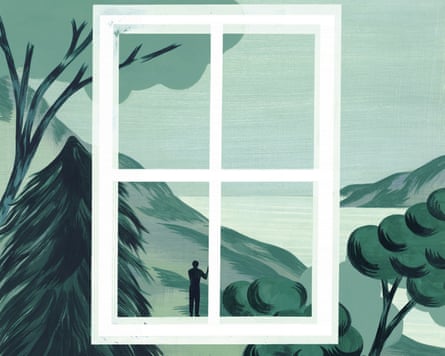
In the future, if I live long enough, I will be able to see this room as though framed, as though completed. It will be part of memory, part of history. I will be able to write about it. This is the room where I learned first‑hand not only what evil is like but how evil is tolerated. What is strange about being in America in the time of Trump is how ordinary it is, how what was unimaginable just over a year ago is suddenly, shockingly no longer a surprise.
For Five Bridges, I imagined an Irishman, illegal in San Francisco, realising the danger if he stayed. A year after it was published, elements of the story came true. On 9 February, the Guardian reported on the case of Seamus Culleton, from County Kilkenny in Ireland, who came to the United States on precisely the same visa as my character in Five Bridges, and who also built a life over decades.
Culleton was arrested by ICE in September while buying supplies at the hardware store in Massachusetts. After being held in ICE facilities near Boston and in Buffalo, he was flown to El Paso, where he was in a cell with more than 70 men. Culleton told the Irish Times that the detention centre was cold, damp and squalid, and there were fights over insufficient food – “like a concentration camp, absolute hell”.
This is a fate my character in Five Bridges managed to avoid. In the stories of the future, such characters will not be so lucky.