2 months ago
81
2 months ago
81
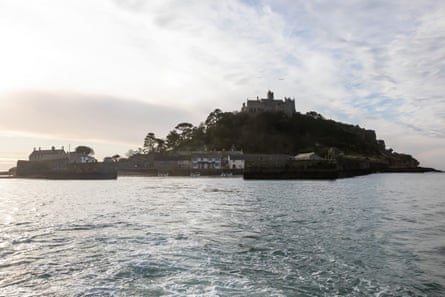
The tidal island of St Michael’s Mount in the far south-west of Britain is usually a place of peace and quiet.
But it has become a hive of noisy activity as gardeners equipped with chainsaws and wood chippers get to grips with the devastating damage caused by Storm Goretti.
The latest count shows that 119 large trees were felled, including holm oaks, hollies, sycamores and Monterey pines the size of four-storey homes. About 80% of the island’s tree cover has been lost.
“When I got out here the next morning, it was still dark but I could see the tree line had changed,” said the head gardener, Darren Little. “As dawn broke, the scale became clear – it’s devastating. In a few hours it destroyed years of work and changed the profile of the island.”
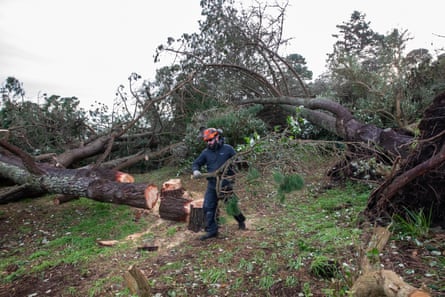
Tens of thousands of trees were toppled in the west of Cornwall as gales howled in from the north-west, the unusual strength and direction making them more vulnerable.
Little has never seen a storm like it in his 25 years living and working on St Michael’s Mount – a granite outcrop near Penzance topped by a castle and accessible at low tide by a causeway, at other times by amphibious craft. “We’re used to one or two trees falling in storms but nothing like this,” he said as he showed the Guardian around on Wednesday.
Its weather station recorded a gust of 111.8mph (180km/h) on the night of 8 January, although the Met Office said the highest in Cornwall was 99mph.
Some trees survived, including a twisted sycamore on the east of the island that is a favourite subject for visiting photographers. Elms have also done well. “I think they whip with the wind,” said Little.
But a holm oak planted to mark the birth of Prince Harry in 1984 has been uprooted. It is not possible to crane such trees back into place and hope they recover because the soil is too shallow – another reason why the island was so badly hit.

A concern is that other trees may have been compromised by the salt water spray that covered the island at the height of the storm and more may fall or have to be felled in the coming months.
Little is looking for the positives. The Cornish name for the island – Karrek Loos yn Koos (grey rock in a wood) – suggests the outcrop was once surrounded by forest.
However, the climate crisis is leading to stronger storms, wetter winters and drier summers in the UK. “We’ll have to bear that in mind when we rethink and redevelop,” Little said.
Back on the mainland, woods and copses important for wildlife have been damaged. A belt of pines near Penzance known as Bog Plantation has been razed. Birdwatchers flocked to this area last January when a booted eagle, a rare visitor to the UK, dropped in.
Farther inland, trees have come down at Friendship Woods, an important roost for starlings and rooks as well as being a popular dogwalking spot.
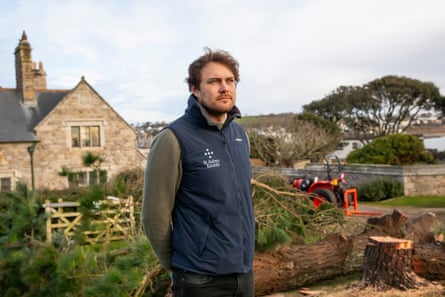
Henry Mathews, of St Aubyn Estates, which owns Bog Plantation and Friendship Woods as well as managing St Michael’s Mount with the National Trust, estimated it had lost 500 large trees across its 5,000 acres (2,000 hectares) of land. “The loss of trees and habitats is immense,” he said. “There’s a feeling of great sadness.”
He pointed out how vistas had changed, with cars heading to Penzance now visible from St Michael’s Mount because so many trees have been lost. “Trees have quietly helped shape the landscape and suddenly it’s changed,” he said.
Beloved trees have fallen across west Cornwall, including one on the Isles of Scilly that had a popular rope swing.
Ian Marsh, the National Trust’s assistant director for the south-west, said the number of trees lost on its properties could be in the tens of thousands.
“One long-term impact is the loss of specimen trees that people really identify with,” he said. “If you walk your dog and pass a particular tree every day, it becomes part of your landscape and you have memories associated with it. It’s impossible to replace that.”
Other spots hit include Penlee Park in Penzance, the setting for an art gallery that is home to paintings by members of the Newlyn School , and the Growing Links community garden near Penzance.
Despite the devastation, the people of Cornwall vowed they would replant and restore their landscapes.
At Tremenheere Sculpture Gardens, which has views across to St Michael’s Mount, magnificent trees including a woodland walk of mature beeches have been lost.
But Polly Bolitho, who works at the gardens, said they were looking forward. “Even in this moment of loss, this garden always evolves,” she added. “It’s in the spaces between light and dark that new ideas begin. From storm to story, we look ahead to the next chapter.”