3 hours ago
13
3 hours ago
13
‘Madam, this looks like breast cancer, and if it is, we will chop off your breast.” That was how the doctor welcomed me into the chaotic world of cancer in 2017 when I was 32 years old. He had his back to me, but kept on talking, peering into the specimen bottle.
For a moment, I could no longer hear him. I thought of my three children, the university degree I had just bagged and the future I had envisaged. If I was going to die, what was the point of it all? I had invested everything I had to obtain that degree, subjecting my children to days of absence while I spent my nights in the university library.
The biopsy result was ready in seven days and the doctor was right: the next course of action was a mastectomy. Everyone had an opinion. My mother insisted a medicine man could heal me and begged me to cancel the scheduled surgery. My friends dragged me to churches because all I needed was prayers to be healed. As the surgery drew near, their voices grew louder. I was berated for lack of faith.
I had been told that the mastectomy was the solution and, after that, I could focus on my life again. That turned out not to be entirely true. A few days after my mastectomy, a group of doctors stood by my bedside and informed me that I would need further treatment, including chemotherapy.
Once they were gone, my friend – a pathologist who was visiting – convinced me that chemotherapy would kill me and that surgery was all I needed. A few friends echoed his sentiments, and with that, I refused chemotherapy.
Instead, I Googled alternative treatments and settled for “wonder foods”, such as cucumber, soursop, spices, roots and more vegetables.
The first two years were lonely. The secrecy surrounding cancer in Nigeria made it feel impossible for me to connect with other patients. I had a strong support system, but no one understood my fears, anxiety and self-image issues in the way someone going through the same experience would.
About 16 months after my mastectomy, the cancer recurred. My doctor advised that I commence chemotherapy. Again, I refused. This time I headed to a village in northern Nigeria for some well-touted herbal cure. I was ready for anything but chemotherapy. A few months later, the aunt who referred me to the herbalist, whom we thought was cured of her breast cancer, died.
She had been silent about her journey until it was well advanced. It was after her death that I realised other relatives on my maternal side had died from cancer. That was a wake-up call for me to return to the hospital and start chemotherapy.
According to the health ministry, about 127,000 new cancer cases are recorded in Nigeria annually, with roughly 80,000 deaths. Breast cancer is the most prevalent cancer among women, representing about 23% of all new cases. Despite this high burden of cancer, there is limited awareness, especially in rural areas. Many cases never make it to the hospital and are therefore unreported. This lack of understanding results in late presentation, diagnosis and treatment. It also fuels the stigma, myths and silence that in extreme cases can lead to cancer patients being abandoned or ostracised by their communities. All these factors contribute to Nigeria having the highest breast cancer mortality rate in Africa.
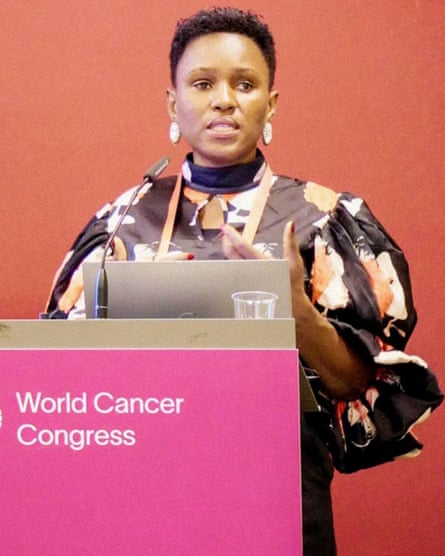
During chemotherapy one day, I decided to become that person who would support fellow patients, challenge the stigma and catalyse positive action within the cancer space.
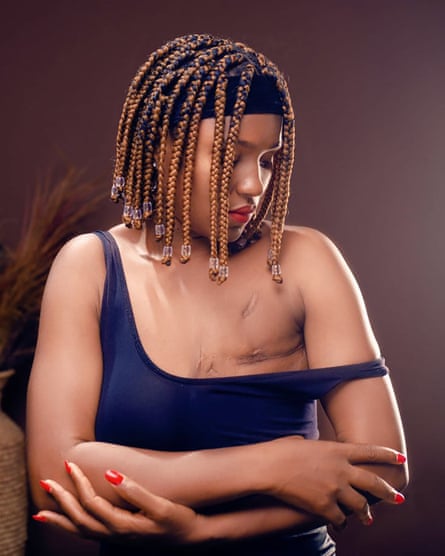
Since 2022, I have been sharing photographs of my scars on social media. Having the first pictures taken was hard – the shock on the photographers’ faces and the thought that my children might one day disapprove nearly stopped me.
Not everyone supported my decision. Some said I should keep my diagnosis private and take the pictures off the internet. But I was determined to show the reality of breast cancer, and give encouragement to other women with battered self-worth due to a mastectomy. These are pictures of resilience. Today, nine years on from my diagnosis, I feel a sense of pride when I look at the photos and realise the role I’ve played in rejecting the shame and secrecy that continues to surround cancer in Nigeria.
It has been a tough, unpredictable journey for me. Yet I have faced cancer with as much courage as I can muster. It is a challenge but it should not define how I live. I am grateful that many women in Nigeria and beyond come across my pictures, stories or policy contributions and draw the strength to face their diagnosis.