3 months ago
153
3 months ago
153
Nobody can phone it in like a famous conceptual artist. Invited to customise one of rock star Jack White’s amplifiers, Ai Weiwei has inscribed the F-word in buttons of various sizes and colours across its front. It’s a cynical, contemptuous gesture, but also a marvellously louche one, reminding you of the dangerous, nihilistic yet creative spirit that this exhibition of White’s art totally lacks.
White was huge in the 00s as one half of duo the White Stripes, with Meg White, and his solo career is still going strong. Clearly the art world wants to be his friend. This show is on at Damien Hirst’s Newport Street Gallery and its luxurious hardback catalogue includes an interview with him by the uber-curator Hans Ulrich Obrist. Hirst has also customised an amp with – guess what? – a model of a rotting cow’s head. In addition, he has collaborated with White on works featuring other hackneyed Hirst tropes: an eternally floating ping-pong ball and a spin painting.
You can see why these luminaries might want to be mates with White. The bluesy raw sound of the White Stripes remains haunting even after Donald Trump appropriated their Seven Nation Army for his rallies. This was art rock. They even titled an album De Stijl, and that Dutch modernist movement is unmissable here as White repeats red, blue and yellow and turns a Mondrian grid into a piece of furniture.
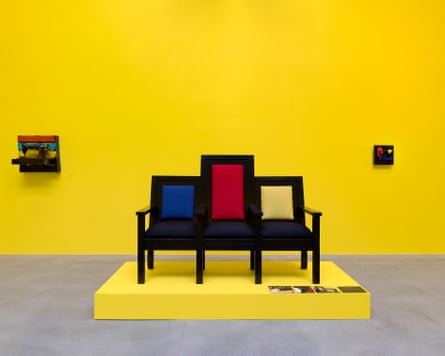
Yet art rock is not art. In a live gig or on vinyl (White’s preferred medium), sounds and words, gestures and rhythms, create atmospheres that can be elusive and fragile in their romantic power, even when the lyrics are banal or nonsensical. But as a visual artist, White is a complete nonstarter.
The show begins with a series of works that pay tribute, I suppose, to the deep musical Americana that White loves – he is a fan of country and blues, reveres Son House and lives in Nashville. So he has found an early 20th-century statuette of a ukulele player that speaks of those American musical histories and created a series of simulacra of this character he calls Ukulele Joe. Yet far from paying poetic homage to the lost highways and forgotten troubadours, these colourful, patterned appropriations are glib and sterile, mere decorative japes.
And this is odd, because White’s passion for the sounds of what the critic Greil Marcus called “the Old, Weird America” is apparently very real: he once paid $300,000 for an acetate of Elvis Presley’s first recording and The White Stripes covered songs by the likes of Robert Johnson. What an intriguing, mysterious exhibition this might have been had it attempted to unlock that heritage. Instead, White favours hard, bright colours and brash jokes that don’t let in the light, or the dark.
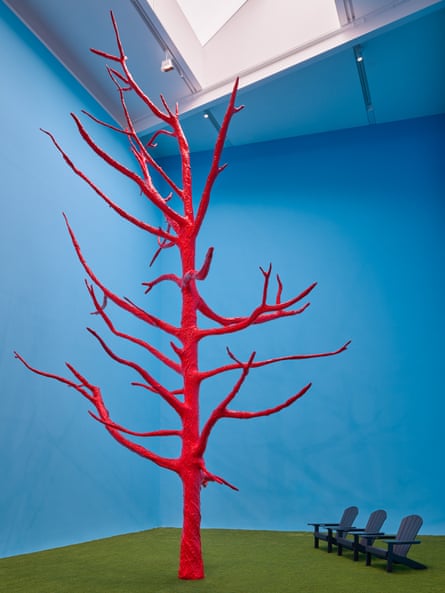
When he thinks he is being original, he retreads well-worn artistic ideas. You find an installation of a tree painted pink, on an artificial lawn, with deckchairs from which to look up at it. Brilliant, Jack, pure genius, I can hear Hirst fawn, whoever thought of putting a tree in an art gallery? Well, Anselm Kiefer and Giuseppe Penone for starters. And they wouldn’t paint it such a dumb colour.
White’s confused and pretentious idea of what contemporary art is – readymades! Installations! – is at the intellectual level of a 12-year-old who has just visited Tate Modern for the first time. The closest he gets to tapping into the real magic of American modern art is a series of works in which he customises wooden pallets used to transport commercial goods and hangs them vertically. There are echoes here, albeit dim and distant, of Jasper Johns and Robert Rauschenberg. Maybe these are OK. Maybe not. It’s hard to care.
Then come his early designs for De Stijl sofas – he trained as an upholsterer – and horrible plasticky blobs that seem to be there to fill the walls. Newport Street is a generously proportioned, sumptuous place, but White just hasn’t got enough visual ideas to fill it. There are electronic drums, keyboards and a Moog Theremini to play through the customised amplifiers. This could get riotous enough to make the show seem fun, but only if you ignore the vacuum of passion or purpose.
The big puzzle is not White but Hirst. He created this superb free gallery but wastes it with a show like this. He keeps telling musicians that they are artists – he convinced Ed Sheeran that he is the new Pollock and has now given White a gorgeous stage on which to artistically die. Surely Hirst can still remember what real art is, because when he was young he created it as loudly and electrically as it comes. It is hard to believe that the Leeds lad once put a real, not fake, rotting cow’s head in a vitrine full of flies and called it art. Now that was rock’n’roll.