3 months ago
164
3 months ago
164
Kamala Harris pays tribute to 'one of America's greatest patriots'
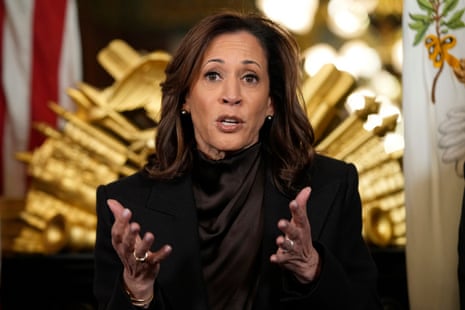
Former vice-president Kamala Harris has also paid tribute to Jesse Jackson, describing him as “one of America’s greatest patriots”.
“He spent his life summoning all of us to fulfil the promise of America and building the coalitions to make that promise real,” she wrote in a post on X, adding that he gave a voice to those who were “removed from power and politics”.
She continued:
He let us know our voices mattered. He instilled in us that we were somebody. And he widened the path for generations to follow in his footsteps and lead. As a young law student, I would drive back and forth from Oakland, where I lived, to San Francisco, where I went to school. I had a bumper sticker in the back window of my car that read: “Jesse Jackson for President.”
As I would drive across the Bay Bridge, you would not believe how people from every walk of life would give me a thumbs up or honk of support. They were small interactions, but they exemplified Reverend Jackson’s life work – lifting up the dignity of working people, building community and coalitions, and strengthening our democracy and nation.
I was proud to partner with and learn from him on this work throughout my career, and I am so grateful for the time we spent together this January. Reverend Jackson was a selfless leader, mentor, and friend to me and so many others.
Key events Show key events only Please turn on JavaScript to use this feature
Obamas pay tribute to 'true giant' Jesse Jackson
The former president Barack Obama has said he is “deeply saddened” by the death of civil rights activist Jesse Jackson.
In a statement from both him and his wife Michelle, he paid tribute to Jackson and the friendship between their families.
The statement reads:
Michelle and I were deeply saddened to hear about the passing of a true giant, the Reverend Jesse Jackson.
For more than 60 years, Reverend Jackson helped lead some of the most significant movements for change in human history. From organizing boycotts and sit-ins, to registering millions of voters, to advocating for freedom and democracy around the world, he was relentless in his belief that we are all children of God, deserving of dignity and respect.
Reverend Jackson also created opportunities for generations of African Americans and inspired countless more, including us. Michelle got her first glimpse of political organizing at the Jacksons’ kitchen table when she was a teenager. And in his two historic runs for president, he laid the foundation for my own campaign to the highest office of the land.
Michelle and I will always be grateful for Jesse’s lifetime of service, and the friendship our families share. We stood on his shoulders. We send our deepest condolences to the Jackson family and everyone in Chicago and beyond who knew and loved him.
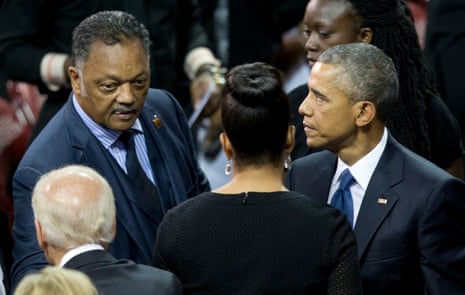
Twenty years after Jackson’s second run for president, Obama saluted Jackson for making his victory possible. Obama celebrated in Chicago, also home to Jackson.
“It was a big moment in history,” Jackson told the Guardian, 12 years later. In an interview with NPR, Jackson said: “I cried because I thought about those who made it possible who were not there … People who paid a real price: Ralph Abernathy, Dr King, Medgar Evers, Fannie Lou Hamer, those who fought like hell [at the Democratic national convention] in Atlantic City in 64, those in the movement in the south.”
Bishop William J Barber II, who co-founded the Poor People’s Campaign, recalled Jackson’s hope for America’s promise as he paid tribute to the late civil rights activist.
“Jesse Jackson was a gift from God and a witness that God exists in the ways he cared for and lifted all people, the way he called forth a rainbow coalition of people to challenge economic and social inequality from the pulpit to a historic presidential run, the way he dared to keep hope alive whenever the nation struggled with being who she says she is and yet ought to be,” said Barber.
He added:
When I was a college student, he was a gift to me as a mentor, and it has been my great privilege to have him walk alongside me through my whole public ministry.
May we all take up his hope for the America that has never yet been but nevertheless must be.
Jackson, who first travelled to South Africa in July 1979, just after Steve Biko’s passing, vigorously advocated for American sanctions on the apartheid regime and supported Nelson Mandela’s anti-apartheid struggle.
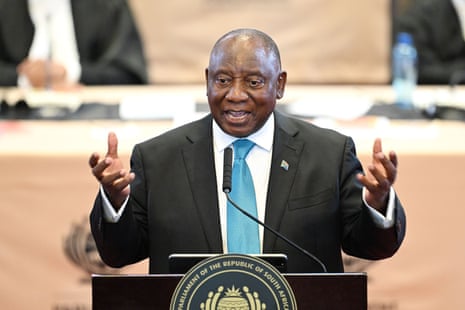
“His campaigns for an end to apartheid included disinvestment from the apartheid economy and challenging the support the regime enjoyed in certain circles and institutions internationally,” President Cyril Ramaphosa said.
“We are deeply indebted to the energy, principled clarity and personal risk with which he supported our struggle and campaigned for freedom and equality in other parts of the world.”
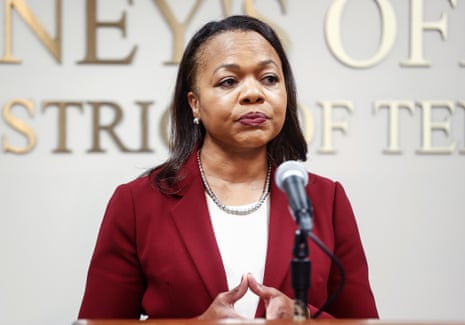
Jackson’s impact “can be felt in virtually every aspect of American life,” said Kristen Clarke, a former Assistant Attorney General for Civil Rights, US Department of Justice during the Joe Biden administration.
“A tireless and extraordinary public servant, his charge to all of us was to stay hopeful, keep up the good fight and respect the dignity and humanity of all people,” Clarke said in a statement on Tuesday.
“Jackson has been, and will always be, a central part of the story regarding America’s ongoing quest for justice and equality.”

Melissa Hellmann
During Black History Month in the early 1970s, Jesse Jackson, the civil rights icon who died Tuesday, appeared on the set of the public television show, Sesame Street. Reciting the poem “I Am Somebody”, which was meant to bolster the self esteem of underserved children in urban environments, Jackson led a group of multiracial children on the show in a call and response:
“I am somebody. I am somebody. I may be poor, but I am somebody. I may be young, but I am somebody. I may be on welfare, but I am somebody. I may be small, but I am somebody. I may have made mistakes, but I am somebody. My clothes are different, my face is different, my hair is different, but I am somebody. I am Black, brown, white, I speak a different language, but I must be respected, protected, never rejected. I am God’s child. I am somebody.”
Jackson’s version of the 1940s poem, originally written by Atlanta minister and civil rights leader Reverend Dr. William Holmes Borders, would become a popular refrain in Black households after its airing on Sesame Street that year.
“I Am Somebody” also served as a rallying call for Jackson throughout his life. In August 2021, he chanted the words with protesters as he advocated for voting rights outside of the US Capitol.
Richard Luscombe
Political leaders have celebrated Jesse Jackson as a “titan” of the civil rights movement after the announcement on Tuesday of his death at the age of 84.
Al Sharpton, the veteran civil rights campaigner who Jackson worked closely with after the 1968 assassination of Martin Luther King Jr, called his friend and mentor “a consequential and transformative leader who changed this nation and the world”.
In a social media post on Tuesday, Sharpton wrote: “He shaped public policy and changed laws. He kept the dream alive and taught young children from broken homes, like me, that we don’t have broken spirits.”
Senior Democrats, the party for which Jackson campaigned twice as a presidential candidate, in 1984 and 1988, were also quick to pay tribute.
Kelley Robinson, president of the Human Rights Campaign, praised Jackson for embodying “courage, hope, and a relentlessness that will not be denied.”
“His historic presidential campaigns paved the way for generations of Black leaders to imagine ourselves in rooms we were once told were closed to us,” Robinson said in a statement.
“Reverend Jackson also stood up when it mattered; when it wasn’t easy and when it wasn’t popular. His support for marriage equality and for LGBTQ+ people affirmed a simple, powerful truth: Our liberation is bound together.”

Ewen MacAskill
The veteran civil rights activist Jesse Jackson, who has died aged 84, made history when he stood for the White House in 1984 and 1988. He was not the first African American to seek the US presidency, but he was the first to mount a serious challenge, breaking through racial barriers, securing millions of votes and, at one point, becoming frontrunner for the Democratic nomination.
His run opened the way for Barack Obama two decades later. But Jackson deserves to be remembered as more than a footnote in Obama’s biography. It took courage and self-confidence to stand in the 1980s, with memories of segregation and the civil rights battles of the 60s still raw.
In the middle of the 1984 presidential run, the writer James Baldwin offered what today still stands as a fitting epitaph. The writer told reporters that the presence of an African-American civil rights activist in the race had been a significant moment.
Jackson’s presence “presents the American Republic with questions and choices it has spent all its history until this hour trying to avoid ... And nothing will ever again be what it was before.” The quote came from Marshall Frady’s sympathetic biography, Jesse: The Life and Pilgrimage of Jesse Jackson, published in 1996.
“Jackson was more than a civil rights advocate – he was a living bridge between generations, carrying forward the unfinished work and sacred promise of the Civil Rights Movement,” Martin Luther King III and his wife Andrea King said in a statement.
The pair added:
He walked with courage when the road was uncertain, spoke with conviction when the truth was inconvenient, and stood with the poor, the marginalized, and the forgotten when it was not popular to do so.
His life was a testament to the power of faith in action – faith that justice could be won, that dignity belongs to every person, and that love must always have the final word.
May his memory be a wellspring of strength and courage for all who continue the sacred work to which he gave his life. As he so often reminded us: keep hope alive.
A statement on behalf of National Association for the Advancement of Colored People (NAACP) chairman, Leon W Russell, vice-chair, Karen Boykin Towns and the organisation’s president, Derrick Johnson paid tribute to Jackson today.
It read:
Reverend Jesse Jackson was not only a civil rights icon - he was family to the NAACP. His work advanced black America at every turn. He challenged this nation to live up to its highest ideals, and he reminded our movement that hope is both a strategy and a responsibility.
His historic run for president inspired millions and brought race to the forefront of American politics.
We honor his legacy by continuing the work he championed: protecting the right to vote, expanding economic opportunity, and fighting for the freedom and dignity of black people everywhere.