2 months ago
95
2 months ago
95
The “future of British horse racing” – and perhaps most immediately, the future of Kempton Park – will be the subject of a debate in Westminster Hall on Tuesday afternoon after Lincoln Jopp, the Conservative member for Spelthorne, secured parliamentary time for MPs to discuss the potential impact of the government’s recent relaxation of planning regulations on the country’s second-biggest spectator sport.
There are 58 active British racecourses, or 59 if you count Newmarket’s Rowley Mile and July courses separately. Plenty are situated on land that could be much more attractive to developers after the introduction of the Planning and Infrastructure Act 2025, which aims to accelerate the planning (and appeals) process and release Green Belt land for development when planning authorities cannot meet housing targets elsewhere.
But no track is in such imminent danger of facing the wrecking ball as Kempton Park. The home of the historic King George VI Chase on Boxing Day has been under threat since January 2017, when the Jockey Club, which owns the track, announced – to widespread astonishment and anger within the sport – that it planned to sell the site to a housing developer, move the King George to Sandown Park and build a replacement all-weather track in Newmarket.
Three years later, in February 2020, it seemed that racing at Kempton had been reprieved, when the Jockey Club announced revised plans for about 550 houses to be built on the site, rather than the 3,000 that had originally been envisaged.
But what the Club did not publicly disclose until December 2025 was that it had entered into a 10-year option agreement on the entire site to the housebuilder Redrow – now Barratt Redrow – way back in 2018.
The track’s train station, which opened on the same day as the racecourse in July 1878, could ultimately prove to be its nemesis too, as the streamlined planning rules mean that, in many cases, applications for sites within 15 minutes’ walk of a well-connected station face a streamlined process with a strong presumption in favour of approval.
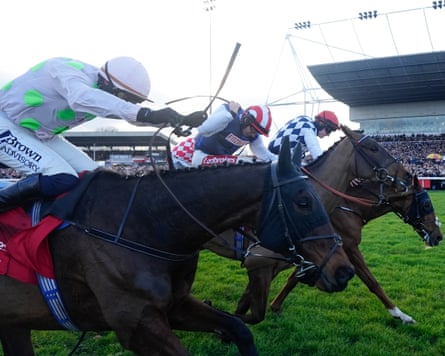
But while the new rules could facilitate Kempton’s demise, the ultimate reason that one of British racing’s most historic venues is in such peril is that back in 2018, the eight stewards of the Jockey Club secretly signed its fate over to a housebuilder.
Jopp said last week that he had been informed an application was about to be made to build more than 2,000 homes on the site. Barratt Redrow immediately denied that this was the case, insisting that there will be no application this year.
Next year, though, is just six months away, and the government is desperate to deliver on its manifesto promise to build 1.5m new homes in five years. Barratt Redrow may be all but obliged to exercise its option. Its shareholders, in all likelihood, would expect nothing less.
If, or more likely when, it does exercise that option, the ultimate accountability for the position the track finds itself in will rest with the Jockey Club leadership who sanctioned the option in 2018.
It happened behind closed doors, and there is much about the whole process that still remains opaque.
The eight stewards who agreed to the deal were elected to their roles by their fellow members of a self-appointed club, and subject to little or no outside scrutiny or accountability, since the Jockey Club operates under a Royal Charter.
after newsletter promotion
They included Roger Weatherby, from the family firm that has operated racing’s in-house banking system for decades, who was the senior steward at the time, and Baroness Dido Harding, more familiar to many outside the racing world as the controversial head of NHS test and trace during the Covid pandemic. Harding is currently the Club’s senior steward.
The minutes of the meeting when the 2018 decision was taken have not been published, and probably never will be. The agreed price for the site in the option contract has also not been disclosed, although it will be if the option is exercised.
The Jockey Club states on its website that its Royal Charter requires is to “act for the long-term good of British racing in everything we do”, and said in a statement on Monday that the option agreement had “gave a housebuilder, Redrow, the right to purchase the racecourse for a significant sum, to be reinvested back into racing, if they were to achieve planning consent to build on it.”
The statement added: “This option remains in place and expires in 2028, with a limited ability to extend if a planning application is under consideration at that point. Any development would be dependent on planning approval and as that process has not started, the focus for us continues to be on hosting racing next year and into the future.”
Tuesday’s debate, though, will be a reminder that both local residents and a solid majority of the sport’s fans and employees remain implacably opposed to the bulldozing of Kempton.
The debate may also see renewed calls for a scaled-down development, which would allow racing to continue. Ultimately, though, that would be up to Barratt Redrow – because the Jockey Club entered into a confidential option agreement that effectively handed long-term control of the site to a housebuilder without public scrutiny.
So in the longer-term sense of the “future of British horse racing”, perhaps, it might also be a good time for interested MPs to ask whether, in 2026, it should be possible for the ruling committee of a self-appointed club, drawn from a muster of scarcely 150 members, to effectively sign a much-loved racecourse’s death warrant behind closed doors.