3 months ago
80
3 months ago
80
The first thing you should know about John Tavener’s 2005 opera Krishna is that it is actually a “mystical pantomime”. If that very idea provokes even the faintest amusement, this is not the country-house opera for you. The second thing you should know is that by the end of Krishna’s posthumous world premiere at Grange Park Opera, there was warm applause for the musicians.
Rightly so. Without Ross Ramgobin’s intense, poised commitment as the Celestial Narrator, or Eliran Kadussi’s sweet, flexible countertenor as the adolescent Krishna, or the impeccably lucid, admirably agile sopranos of Rosa Sparks (the child Krishna), Nazan Fikret (his wife Rukmini) and Jennifer Statham and Julia Sitkovetsky (Radha as child and woman respectively), this short work would have felt even more interminable.
In the pit, the Gascoigne Orchestra provided frequent bass drones and occasional stampedes of brass. There were textures that shimmered and textures that throbbed and bonged, an array of gongs jangling noisily against Tavener’s post-Wagnerian post-minimalism. Repetition came as standard, as did sudden switches and stoppages, superintended by conductor Mark Shanahan with the dispassionate competence of a veteran traffic police officer. Nao Masuda’s interjections of onstage drumming – brutal and balletic – marked out the piece’s 15 scenes and was easily the most dramatic thing that happened.
Krishna is a set of vignettes from the life of the Hindu god, each one introduced by the Celestial Narrator. The Sanskrit and English libretto is by Tavener himself, though the British Hindu scholar Ranchor Prime is credited with “some inspiration with mantras and some words”. Much of the text was inaudible – a result of the high, melismatic vocal lines on the one hand and muddy orchestral and choral textures on the other – and the surtitles often vanished before the given words had been sung.
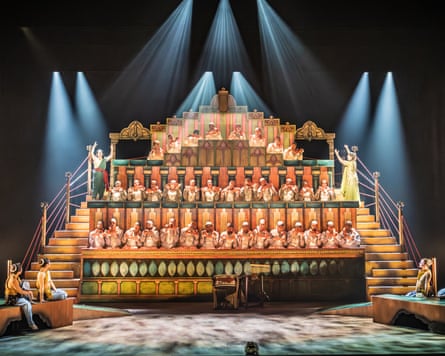
In David Pountney’s production, the characters stood around and occasionally struck poses, leaving the acting to six female dancers. During their “ecstatic love play”, Radha and Krishna faced the audience before writhing vaguely on separate beds on opposite sides of the stage. Evil arrived several times in a wash of red light. A deadly serpent was a large inflatable, Krishna’s struggle with it recognisable to anyone who has attempted to pack away an airbed. In one scene, the chorus – seated in a pyramid throughout, as if in a pre-perspective painting – inexplicably did rapid Mexican waves.
Mainstream cultural attitudes have shifted significantly in the 20 years since Krishna was written. But it didn’t just feel old-fashioned in its wide-eyed, white-British-authored riff on a major world religion; it sounded and looked as if it had emerged straight from the playbook of 19th-century operatic Orientalism. Grange Park’s willingness to mount a world premiere in a difficult economic climate is laudable. But some works are better left unperformed.